
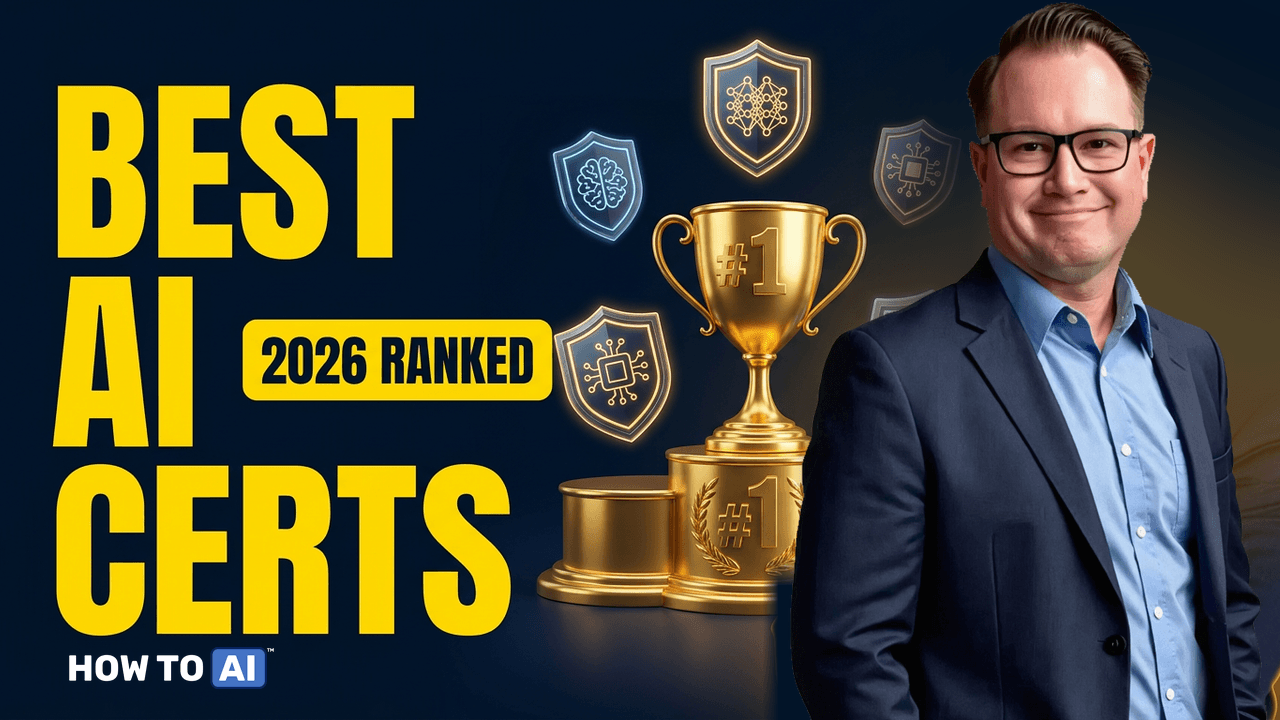
Every week somebody asks me the same question: which AI certification should I get? And almost everybody asks it wrong. The real question isn’t which cert is best. It’s which cert is worth anything for you — your job, your company’s tech stack, your next move. Get that match right and a $100 exam can change how employers see you. Get it wrong and you’ve bought an expensive PDF for your LinkedIn profile.
In this video I rank the 11 major AI certifications as they stood in July 2026: what they cost, who they’re for, which one I’d start with, and the three situations where a certification is honestly a waste of your money. The written ranking below is kept up to date and now covers 21, including Anthropic’s four Claude exams and newer certifications from Google, Microsoft, Databricks, Salesforce, CompTIA and PMI.
The short answer
The best AI certification is the one that matches your job and the platform your employer uses. If you only read one section, read this one:
- Best first certification for most people: AWS AI Practitioner ($100).
- Best if your workplace runs on Microsoft: Azure AI Fundamentals (AI-901) ($99).
- Best for managers and team leads: Google Cloud Generative AI Leader ($99).
- Best free certification: Oracle OCI AI Foundations (the exam and the training are free).
- Best technical certification not tied to one cloud: NVIDIA NCA-GENL ($125).
- Best for developers building AI agents: Microsoft AI-103 ($165).
- Best for machine learning engineers: the AWS Machine Learning Engineer ($150), or Google Cloud Professional Machine Learning Engineer ($200) if you work on Google Cloud.
- Best for security professionals: CompTIA SecAI+.
- Best for project managers: PMI-CPMAI.
- Best if your company runs on Salesforce or Databricks: the Salesforce Agentforce Specialist or the Databricks Generative AI Engineer Associate ($200 each).
The rest of this page explains how to choose, ranks all 21 in four tiers, and ends with a side-by-side table. Prefer to be asked a few questions instead? Take the 2-minute certification quiz.
First: should you even get a certification?
A certification is worth it for three reasons. It proves to an employer (or yourself) that you actually understand the material. It can help you move toward an AI or cloud role. And even if you never use the credential, studying for one gives you a structured path through a subject that’s otherwise easy to wander around in aimlessly.
If none of those apply to you, you may not need a cert at all. Plenty of people use AI brilliantly without one. But if any of them resonate, here’s how to pick well.
The three tests every cert has to pass
Before ranking anything, here’s the rule I use. A certification is only worth money if it passes three tests:
- Recognition. Does the person you want to hire you actually know this cert exists? A credential nobody recognizes is a certificate of participation.
- Stack match. Most companies live on one cloud — AWS, Microsoft, Google, or Oracle. A cert in the platform your employer actually uses is worth double a cert in one they don’t.
- Role match. Are you leading people who use AI, or building with it yourself? Leadership and engineering are different tools.
Here’s the uncomfortable part: any certification that fails two of these three tests for your situation is, for you, worthless. Not bad — wrong. The rankings below only make sense through these tests.
Tier 1 — The beginner tier
No prerequisites, mostly no coding (Azure AI Fundamentals expects basic Python), and the fastest return on investment for most people. Four credentials live here:
- AWS AI Practitioner (AIF-C01) — $100. AWS is the biggest cloud on Earth, which makes this the most recognized entry-level AI credential you can put on a resume today — and over half the exam is generative AI. 65 questions, 90 minutes, 700/1000 to pass, valid 3 years. If your company runs on AWS — or you have no idea what your company runs on — this is my default answer. Study guide · full review.
- Azure AI Fundamentals (AI-901) — $99. If your workplace is a Microsoft shop — Teams, Outlook, Copilot everywhere — this is the one. Roughly 40–60 questions in 45 minutes, and unlike AWS it never expires. It replaced the retired AI-900 exam in 2026 and is far more hands-on: over half the exam is building with Microsoft Foundry, so expect basic Python. Study guide · what changed from AI-900.
- CompTIA AI Fundamentals: $99 per learner through schools. CompTIA’s superpower is vendor neutrality: practical AI literacy — how AI works, prompt writing, verifying output, responsible use — as a course with a built-in assessment that earns a competency certificate rather than a proctored certification exam (roughly 50–56 instructional hours). If you don’t want to bet on any one cloud, this covers the concepts without the ecosystem lock-in. The trade-off: it’s newer, so recognition is still building. Study guide.
- Google Cloud Generative AI Leader — $99. Notice the word leader. This one is built for managers, directors, and executives who need to make smart AI decisions without writing code — 50–60 questions, 90 minutes, no hands-on cloud experience required. If you lead a team, this beats the other three. Study guide.
Beginner tier verdict: pick exactly one, matched to your stack and your role. That word “one” matters — more on that below.
Tier 2 — The career tier
These are for people whose job is building, securing or running AI systems, not just talking about them. This is where certifications start showing up in job requirements instead of nice-to-haves:
- AWS Machine Learning Engineer (MLA-C01) — $150, intermediate, in English until September 28, 2026. If you want the words “machine learning engineer” in your next job title and your world is AWS, this is the strongest single signal on this list: data prep, model development, deployment, and MLOps on SageMaker. 65 questions, 130 minutes, 720/1000, with about a year of hands-on ML experience recommended. It’s also the successor to the retired ML Specialty — if you were eyeing MLS-C01, read this first. Heads up: AWS is replacing MLA-C01 with MLA-C02 (in beta now), and the English MLA-C01 exam’s last day is September 28, 2026. Study guide · ML Engineer worth-it review.
- NVIDIA NCA-GENL — $125. The certification that goes deepest on how LLMs actually work — machine-learning fundamentals, embeddings, prompt engineering, RAG, experimentation, and trustworthy AI. 50–60 questions, 60 minutes, valid 2 years. NVIDIA certs punch above their weight because every serious AI workload on the planet runs on NVIDIA hardware — the recognition test passes everywhere, cloud-agnostic. This is the one I’d point most technical people at. Honest review.
- NVIDIA NCA-AIIO — $125. GENL’s sibling, covering AI infrastructure and operations — GPU clusters, InfiniBand, Slurm, Kubernetes — for the infrastructure and data-center folks keeping the GPUs humming. 50 questions, 60 minutes. NCA-AIIO vs NCA-GENL compared.
- Microsoft Azure AI Apps & Agents Developer (AI-103) — $165, intermediate. The newest of the bunch (GA since ~June 2026), aimed squarely at the hottest skill of 2026: building AI agents, with Python + Microsoft Foundry and agentic solutions as the heaviest exam domain (30–35%). Renewed annually via a free online assessment, and because it’s brand new, early holders differentiate hard. (It replaced AI-102, which Microsoft retired on June 30, 2026; the full Microsoft AI path shows how the new lineup fits together.) Study guide · AI-901 vs AI-103 compared.
- Google Cloud Professional Machine Learning Engineer — $200, advanced. The Google Cloud counterpart to the AWS ML Engineer, and the more senior of the two: Google recommends 3+ years of industry experience, including at least a year designing and managing solutions on Google Cloud. 50–60 questions in two hours. Google recently updated the exam for the move from Vertex AI to Gemini Enterprise Agent Platform, so older study material will use outdated product names.
- Microsoft Machine Learning Operations Engineer (AI-300) — typically $165 in the US, intermediate. The successor to DP-100, which Microsoft retired on June 1, 2026. It covers running AI in production: MLOps with Azure Machine Learning, plus GenAIOps for generative AI apps and agents in Microsoft Foundry. 120 minutes, and Microsoft expects Python, a data science background and some DevOps experience (GitHub Actions, the command line). Is AI-300 worth it?
- CompTIA SecAI+ (CY0-001) — advanced. Launched February 17, 2026, for security professionals rather than beginners: CompTIA recommends 3–4 years in IT and 2+ years of hands-on cybersecurity, with Security+, CySA+ or PenTest+ as a typical background. Up to 60 multiple-choice and performance-based questions in 60 minutes; you need 600 on a 100–900 scale. If your job is securing AI systems, this is the one to watch. The exam voucher is $298, or $332 with a retake included, and renewal takes 15 continuing education credits plus a $75 fee every three years.
- PMI Certified Professional in Managing AI (PMI-CPMAI). The project manager’s AI certification, from the organization behind the PMP. It tests a structured method for running AI and data projects, not coding: 120 questions in 160 minutes, with a 21-hour official prep course. You keep it by earning 30 PDUs every three years. PMI doesn’t list the exam fee on its certification page, so check it when you register. Best AI certifications for project managers
Career tier verdict: only enter this tier when a job you actually want lists these skills. A career-tier cert without the beginner-tier foundation is a hard exam and a harder interview.
Tier 3 — The ecosystem tier
Certs that are extremely valuable inside one specific world and nearly invisible outside it:
- Oracle OCI AI Foundations — free. Completely free — the exam and the official training. 40 questions, 60 minutes, 65% to pass. If your company runs Oracle — and a huge slice of the enterprise world does — that’s the best price-to-value ratio in this entire ranking. If your company doesn’t run Oracle, the stack-match test fails. More on what’s genuinely free.
- VMware VCP-VCF Administrator — around $250. Matters if you live in the private-cloud and virtualization world, where AI workloads are landing fast — 60 questions in a 135-minute appointment, with about a year of IT experience plus ~6 months of VCF recommended. Outside that world, skip it. Study guide.
- CertNexus CAIP (AIP-210) — $367.50. The most expensive on the list, and the only one expecting 1–3 years of machine-learning experience before you sit down: 90 questions (80 scored), 120 minutes, valid 3 years, with operationalizing models as the heaviest domain. It’s a legitimate hands-on, vendor-neutral credential — you’ll often see it searched as “CompTIA AIP-210,” but CertNexus is a separate company (a division of Logical Operations) — but at that price with that prerequisite, it’s a specialist tool. Honest review.
- Databricks Generative AI Engineer Associate — $200. If your company’s data lives in Databricks, this is the generative AI credential that matches your actual platform: it tests designing and building LLM-powered applications on Databricks, with application development the biggest section (30%). 45 scored questions in 90 minutes, about 6 months of hands-on experience recommended, valid for 2 years, and you recertify by passing the current version of the exam.
- Salesforce Agentforce Specialist — $200. For Salesforce admins, developers and architects who build AI agents and prompt templates on the Salesforce Platform, using Prompt Builder and Data 360. 60 scored questions plus up to five unscored in 105 minutes, 72% to pass, and retakes cost $100. Inside a Salesforce shop it carries real weight; outside one, it fails the stack-match test.
Ecosystem tier verdict: these aren’t for climbing into AI — they’re for going deeper where you already are. If the vendor name on the cert isn’t a vendor in your building, your money is better spent one tier up.
Tier 4 — The gated tier
New since March 2026, and the odd one out in this ranking: Anthropic’s four Claude certifications. They are cheap, they are current, and most of you cannot take them.
- Claude Certified Associate — Foundations (CCAO-F) — $99. 60 questions, 120 minutes, pass at 720/1000. The non-coding one: scoping, prompting, safety, when to reach for Claude and when not to. It is the only one of the four that does not count toward Claude Partner Network tier standing. Study guide.
- Claude Certified Developer — Foundations (CCDV-F) — $125. 53 questions. For people who write code against the Messages API, define tools and wire up MCP servers. Study guide.
- Claude Certified Architect — Foundations (CCAR-F) — $125. 60 questions. The original Claude exam, and the one with the most community material behind it. Design plus implementation: Agent SDK, CLAUDE.md, MCP tool design, Claude Code in CI. Study guide.
- Claude Certified Architect — Professional (CCAR-P) — $175. 63 questions. End-to-end enterprise delivery: RAG pipelines, observability, compliance, SLAs. Counterintuitively, the best first-hand evidence available says this one is not the harder of the two architect exams — we dug into that here.
The catch, and it is a big one. Anthropic restricts exam registration to employees of Claude Partner Network companies, and its partner application says a company should have at least 10 employees. Freelancers, solo consultants and small shops are locked out — I tried, and I did not qualify. If that is you, read who can actually take the Claude certification before you spend any time studying.
Gated tier verdict: if you work at a partner firm delivering Claude engagements, these are the highest-signal credentials on this page and the cheapest current ones — take the exam that matches your job, not the most senior one. If you do not, treat them as a reason to learn the material, not as a cert you can put on a résumé. And note the twelve-month expiry: shortest validity period of anything in this ranking, though renewal is free if you do it before the clock runs out.
All 21 side by side
| Certification | Best for | Cost | Coding? | Level |
|---|---|---|---|---|
| Claude Certified Associate (CCAO-F) | Partner-firm consultants and delivery leads | $99 | No | Beginner |
| Claude Certified Developer (CCDV-F) | Engineers building on the Claude API | $125 | Yes | Intermediate |
| Claude Certified Architect (CCAR-F) | Hands-on architects designing Claude systems | $125 | Yes | Intermediate |
| Claude Certified Architect Pro (CCAR-P) | Enterprise-scale Claude delivery owners | $175 | Yes | Advanced |
| AWS AI Practitioner | AWS users, first cert | $100 | No | Beginner |
| Azure AI Fundamentals (AI-901) | Microsoft users, first cert | $99 | Basic Python | Beginner |
| CompTIA AI Fundamentals | Vendor-neutral learners | $99 per learner via schools | No | Beginner |
| Google Generative AI Leader | Managers and leaders | $99 | No | Beginner |
| AWS ML Engineer (MLA-C01) | Aspiring ML engineers | $150 | Yes | Intermediate |
| NVIDIA NCA-GENL | Generative AI focus | $125 | Some | Beginner |
| NVIDIA NCA-AIIO | AI infrastructure and ops | $125 | Some | Beginner |
| Azure AI Apps & Agents Dev (AI-103) | Developers building AI agents on Azure | $165 | Yes | Intermediate |
| Oracle OCI AI Foundations | Oracle Cloud users | Free | No | Beginner |
| VMware VCF Administrator | Virtualization admins | ~$250 | Some | Intermediate |
| CertNexus CAIP (AIP-210) | Hands-on ML practitioners, vendor-neutral | $367.50 | Yes | Intermediate |
| Google Professional ML Engineer | Senior ML engineers on Google Cloud | $200 | Yes | Advanced |
| Microsoft MLOps Engineer (AI-300) | Running ML and generative AI in production on Azure | ~$165 (US) | Yes | Intermediate |
| CompTIA SecAI+ (CY0-001) | Security pros protecting AI systems | $298 | Hands-on tasks | Advanced |
| PMI-CPMAI | Project managers running AI projects | See PMI | No | Intermediate |
| Databricks Generative AI Engineer | Teams building generative AI on Databricks | $200 | Yes | Intermediate |
| Salesforce Agentforce Specialist | Salesforce admins, developers and architects | $200 | Low-code | Intermediate |
When a certification is actually worthless
Three situations, and I see all three constantly:
- Cert collecting. Stacking the AWS Practitioner on top of Azure Fundamentals on top of CompTIA. They certify the same foundational knowledge with different logos. The second one adds almost nothing — that $99 was a donation.
- Certs without reps. If you pass the exam but never actually build anything — never run a prompt, never touch the console — the first 15 minutes of a technical interview will erase everything the certificate claimed. A cert is proof you learned something, not a substitute for doing it.
- The wrong-stack cert. An Oracle cert in an AWS shop. A VMware cert when you’re aiming at a Google role. That’s a stack-match failure, and no exam score fixes it.
Avoid those three traps and honestly, every cert in this ranking can earn its keep. (And if you’re wondering whether any of this moves your paycheck: here’s what the salary data actually says.)
So which one should you get?
- Brand new and unsure: AWS AI Practitioner — or Azure AI Fundamentals if you work in a Microsoft shop. That’s the answer for probably eight out of ten people.
- You lead teams rather than build: the Google Cloud Generative AI Leader.
- Technical and job hunting: the AWS Machine Learning Engineer — or NVIDIA’s NCA-GENL if you want to stay cloud-neutral.
- Your company runs Oracle: take the free one. Free passes every value test.
- Your company runs Salesforce or Databricks: take that platform’s own certification (the Agentforce Specialist or the Databricks Generative AI Engineer). Same stack-match logic as Oracle.
- You work in security: CompTIA SecAI+, once you have the security experience CompTIA recommends.
- You manage projects: PMI-CPMAI, or the Google Cloud Generative AI Leader as a lighter first step.
Still torn between two? Here’s the fastest tiebreaker there is: open a set of practice questions for each and see which material clicks. Ten minutes of real questions beats ten hours of reading reviews. And if cost is the blocker, start with the free AI certifications. On iPhone? The same questions are in our free AI certification practice app.
📚 Free: The AI Cert Starter Kit
Want this as a downloadable template? The free AI Cert Starter Kit bundles a one-page decision guide, a side-by-side comparison of the major certs, a 4-week study plan, and links to free practice for each — in one Notion doc. Grab it free →
🎯 Free practice questions for 15 certs in this ranking
Real exam-style questions with explanations for 15 of the certifications above, including every Tier 1 cert. Try the two you’re torn between, feel the difference, then commit. Free to start, no email required.
HOW TO // AI is not affiliated with or endorsed by Amazon Web Services, Microsoft, Oracle, NVIDIA, CompTIA, CertNexus, Google, Broadcom/VMware, Anthropic, Databricks, Salesforce, or PMI. All certification names are trademarks of their respective owners, referenced descriptively. Prices are USD list prices checked on each vendor’s site in September 2026; confirm on the official exam page before you book.
Related guides
- AI Certifications for Beginners: 5 You Can Earn With No Experience
- The AI Cert Starter Kit
- Free AI Certifications in 2026: What’s Actually Free (and What Isn’t)
- AI Exam Prep
- Do AI Certifications Actually Increase Your Salary? An Honest Answer
Frequently asked questions
Which AI certification should a beginner get first?
For about eight out of ten people: the AWS AI Practitioner ($100) — or Azure AI Fundamentals AI-901 ($99) if you work in a Microsoft shop. Pick the one matching the cloud your employer actually uses.
Are AI certifications worth it without hands-on experience?
A cert without reps is one of the three traps: if you never build anything, the first 15 minutes of a technical interview erases what the certificate claimed. Treat a cert as proof you learned something, then practice with it.
Is there a completely free AI certification?
Yes — Oracle OCI AI Foundations is free. If your company runs Oracle, it is the best price-to-value ratio of any AI cert; if not, it fails the stack-match test and a paid cert in your actual stack is a better spend.
Do AI certifications require coding?
AWS AI Practitioner, Google Generative AI Leader, CompTIA AI Fundamentals and PMI-CPMAI require no coding. Azure AI Fundamentals (AI-901) expects basic Python, since over half of the exam is hands-on work in Microsoft Foundry. AI-103, AI-300, the AWS ML Engineer, the Databricks Generative AI Engineer and CertNexus CAIP expect real coding, and the NVIDIA certs assume some technical familiarity.
Which AI certification is best for managers or non-technical roles?
Google Generative AI Leader is aimed at managers and decision-makers: it covers AI strategy and adoption without the technical weeds. Project managers running AI projects should also look at PMI-CPMAI, and CompTIA AI Fundamentals is a good vendor-neutral option for general AI literacy.
How much do AI certifications cost?
Most cost $99 to $200: AWS AI Practitioner $100, Azure AI Fundamentals $99, Google Generative AI Leader $99, AWS ML Engineer $150, Microsoft associate exams such as AI-103 and AI-300 typically $165 in the US, and Google Professional ML Engineer, Databricks Generative AI Engineer and Salesforce Agentforce Specialist $200 each. NVIDIA's associate certs are $125, the Claude exams $99–$175, Oracle OCI AI Foundations is free, VMware is around $250, and CertNexus CAIP is the priciest at $367.50.
Which AI certification is the hardest?
For experience alone, Google's Professional Machine Learning Engineer (3+ years of industry experience recommended) and CompTIA SecAI+ (3–4 years in IT plus 2+ years of cybersecurity) set the highest bar. Among the rest, the AWS ML Engineer Associate and CertNexus CAIP are the toughest, with about one to three years of hands-on ML experience recommended. The fundamentals-level certs are all beginner-friendly.
Should I stack multiple entry-level AI certifications?
No. AWS AI Practitioner, Azure AI Fundamentals, and CompTIA AI Fundamentals certify largely the same foundational knowledge under different logos. Pick exactly one entry-level cert, then move up a tier or go build with it.
What is the best AI certification for cybersecurity?
CompTIA SecAI+ (CY0-001), launched in February 2026, is built for security professionals who protect AI systems. It is not an entry-level exam: CompTIA recommends 3–4 years in IT and at least 2 years of hands-on cybersecurity, with Security+ or similar as a typical background.