
HOW TO // AI — CERT · MICROSOFT AI-901
Pass Azure AI Fundamentals (AI-901) — the First Time
332 original practice questions weighted to the official AI-901 blueprint, with a plain-English explanation on every single one.
Start the free quiz — no signup →10 free questions now · 10 more with your email · the full bank from $12 a month
Claude AI Tutor included with Pro — miss a question and it explains exactly why, in plain English, until it clicks.
Microsoft Azure AI Fundamentals (AI-901) is Microsoft’s entry-level AI certification — the 2026 successor to the popular AI-900 exam, which retired on June 30, 2026. It validates your understanding of core AI concepts and your ability to implement AI solutions by using Microsoft Foundry, and Microsoft’s audience profile asks for conceptual knowledge of AI solutions in Azure plus knowledge of Python coding syntax and programming techniques and familiarity with Azure resources, and says you should be familiar with REST APIs, SDKs, and CLIs. Expect roughly 40 to 60 questions in 45 minutes, with a passing score of 700 out of 1000. AI-901 is a genuine replacement rather than a refresh: the outline was rebuilt around Microsoft Foundry, and 55 to 60 percent of the exam is now hands-on implementation.
Practice questions are the highest-leverage way to prepare: they show you how concepts get tested, expose the gaps you didn’t know you had, and make the real exam feel familiar. The free quiz below works like the real thing — multiple choice with plain-English explanations — and every question explains why the answer is right, which is where the actual studying happens.
How these questions were made. Every question here is original. HOW TO // AI writes them from Microsoft’s public AI-901 exam guide and maps each one to a domain in its blueprint. They are not real exam questions: real exam content is confidential for every candidate, and we never use exam recall or dumps.
What Microsoft’s public exam guide covers
Everything in this section comes from Microsoft’s public exam guide, not from the exam itself.
Microsoft’s skills-measured outline (dated April 15, 2026) covers just two areas, and the balance is the important part: most of AI-901 is hands-on work in Microsoft Foundry. Our question set is mapped to these weights, so your practice score roughly tracks how the real exam distributes its questions:
| Skill area | Exam weight | What it covers |
|---|---|---|
| Identify AI concepts and capabilities | 40 to 45% | The six responsible AI principles (fairness, reliability and safety, privacy and security, inclusiveness, transparency, accountability); how generative AI models work; choosing an appropriate model based on capability; deployment options and configuration parameters such as temperature, top_p and max tokens; and identifying workloads across generative and agentic AI, text analysis, speech, computer vision, and information extraction |
| Implement AI solutions by using Microsoft Foundry | 55 to 60% | Writing effective system and user prompts; deploying a model and working with it in the Foundry portal; building a chat client with the Foundry SDK; creating and testing single-agent solutions; text and speech solutions including Azure Speech in Foundry Tools; vision and image generation with multimodal models; and extracting information from documents, forms, images, audio and video using Azure Content Understanding |
Take the free practice quiz
Start with 10 free questions — read the explanation after each — then unlock 10 more with your email. Twenty in all, weighted like the real blueprint, no account needed to begin.
FREE PRACTICE QUIZ
Try 10 free AI-901 practice questions
Answer at your own pace. Every question shows the correct answer and a plain-English explanation, and that's where the learning happens. Unlock 10 more questions free at the end.
Read the 10 free AI-901 questions as text, with answers and explanations
A bank deploys a generative AI assistant that summarizes loan applications and recommends approve or decline. An audit shows that applicants from one neighborhood are recommended for decline far more often than applicants with identical income and credit history from another neighborhood. Which responsible AI principle is most directly at stake?
- A. Accountability
- B. Inclusiveness
- C. Fairness
- D. Transparency
Answer: C. Fairness requires that an AI system treat people equitably and not produce different outcomes for similar people based on sensitive attributes or proxies for them. Neighborhood frequently acts as a proxy for race or income, so the outcome gap is a fairness problem. Transparency concerns explaining how the system works, inclusiveness concerns serving people of all abilities and backgrounds, and accountability concerns human ownership and governance, none of which describes the outcome disparity itself.
A retailer launches a customer support chat experience powered by a large language model. Customers assume they are messaging a human agent, and nothing in the interface indicates otherwise. Which responsible AI principle is the retailer failing to uphold?
- A. Reliability and safety
- B. Transparency
- C. Fairness
- D. Privacy and security
Answer: B. Transparency means people understand how and when AI is being used, which starts with disclosing that they are talking to an AI system rather than a person. Reliability and safety would concern whether the bot answers correctly and fails gracefully, privacy and security would concern what happens to the chat data, and fairness would concern whether some customers get worse service than others.
A university's lecture capture service uses speech to text. Students who are deaf report that audience questions are never captioned, and students with strong regional accents report frequent transcription errors. Which principle should guide the fix?
- A. Inclusiveness
- B. Accountability
- C. Transparency
- D. Privacy and security
Answer: A. Inclusiveness means AI systems should empower and engage everyone, including people with disabilities and people whose speech, language, or background differs from the majority in the training data. Accountability addresses who owns the outcome, transparency addresses explaining the system, and privacy and security addresses protection of the recordings, none of which is the barrier described here.
A developer estimating the cost of a chat application reads that the model is billed per token. Which statement best describes what a token is in this context?
- A. An authentication credential used when calling the endpoint
- B. One single character of text sent to the model
- C. A common chunk of text, a word or piece of a word
- D. One complete sentence of text sent to the model at a time
Answer: C. Language models split text into subword tokens, so a short common word is usually one token while a long or unusual word becomes several. A token is not a character and not a sentence. The word token is also used for access credentials in authentication, which is a different meaning entirely and a common source of confusion.
A team wants their internal search to return documents that are conceptually related to a query even when the documents do not contain the query's exact words. Which representation of the text makes that possible?
- A. A keyword inverted index built from the exact terms that appear in each document
- B. A confusion matrix summarizing the classification results
- C. A cryptographic hash computed from each of the documents
- D. An embedding, a vector placing similar meanings close together
Answer: D. Embeddings encode meaning as coordinates, so semantically similar text ends up near other similar text and can be found by vector similarity rather than exact word overlap. An inverted index matches literal terms and is exactly the limitation being solved, a hash is designed so similar inputs produce completely different outputs, and a confusion matrix is an evaluation artifact, not a text representation.
A compliance team needs a model to produce policy summaries with wording that is as consistent as possible from run to run for the same input. Which configuration change best supports this?
- A. Set temperature to 1.5
- B. Set temperature to a value at or near 0
- C. Increase the maximum output tokens
- D. Increase the frequency penalty on each request
Answer: B. Temperature controls how much randomness is introduced when picking the next token, so a value at or near 0 makes the model consistently choose the highest probability token and produces the most repeatable output. A high temperature does the opposite, max tokens only changes how long the response can be, and a frequency penalty only discourages the model from repeating tokens within a response, which does nothing to make output repeatable from run to run.
A support team wants a solution that reads an incoming customer email and drafts a suggested reply for a human agent to review before sending. The solution never looks anything up and never updates another system. Which type of AI workload best fits this scenario?
- A. An anomaly detection workload
- B. A single call to a generative language model
- C. An agentic AI solution that plans and calls tools
- D. A speech synthesis workload
Answer: B. The task is text in, text out, with all the needed context already supplied in the prompt, so one generative model call is sufficient. An agentic solution is only warranted when the system must call tools, take actions, or work through multiple dependent steps. Speech synthesis produces audio and anomaly detection flags unusual data points, neither of which is being asked for.
A retailer wants a solution that handles a returns request end to end: it looks up the order in the order management system, decides whether the return falls inside policy, generates a shipping label, and updates the CRM record. Which workload type does this describe?
- A. A single prompt to a generative model with a long system message
- B. A text classification model applied to the request
- C. A speech recognition workload
- D. An agentic AI solution that can call tools and perform multiple steps
Answer: D. The solution has to reach into external systems, act on the results, and take real actions, which is the defining shape of an agentic workload. A longer system message does not give a model the ability to query an order system or write to a CRM. Classification would only label the request, and speech recognition is irrelevant because the input is text.
A developer is building a chat app on a model deployed in Microsoft Foundry. The assistant must always behave as a formal IT helpdesk agent, no matter what the user types. Which message role should carry those standing instructions?
- A. The tool role
- B. The system role
- C. The assistant role
- D. The user role
Answer: B. The system message, sometimes called the developer message, carries persistent behavior, persona, and rules that apply to the whole conversation. The user role carries each individual request, the assistant role holds the model's own previous replies, and the tool role returns output from a tool call back to the model.
A prompt sent to a model deployed in Foundry looks like this:Classify the ticket sentiment as Positive, Neutral, or Negative.Ticket: "Shipping was fast and the item works great." -> Positive Ticket: "It arrived, but the box was dented." -> Neutral Ticket: "Third failure this month, I want a refund." -> Negative Ticket: "The app crashes every time I open it." ->Which prompt engineering technique is being used?
- A. Retrieval augmented generation
- B. Zero-shot prompting
- C. Few-shot prompting
- D. Chain-of-thought prompting
Answer: C. Supplying several worked input and output pairs before the real input is few-shot prompting, which teaches the model the label set and the exact output shape by example. Zero-shot gives instructions with no examples, chain-of-thought asks the model to reason step by step, and retrieval augmented generation injects retrieved source documents into the prompt.
Want more? Finish the quiz above to unlock 10 more free questions, or open the full AI-901 practice app.
After the free 20
Practice the full AI-901 bank, timed like exam day
HOW TO // AI CERT has 332 original AI-901 practice questions written from Microsoft’s public exam guide. You also get timed mock exams, an AI tutor powered by Claude that explains every miss, and a readiness score that tells you when to book. Pro is $12 a month, or $39 for the whole year, and covers every exam we offer. Start with a free account. 14-day refund.
These are original practice questions, not real exam questions. No brain dumps, nothing copied from real exams.
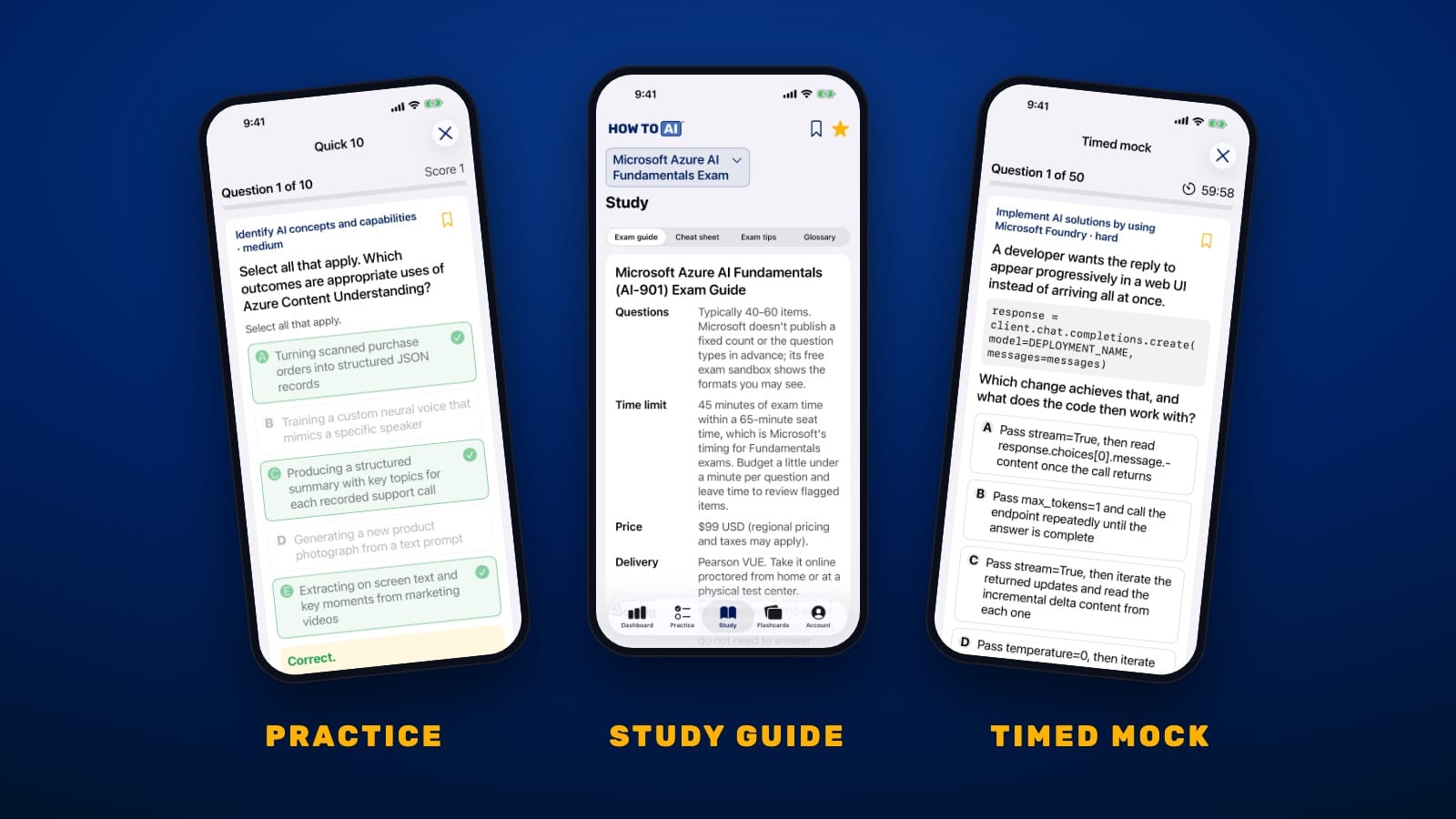
Study this exam on your phone
HOW TO // AI CERT has 6,151 original practice questions across 18 AI and cloud certifications, with plain-English explanations on every answer, full timed mock exams, weak-area drills, and an AI tutor powered by Claude. Free to download, with a free question set for every exam.

How to prepare for the Azure AI Fundamentals exam
Microsoft offers free self-paced learning paths on Microsoft Learn for Azure AI Fundamentals, plus an official practice assessment. A study loop that works: read the skills-measured study guide, take a practice set like the one above, then study the areas where you missed questions. Implementing AI solutions in Microsoft Foundry is by far the most heavily weighted area at 55 to 60 percent, so make sure you are comfortable in the Foundry portal, reading Python that uses the Foundry SDK, and working with agents and Azure Content Understanding. New to the concepts? Our plain-English AI glossary and explainer on how AI models actually work cover the fundamentals.
Free Azure AI Fundamentals study guide & cheat sheet
No sign-up needed — quick study tips, a topic-by-topic cheat sheet, and a full glossary for the Azure AI Fundamentals exam.
Open the full Azure AI Fundamentals study guide →
Keep reading: How to pass AI-901: a 2-week study plan · Is Azure AI Fundamentals worth it? · AI-900 vs AI-901: what changed · Microsoft’s new AI certification path · Ready for the next step? The new AI-103 agents exam
HOW TO // AI is not affiliated with or endorsed by Microsoft. Azure AI Fundamentals, AI-901, and AI-900 are certifications and trademarks of Microsoft Corporation; we reference them descriptively. All practice questions on this page are original, written from the publicly published exam objectives — they are not actual exam questions.
Related practice sets
- NVIDIA NCA-AIIO Practice Questions
- AWS AI Practitioner (AIF-C01) Practice Questions
- VMware VCP-VCF Administrator Practice Questions
- All AI & Cloud Exam Prep
Practice for every AI & cloud cert
- NVIDIA NCA-AIIO practice questions
- NVIDIA NCA-GENL practice questions
- AWS AIF-C01 practice questions
- AWS MLA-C02 practice questions
- AWS MLA-C01 practice questions
- Microsoft AI-103 practice questions
- VMware VCP-VCF Administrator practice questions
- CompTIA AI Fundamentals practice questions
- Google Cloud Generative AI Leader practice questions
- Oracle OCI AI Foundations practice questions
- CertNexus AIP-210 practice questions
- Anthropic CCAO-F practice questions
- Anthropic CCDV-F practice questions
- Anthropic CCAR-F practice questions
- Anthropic CCAR-P practice questions
- Databricks GenAI Engineer Associate practice questions
- Salesforce Agentforce Specialist practice questions
- CompTIA SecAI+ practice questions
- All AI & cloud exam prep →
Frequently asked questions
How many questions are on the Azure AI Fundamentals (AI-901) exam, and what do I need to pass?
The Microsoft Certified: Azure AI Fundamentals exam has typically 40–60 items (Microsoft does not publish a fixed count) and gives you 45 minutes. To pass you need a scaled score of 700 out of 1000. It is delivered online proctored or at a Pearson VUE test center.
How much does the Azure AI Fundamentals exam cost?
Microsoft's Microsoft Certified: Azure AI Fundamentals exam costs $99 USD. You register through the official Microsoft certification site. Pricing can vary by region and taxes.
How should I prepare for the Azure AI Fundamentals exam?
It is a fundamentals exam for people at the beginning of a career in AI solution development; Microsoft expects knowledge of Python coding syntax and familiarity with Azure resources. The most reliable way to prepare is to study the official exam guide and then work through lots of practice questions to find and fix weak spots. Our 332-question bank for AI-901 is blueprint-weighted, so the topic mix mirrors the real exam — practice until your readiness score is consistently high, then book your exam.
Are HOW TO // AI — CERT's Azure AI Fundamentals questions real exam questions?
No. All 297 of our AI-901 practice questions are 100% original, written from the published exam objectives. We never copy, leak, or reproduce real exam content ("brain dumps") — that would violate Microsoft's policies and would not actually teach you the material. Every question comes with a plain-English explanation so you learn the concept, not just the answer.
Is HOW TO // AI — CERT affiliated with Microsoft?
No. HOW TO // AI — CERT is an independent study resource and is not affiliated with, authorized by, endorsed by, or sponsored by Microsoft. All product and exam names are trademarks of their respective owners; we reference them only to describe what our practice questions cover.
Can I try Azure AI Fundamentals practice questions for free?
Yes. You can practice a free set of AI-901 questions with no sign-up required, then unlock more by email. Pro unlocks the full 332-question bank plus timed mock exams, flashcards, spaced-repetition review, a readiness score, and an AI tutor that explains any question — from $12/month, and one subscription covers every certification we offer.