
HOW TO // AI — CERT · COMPTIA
Master CompTIA AI Fundamentals with Confidence
296 original practice questions mapped to CompTIA’s published course objectives, with a plain-English explanation on every single one.
Start the free quiz — no signup →10 free questions now · 10 more with your email · the full bank from $12 a month
Claude AI Tutor included with Pro — miss a question and it explains exactly why, in plain English, until it clicks.
CompTIA AI Fundamentals is a course, not a certification exam. CompTIA’s own FAQ says so: you work through the course (about 50 to 56 hours) and pass its built-in Competency Assessment to earn a CompTIA CompCert, a Competency Certificate. There is no separate exam to book. These original practice questions help you check your grasp of the course objectives before that assessment, and every one comes with an explanation of why the answer is right.
Want a CompTIA AI certification exam? For security pros that is CompTIA SecAI+ (CY0-001): a proctored exam of up to 60 questions in 60 minutes, $298 for the US voucher, aimed at people with 3–4 years in IT and 2+ years of hands-on cybersecurity. Our guide to AI security certifications compares it with the alternatives. Looking for CompTIA’s AI certifications rather than this course? See every CompTIA AI certification compared.
How these questions were made. Every question here is original. HOW TO // AI writes them from CompTIA’s public AI Fundamentals course objectives and maps each one to one of those objectives. They are not questions from CompTIA’s course or its Competency Assessment, and we never use recall or dumps.
What’s in CompTIA AI Fundamentals
| Format | Instructor-led or self-paced course with built-in assessments |
|---|---|
| Duration | ~50-56 instructional hours |
| Price | $189 for the course (US list price on comptia.org), or $99 per learner when schools adopt it; the Competency Assessment is built in, so there is no separate exam fee |
| Credential | CompTIA AI Fundamentals CompCert (Competency Certificate); CompTIA says it is not a certification |
| Assessment | Built-in Competency Assessment, plus formative and summative auto-graded assessments inside the course |
| Prerequisites | None; no technical background required |
| Audience | Students and non-technical professionals building AI literacy |
| Availability | Since June 2026; 12 months of course access after you activate it |
CompTIA doesn’t publish official domain weights for AI Fundamentals. Our practice set covers the course objectives in roughly these proportions (our own distribution, not official weights):
| Domain | Weight | What it covers |
|---|---|---|
| AI concepts and how AI works | 18% | Covers what artificial intelligence, machine learning, and generative AI are conceptually, and how systems learn patterns from large amounts of data. Explains in plain language how chatbots and large language models generate text by predicting the most likely next word, with no math required. |
| When to use AI (appropriate use) | 14% | Helps learners judge which tasks AI handles well, such as drafting, summarizing, and brainstorming, versus situations where AI is a poor fit, such as decisions needing guaranteed accuracy, confidential data, or human judgment. Emphasizes matching the tool to the task and keeping a human in the loop. |
| Responsible and ethical AI | 16% | Introduces the core risks of AI use, including bias, hallucinations, privacy, security, transparency, and intellectual property or copyright concerns. Encourages disclosure, fairness, and careful handling of sensitive information when using AI tools. |
| Prompt engineering | 20% | Teaches how to write clear, specific prompts that include context, a defined role or goal, the desired format, and examples when helpful. Covers iterating and refining prompts to steer the output toward better, more useful results. |
| Evaluating and verifying AI output | 16% | Builds the habit of treating AI output as a draft to be checked rather than a final answer. Covers verifying facts against trusted sources, spotting hallucinations and confident-sounding errors, and judging quality, tone, and relevance. |
| Applying AI and automation | 16% | Shows practical ways to use AI for writing, summarizing, learning, and basic analysis, and introduces simple automation of repetitive tasks. Connects these skills to everyday work and career readiness across many roles. |
Take the free practice quiz
Start with 10 free questions — read the explanation after each — then unlock 10 more with your email. No account needed to begin.
FREE PRACTICE QUIZ
Try 10 free CompTIA AI Fundamentals practice questions
Answer at your own pace. Every question shows the correct answer and a plain-English explanation, and that's where the learning happens. Unlock 10 more questions free at the end.
Read the 10 free CompTIA AI Fundamentals questions as text, with answers and explanations
A new employee is trying to understand the relationship between the terms artificial intelligence (AI), machine learning (ML), and generative AI. Which statement BEST describes how these three concepts relate to one another?
- A. Machine learning is the broadest field, and both AI and generative AI are smaller specialties contained within it.
- B. Artificial intelligence is the broad field, machine learning is a subset of AI, and generative AI is a subset of machine learning.
- C. The three terms are interchangeable and describe exactly the same technology.
- D. Generative AI is the broad field, and artificial intelligence and machine learning are types of generative AI tools.
Answer: B. AI is the broad umbrella concept of machines performing tasks that appear intelligent; machine learning is a subset of AI in which systems learn patterns from data rather than following only hand-coded rules; generative AI is a further subset of ML focused on creating new content. Option A inverts the hierarchy, C is wrong because the terms describe different scopes, and D wrongly places the narrowest term (generative AI) at the top.
A retailer uses two different systems. System 1 analyzes historical sales data to predict which customers are likely to cancel their subscriptions. System 2 produces brand-new product descriptions and marketing images from a short text prompt. Which classification correctly describes each system?
- A. Both systems are examples of generative AI because they both use data.
- B. System 1 is best described as predictive machine learning, while System 2 is best described as generative AI.
- C. System 1 is generative AI, while System 2 is traditional rule-based software.
- D. Neither system involves artificial intelligence because they are automated business tools.
Answer: B. System 1 learns patterns from past data to make a prediction (a churn likelihood), which is classic predictive machine learning. System 2 creates original content (text and images), the defining behavior of generative AI. Option A overgeneralizes since using data does not make a tool generative, C reverses the categories, and D is wrong because both are AI-based capabilities.
Which characteristic MOST clearly distinguishes a machine learning approach from traditional, explicitly programmed software?
- A. Machine learning systems never make mistakes once they are deployed.
- B. Machine learning systems learn patterns from examples in data rather than relying solely on rules written by a programmer.
- C. Machine learning systems run only in the cloud, while traditional software runs only on local computers.
- D. Machine learning systems do not require any data to function.
Answer: B. The defining trait of machine learning is that behavior is learned from data and examples instead of being fully specified by hand-coded rules. Option A is false because ML systems can and do make errors, C describes an unrelated deployment detail that is also factually untrue, and D is the opposite of the truth, as ML depends heavily on data.
At a conceptual level, how does a large language model (LLM) generate the text in its response to a user?
- A. It searches a built-in database of pre-written answers and returns the closest exact match.
- B. It predicts the next token from learned patterns and prior words.
- C. It connects live to the author of every source document to confirm each sentence before replying.
- D. It randomly selects complete sentences with no relationship to the user's prompt.
Answer: B. An LLM works by repeatedly predicting a likely next token given the prompt and the text generated so far, assembling a response piece by piece. Option A describes a lookup table rather than a generative model, C is not how LLMs operate, and D ignores that outputs are conditioned on the prompt and learned patterns.
A marketing coordinator needs to generate a dozen rough first-draft social media captions to brainstorm ideas before a human edits and approves the best ones. Why is this task a GOOD fit for a generative AI chatbot?
- A. AI guarantees that every caption it produces will be factually verified and legally cleared
- B. The task involves producing many low-stakes creative drafts quickly, with a human reviewing the output before use
- C. AI removes the need for any human involvement in the marketing process
- D. AI can legally bind the company to whatever promises appear in the captions
Answer: B. Generative AI excels at quickly producing volume drafts for brainstorming and creative ideation when the stakes are low and a human reviews before publishing. Options A and D overstate AI's reliability and authority (AI does not verify facts or carry legal authority), and C is wrong because human review remains essential.
Which of the following tasks is the LEAST appropriate use of a general-purpose AI chatbot?
- A. Drafting a friendly out-of-office email reply
- B. Summarizing the key points of a long article you provide
- C. Making a final, unreviewed decision to deny a claim
- D. Suggesting synonyms to vary the wording of a paragraph
Answer: C. High-stakes decisions that affect people's rights, finances, or well-being should not be made autonomously by AI without human oversight, because AI can be biased or wrong and lacks accountability. The other tasks are low-stakes drafting and summarization activities where AI assistance is appropriate, especially with light human review.
A small accounting firm wants to use a public AI chatbot to draft a client's tax return by pasting in the client's full name, Social Security number, and income details. Beyond accuracy concerns, what is the PRIMARY reason this is a poor fit?
- A. Chatbots can only process text written in English
- B. AI chatbots are physically incapable of producing numbers
- C. Tax returns are too short for an AI to be useful
- D. Pasting sensitive personal data into a public tool risks exposure
Answer: D. Entering confidential personal data such as Social Security numbers into a public AI tool can expose that data and violate privacy and data-protection obligations, making it an inappropriate use. The other options are factually false: chatbots handle multiple languages and numbers, and length is not the issue here.
Which of the following is a well-recognized STRENGTH of generative AI chatbots?
- A. Personally taking full legal responsibility for the content it creates
- B. Guaranteeing the output contains no bias
- C. Always producing 100% factually accurate answers
- D. Quickly generating drafts and ideas across many topics in seconds
Answer: D. A core strength of generative AI is rapidly producing drafts, ideas, and text across a wide range of topics. The other options describe things AI cannot guarantee: it can be inaccurate, can reflect bias from training data, and cannot bear legal accountability.
A company trains an AI resume-screening tool using ten years of its own past hiring decisions, during which it rarely hired women for engineering roles. The tool now tends to rank male applicants higher. What is the most likely cause of this outcome?
- A. The model is hallucinating applicant qualifications that do not exist
- B. The training data reflected historical bias, which the model learned and reproduced
- C. The applicants intentionally entered misleading information in their resumes
- D. The model lacked enough computing power to evaluate female candidates
Answer: B. AI systems learn patterns from their training data, so biased historical data leads to biased predictions, a phenomenon often called data or historical bias. Hallucination (A) refers to fabricated content, not skewed rankings from real data. Applicant behavior (C) and compute limits (D) do not explain a consistent, systematic preference traced to the historical hiring record.
A healthcare organization wants to reduce the chance that its AI risk-prediction model treats one demographic group less favorably than another. Which approach BEST addresses fairness before the model is deployed?
- A. Increase the model's response speed so results are returned faster
- B. Audit the training data and model outputs across different demographic groups for disparities
- C. Hide the demographic fields from end users so they cannot see the predictions
- D. Add a disclaimer telling users the model may occasionally be wrong
Answer: B. Proactively examining training data and testing outputs across groups helps detect and correct unfair disparities before deployment. Faster responses (A) and disclaimers (D) do nothing to reduce bias, and merely hiding fields from users (C) conceals the problem rather than fixing the underlying disparity in the model.
Want more? Finish the quiz above to unlock 10 more free questions, or open the full CompTIA AI Fundamentals practice app.
After the free 20
Practice the full CompTIA AI Fundamentals bank before the Competency Assessment
HOW TO // AI CERT has 296 original CompTIA AI Fundamentals practice questions written from CompTIA’s public course objectives. You also get timed mock exams, an AI tutor powered by Claude that explains every miss, and a readiness score that tells you when you are ready for the assessment. Pro is $12 a month, or $39 for the whole year, and covers every exam we offer. Start with a free account. 14-day refund.
These are original practice questions, not questions from CompTIA’s course or its Competency Assessment. No brain dumps, nothing copied from CompTIA.
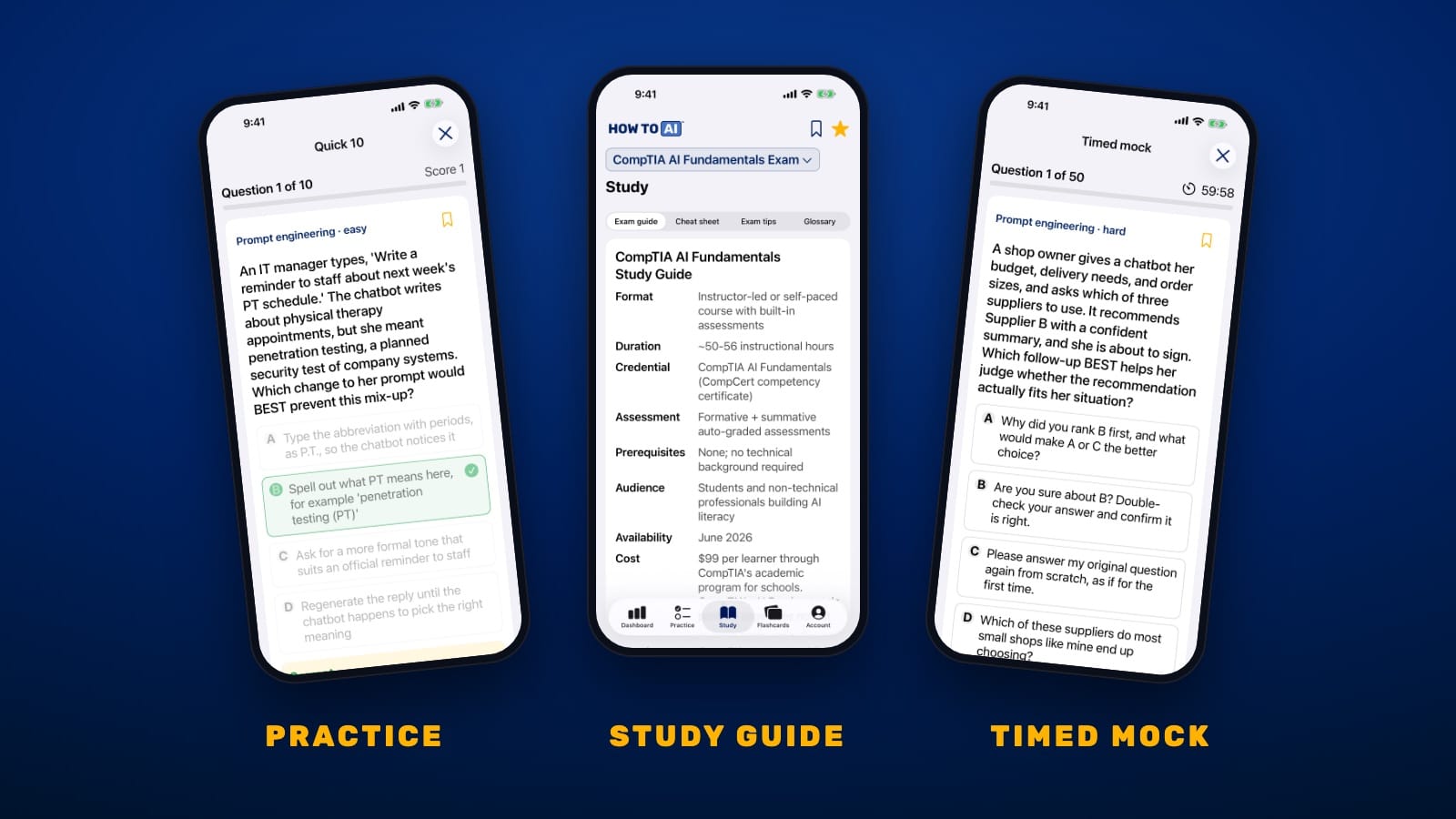
Study this course on your phone
HOW TO // AI CERT has 6,151 original practice questions across 18 AI and cloud certifications, with plain-English explanations on every answer, full timed mock exams, weak-area drills, and an AI tutor powered by Claude. Free to download, with a free question set for every exam.

Free CompTIA AI Fundamentals study guide & cheat sheet
Prefer to study first? The free CompTIA AI Fundamentals study guide has the course breakdown, a topic cheat sheet, and a full glossary, with no sign-up.
How to prepare
Download the official course objectives from CompTIA’s AI Fundamentals page, take a practice set above, then focus your studying on the areas where you missed questions rather than re-reading everything. Pair it with the study guide for the concepts.
HOW TO // AI is not affiliated with or endorsed by CompTIA. CompTIA AI Fundamentals is a CompTIA course and CompCert; we reference it descriptively. All questions are original.
Practice for every AI & cloud cert
- NVIDIA NCA-AIIO practice questions
- NVIDIA NCA-GENL practice questions
- AWS AIF-C01 practice questions
- AWS MLA-C02 practice questions
- AWS MLA-C01 practice questions
- Microsoft AI-901 practice questions
- Microsoft AI-103 practice questions
- VMware VCP-VCF Administrator practice questions
- Google Cloud Generative AI Leader practice questions
- Oracle OCI AI Foundations practice questions
- CertNexus AIP-210 practice questions
- Anthropic CCAO-F practice questions
- Anthropic CCDV-F practice questions
- Anthropic CCAR-F practice questions
- Anthropic CCAR-P practice questions
- Databricks GenAI Engineer Associate practice questions
- Salesforce Agentforce Specialist practice questions
- CompTIA SecAI+ practice questions
- All AI & cloud exam prep →
Frequently asked questions
Is CompTIA AI Fundamentals a certification?
No. CompTIA's own FAQ says CompTIA AI Fundamentals is not a certification: it is a course of about 50 to 56 hours, and learners who pass its built-in Competency Assessment earn a CompTIA CompCert (Competency Certificate). There is no separate exam voucher to buy.
How much does CompTIA AI Fundamentals cost?
CompTIA lists the course at $189 (US list price), and schools that adopt it pay $99 per learner. The Competency Assessment is built into the course, so there is no separate exam fee. Course access lasts 12 months after activation.
What are CompTIA's AI certification exams?
CompTIA has two: SecAI+ (CY0-001), a proctored AI security exam with up to 60 questions in 60 minutes and a $298 US voucher, and DataAI (DY0-001), an expert data science and machine learning exam. Neither is a beginner credential.
How should I prepare for CompTIA AI Fundamentals?
Work through the course itself, since the Competency Assessment is built into it. Then check yourself on the core topics: how AI works, when to use it, responsible use, prompt design, evaluating outputs, and basic automation and agents. Our 297-question bank covers CompTIA's published course objectives in our own estimated proportions.
Are HOW TO // AI CERT's CompTIA AI Fundamentals questions real assessment questions?
No. All 297 questions are original, written from CompTIA's published course objectives. We never copy or reproduce real assessment content, and every question includes a plain-English explanation so you learn the concept, not just the answer.
Is HOW TO // AI CERT affiliated with CompTIA?
No. HOW TO // AI CERT is an independent study resource and is not affiliated with, authorized by, endorsed by, or sponsored by CompTIA. CompTIA and its product names are trademarks of their respective owner; we reference them only to describe what our practice questions cover.
Can I try CompTIA AI Fundamentals practice questions for free?
Yes. Practice a free set of questions with no sign-up required, then unlock more by email. Pro unlocks the full 297-question bank plus timed mock exams, flashcards, spaced-repetition review, a readiness score, and an AI tutor, from $12/month; one subscription covers every certification we offer.