
HOW TO // AI CERT · ANTHROPIC CCDV-F
CCDV-F Practice Questions for the Claude Certified Developer: Foundations Exam
315 original practice questions written from Anthropic’s published CCDV-F exam guide and weighted to its blueprint, with a plain-English explanation on every one.
Start the free quiz, no signup →5 questions free right now · 15 more with your email · full bank from $12/mo
Claude AI Tutor included with Pro. Miss a question and it explains exactly why, in plain English, until it clicks.
CCDV-F is Anthropic’s Claude Certified Developer: Foundations exam: 53 multiple-choice and multiple-response items in 120 minutes, a scaled passing score of 720, and a $125 fee. The free CCDV-F practice questions on this page are original, written by HOW TO // AI from Anthropic’s published exam guide, and every answer comes with a plain-English explanation.
How these questions were made. Every question here is original. HOW TO // AI has never seen the CCDV-F exam (registration is limited to Claude Partner Network employees), so each question is written from Anthropic’s published CCDV-F exam guide, which is free and public, and maps to a domain in its blueprint. They are not real exam questions: live exam content is confidential under Anthropic’s exam NDA, and we never use exam recall or dumps.
CCDV-F is the developer exam, and it has the fewest questions of the four at 53. Fewer questions means each one carries more weight and there is less room to absorb a weak domain. It is also the only Claude exam that publishes sub-skill weights to one decimal place, which makes study allocation unusually precise.
Practice questions are the fastest way to get ready. They show you how concepts get tested, surface your gaps, and make exam day feel familiar.
CCDV-F exam at a glance
| Exam | Claude Certified Developer: Foundations (CCDV-F) |
|---|---|
| Questions | 53 items, multiple choice and multiple response (each item says how many answers to pick) |
| Time | 120 minutes (plan for about 135 minutes of seat time) |
| Passing score | Scaled 720 on a range of 100–1,000 |
| Price | $125 USD. 50% off for Select, Preferred and Global Premier partners, and free for Global Premier through December 31, 2026 |
| Delivery | Pearson VUE, online proctored (OnVUE) or at a Pearson test center |
| Who can register | Claude Partner Network employees only, with a recognized company email (details) |
| Language | English only |
| Prerequisites | None. Anthropic recommends 1 to 5 years of software engineering and 6+ months with Claude or similar LLMs |
| Validity | 12 months, then a free on-time renewal |
| Partner tier credit | Yes, it counts toward Claude Partner Network tier standing |
| Official practice exam | Retired on June 30, 2026. The exam guide includes 3 sample questions |
Checked against Anthropic’s Partner Academy CCDV-F exam guide and certification FAQ on October 8, 2026.
CCDV-F exam domains and weights
This is the published exam outline from Anthropic’s CCDV-F exam guide (Version 1.0, effective July 2026). Our practice questions follow the same weights.
| Domain | Weight | What it covers |
|---|---|---|
| Applications and Integration | 33.1% | Claude application design across interfaces, software engineering foundations, API mechanics, configuration management, requirements, systems lifecycle. |
| Model Selection and Optimization | 16.8% | LLM fundamentals, technical fundamentals (SDKs that wrap REST APIs, websockets), model options and effort levels, Opus versus Sonnet versus Haiku trade-offs, token and cost management, caching. |
| Agents and Workflows | 14.7% | Workflow versus agent decision criteria, manager hierarchies, the Agent SDK, custom loops, hooks, agent patterns and frameworks. |
| Prompt and Context Engineering | 11.0% | Instruction clarity, few-shot, input sanitization, context drift and compaction, structured output and defensive parsing. |
| Tools and MCPs | 10.6% | Tool use and function calling, tool descriptions, client versus server tools, MCP server development, built-in versus custom versus Skills versus MCP. |
| Security and Safety | 8.1% | Prompt injection, jailbreak defense, untrusted input, PII, guardrail layering, secrets and key management, hooks as guardrails. |
| Claude Code | 3.1% | Rules, skills, commands, session management, headless mode, the CLAUDE.md hierarchy, settings.json. |
| Eval, Testing, and Debugging | 2.6% | Error identification, recovery strategy, trace analysis, isolating integration-layer versus model-output problems. |
Worth knowing. One third of this exam is a single domain. If you study nothing else, study Applications and Integration. At the other end, Claude Code and Eval together are about three questions, so do not spend a week on them.
How to use these practice questions
- Take the 5 free questions cold, before you study, to get a baseline.
- Read every explanation, including the ones you got right. The reasoning is what transfers to new questions.
- Note the domain of each miss and study that part of the outline above, starting with Applications and Integration.
- Unlock 15 more with your email and take them after a few days of study to see what moved.
- Finish with Anthropic’s own sample questions in the official exam guide, which show the item style.
About the official sample questions: Anthropic retired its practice exam when delivery moved to Pearson VUE on June 30, 2026. The CCDV-F exam guide now carries 3 sample questions with answers and rationales, on batch processing, prompt injection and MCP, and Anthropic notes they are not drawn from the live item bank. Our questions are a separate, original set written from the same published guide.
Take the free practice quiz
Start with 5 free questions, read the explanation after each, then unlock 15 more with your email. No account needed to begin.
FREE PRACTICE QUIZ
Try 5 free CCDV-F practice questions
Answer at your own pace. Every question shows the correct answer and a plain-English explanation — that's where the learning happens. Unlock 15 more questions free at the end.
Read the 5 free CCDV-F questions as text, with answers and explanations
A team uses Claude Code from the terminal, from a VS Code extension, and from the desktop app against the same repository. What should they expect about project configuration?
- A. Each surface keeps an isolated configuration store, so CLAUDE.md and any MCP server registrations must be duplicated once per surface.
- B. Only the terminal CLI reads CLAUDE.md; the graphical surfaces rely solely on settings.json.
- C. The surfaces share one underlying engine, so CLAUDE.md, settings and configured MCP servers carry across them.
- D. MCP servers carry across surfaces but memory files and settings do not.
Answer: C. The Claude Code surfaces (terminal, IDE extensions, desktop, web and mobile) are front ends over one engine, so project memory, settings and MCP server configuration apply consistently across them. A is wrong because duplication is unnecessary and would immediately drift. B invents a restriction that does not exist; memory loading is an engine behavior, not a terminal feature. D splits the behavior arbitrarily, and configuration and memory travel by the same mechanism as MCP registration.
Which of these tool names is rejected by the Messages API tool-name constraint?
- A. get_order_status
- B. lookup-customer-record
- C. inventory.check_stock
- D. SearchDocs2
Answer: C. Tool names must match ^[a-zA-Z0-9_-]{1,128}$: letters, digits, underscores and hyphens only. The dot in inventory.check_stock is outside that character set, so the request is rejected. A uses underscores, B uses a hyphen, and D mixes letters and a digit, all of which are inside the allowed set. Namespacing with a dot is a common habit from other RPC systems and is the trap here; use an underscore instead.
A chatbot built on the Messages API sends only the newest user message on each request and users complain that Claude forgets everything.
- A. The conversation ID was not supplied, so the server could not restore the thread.
- B. The Messages API is stateless, so the client must send the full conversation history on every request.
- C. Session memory expires after five minutes and the client must refresh it sooner.
- D. Memory requires enabling the memory tool, which is on by default in Claude Code but must be requested explicitly through the API.
Answer: B. The Messages API keeps no server-side conversation state; each request must carry the entire messages array the model should see. A invents a conversation identifier that would restore history. C describes cache TTL behavior, which affects cost and latency but never response content. D is wrong because the memory tool is a separate client-side persistence mechanism, not what makes ordinary multi-turn conversation work.
A team is deciding between calling the Messages API with a hand-rolled HTTP client and using Anthropic's official Python SDK. What does the SDK actually give them?
- A. A private binary protocol that is faster than the public REST endpoints.
- B. Local caching of responses, which reduces billed input tokens on repeat prompts. The SDK keys the cache on the exact request body and reuses the stored completion whenever an identical request is sent inside the client's configured window.
- C. A typed wrapper over the same REST endpoints, adding request and response models, automatic retries with backoff on transient failures, and streaming helpers.
- D. A higher rate limit, because SDK traffic is pooled across the organization.
Answer: C. The SDKs are thin, typed wrappers around the same public REST API, and their value is engineering ergonomics: typed models, sensible default retries on transient errors, and helpers that assemble streamed events into a finished message. A is wrong because there is no private protocol; the SDK sends ordinary HTTPS requests to the documented endpoints. B is wrong because the SDK does not cache responses, and billing savings come from server-side prompt caching, which you request explicitly with cache_control. D is wrong because rate limits are enforced per organization regardless of whether the caller uses an SDK.
Before sending a large assembled prompt, a service needs to know how many input tokens it will consume, without paying for a generation. What should it call?
- A. POST /v1/messages/count_tokens with the same model, system prompt, tools and messages; it returns input_tokens, is free, and is rate limited separately.
- B. POST /v1/messages with max_tokens set to 1 and read usage.input_tokens from the response.
- C. Nothing. Client-side estimation at roughly four characters per token is the only supported method. Anthropic publishes that ratio for exactly this purpose and exposes no counting endpoint, because counting would require running the tokenizer server-side.
- D. GET /v1/models, which returns the token count of the prompt you supply in the query string.
Answer: A. The token counting endpoint exists precisely for this: it accepts the same request shape and returns input_tokens at no cost, under its own rate limit. B works but bills you for a real request and its output token, which is the thing the question asks you to avoid. C is wrong because a supported endpoint exists, and character heuristics are unreliable across languages and content types. D is wrong: the Models API returns model metadata such as max_input_tokens, max_tokens and capabilities, not a count of your prompt.
Want more? Finish the quiz above to unlock 15 more free questions, or open the full CCDV-F practice app.
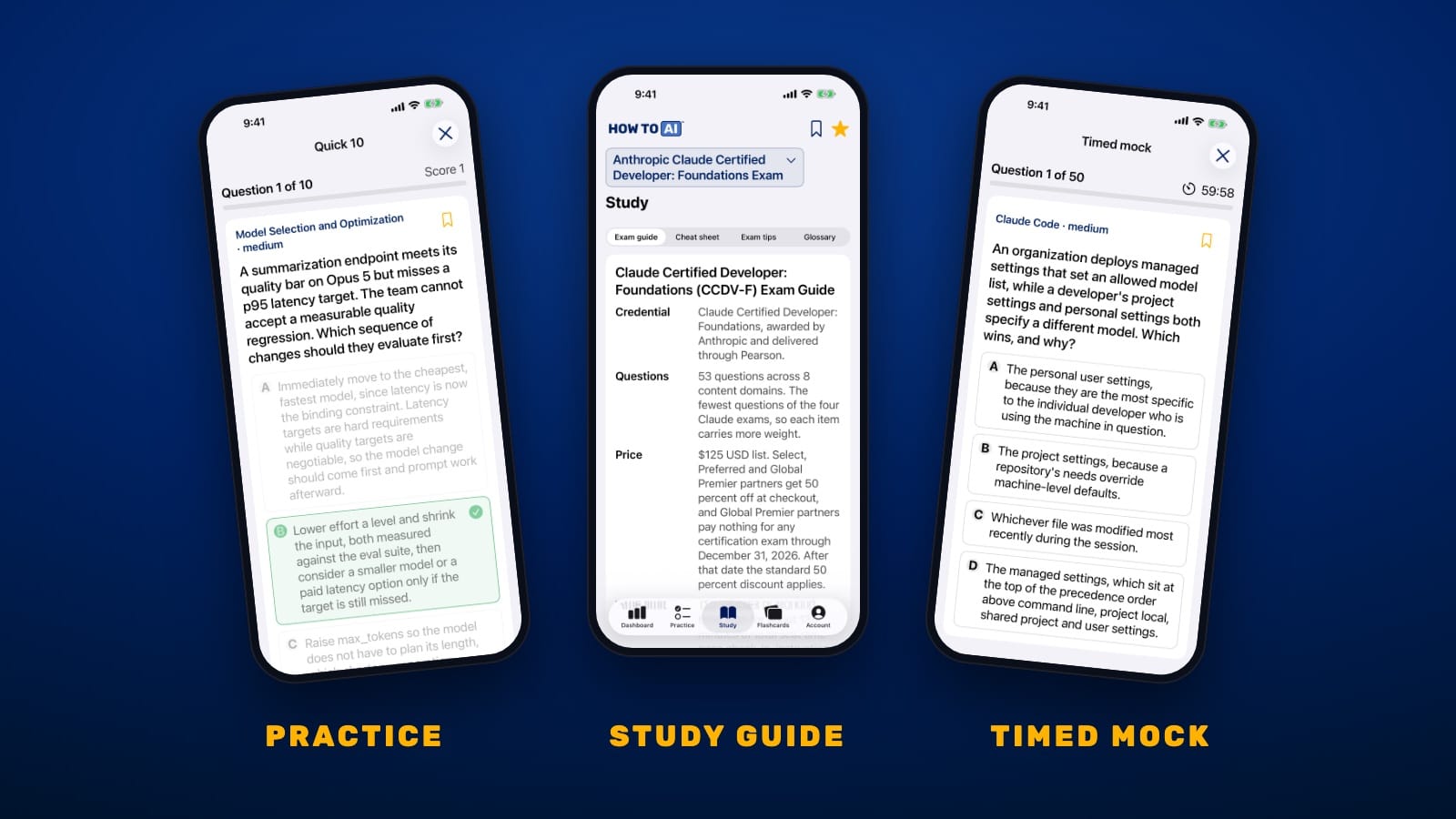
Study this exam on your phone
HOW TO // AI CERT has 5,245 original practice questions across 15 AI and cloud certifications, with plain-English explanations on every answer, full timed mock exams, weak-area drills, and an AI tutor powered by Claude. Free to download, with a free question set for every exam.

🤖 An AI Tutor on every question, powered by Claude
Stuck? Ask the AI Tutor. It explains the concept, shows why your pick was tempting but wrong, and answers follow-ups. Included with Pro.
🎓 Want the full question bank?
HOW TO // AI CERT unlocks the complete CCDV-F bank, timed mock exams, flashcards, spaced-repetition review, and the AI tutor. Free to start, Pro from $12/month, and one subscription covers every cert.
Free CCDV-F study guide & cheat sheet
Prefer to study first? The free CCDV-F study guide has the full exam breakdown, every domain and sub-skill with its official weight, and an API cheat sheet. No sign-up.
How to prepare for CCDV-F
Read Anthropic’s official CCDV-F exam guide PDF first, since it carries the complete blueprint plus sample questions with answer rationales. The guide’s main advice is to build and operate at least one Claude application that uses the API, tools, prompt and context engineering, and basic security and evaluation. Take a practice set above, then focus your studying on the domains where you missed questions.
The free courses at academy.claude.com cover the Claude API, Claude Code, MCP and agent skills at no cost. Building with the Claude API (about 9 hours) is the core one for this exam. Partners also get a free Developer: Foundations prep course on Anthropic Partner Academy. For a week-by-week schedule, follow our 4-week CCDV-F study plan.
Before you book: registration is open only to people at Claude Partner Network organizations, so check who can take the Claude certification and what each Claude exam costs with partner discounts.
Searching for CCDV-F dumps? Skip them. Every candidate accepts a non-disclosure agreement, and Anthropic’s exam policy treats using leaked exam content as misconduct that can get your result invalidated or your certification revoked. Here is why you don’t need dumps to pass.
Not sure this is the right exam for you? Compare all four: Claude certification explained, or read whether the Claude certification is worth it. Weighing the two architect exams? CCAR-F vs CCAR-P.
HOW TO // AI is not affiliated with or endorsed by Anthropic. CCDV-F, Claude Certified Developer: Foundations, Claude and Claude Code are trademarks of Anthropic PBC; we reference them descriptively. All questions are original and written from Anthropic’s published exam blueprint.
Practice for every AI & cloud cert
- NVIDIA NCA-AIIO practice questions
- NVIDIA NCA-GENL practice questions
- AWS AIF-C01 practice questions
- AWS MLA-C02 practice questions
- AWS MLA-C01 practice questions
- Microsoft AI-901 practice questions
- Microsoft AI-103 practice questions
- VMware VCP-VCF Administrator practice questions
- CompTIA AI Fundamentals practice questions
- Google Cloud Generative AI Leader practice questions
- Oracle OCI AI Foundations practice questions
- CertNexus AIP-210 practice questions
- Anthropic CCAO-F practice questions
- Anthropic CCAR-F practice questions
- Anthropic CCAR-P practice questions
- All AI & cloud exam prep →
Frequently asked questions
What is the CCDV-F exam?
CCDV-F is the exam code for Claude Certified Developer: Foundations, Anthropic's certification for engineers who build, integrate and ship applications and agents on Claude. It is one of four Claude certifications and counts toward Claude Partner Network tier standing.
How many questions are on the CCDV-F exam, and what is the passing score?
The CCDV-F exam has 53 multiple-choice and multiple-response items with a 120-minute time limit. You need a scaled score of 720 on a range of 100 to 1,000 to pass.
How much does the CCDV-F exam cost?
CCDV-F costs $125 USD. Select, Preferred and Global Premier partners get 50% off, and Global Premier partners get 100% off through December 31, 2026.
Who can take the CCDV-F exam?
Only people at Claude Partner Network organizations can register, using a company email on a recognized domain. Anyone can still use these practice questions to learn the material.
How is the CCDV-F exam delivered?
Every Claude certification exam is proctored and delivered by Pearson VUE, either online through OnVUE or at a Pearson test center. It is closed book and in English only, and you verify your identity with a government-issued ID before you start.
Is there an official CCDV-F practice test?
Not anymore. Anthropic retired its practice exam when delivery moved to Pearson VUE on June 30, 2026, and the official exam guide now includes 3 sample questions with answers and rationales.
Are these real CCDV-F exam questions?
No. They are original questions written by HOW TO // AI from Anthropic's published exam guide, each with a plain-English explanation. Real exam content is confidential, and we never use exam recall or dumps.
Should I use CCDV-F dumps?
No. Candidates accept a non-disclosure agreement, and Anthropic's exam policy treats using leaked exam content as misconduct that can get your result invalidated or your certification revoked. Practice questions written from the published guide prepare you without that risk.
Can I try CCDV-F practice questions for free?
Yes. The quiz on this page gives you 5 free CCDV-F questions with explanations, no sign-up needed, and you can unlock 15 more free by adding your email at the end. The full question bank, timed mock exams and an AI tutor are in the HOW TO // AI CERT app.