
AIP-210 (CertNexus CAIP) Study Guide & Cheat Sheet
Everything you need to study for AIP-210, the CertNexus Certified Artificial Intelligence Practitioner (CAIP) exam: the domain breakdown, study and test-day tips, a topic cheat sheet and a full glossary. Free, and no sign-up.
Ready to practice? Take the free AIP-210 practice quiz → · Get the full exam prep →
What AIP-210 actually is
AIP-210 is the exam behind the CertNexus Certified Artificial Intelligence Practitioner (CAIP) credential. First, the thing that confuses nearly everyone searching for it: this is not a CompTIA exam. CertNexus is a division of Logical Operations, and it sells through some of the same training channels as CompTIA, which is why “CompTIA AIP-210” is such a common search. The exam, the blueprint and the credential are CertNexus’s.
It is also a practitioner exam rather than an AI-literacy quiz. Where entry-level certs ask you to describe what machine learning is, AIP-210 asks how you would frame a problem, prepare the data, pick and tune an algorithm, choose the right evaluation metric, and then keep the thing running once it is in production. CertNexus suggests one to three years of hands-on exposure before you sit it. If you have never built a model, start somewhere gentler and come back.
It is also vendor-neutral, which cuts both ways: nothing here is tied to AWS, Azure or Google, so the knowledge travels, but no cloud provider is pushing the credential on your behalf either. Whether that trade is worth it for you is a separate question, and we answer it honestly in Is the CertNexus CAIP worth it?
How to use this guide
The material below is ordered the way it is worth studying, not the way the blueprint lists it.
- Start with the domain weights. They tell you where the questions are. The biggest slice is the operations end of the job, deploying and monitoring models, and that is exactly the part people who mostly build models underestimate. Weight your hours accordingly rather than evenly.
- Read the tips before you read the cheat sheet. Most AIP-210 questions are scenarios, so knowing how the exam asks is worth as much as knowing the answer.
- Use the cheat sheet as a checklist, not a read-through. Work down the six topic groups and mark anything you could not explain out loud to a colleague. Those gaps are your study plan.
- Then test yourself, early and often. Recognising a term in a glossary is not the same as answering a question under time pressure. Our free AIP-210 practice questions are written from the same blueprint, and every answer is explained.
Want that turned into a week-by-week schedule? Our six-week AIP-210 study plan puts the same material on a calendar.
Before you book
Two things are worth knowing before you spend anything. The AIP-210 voucher is expensive next to the big cloud certs, though it includes a retake, and it has an expiry date of its own: see what AIP-210 really costs for the current numbers, including bundles and renewal. And because the exam is pricey, the temptation to shortcut it with brain dumps is stronger here than almost anywhere else, which is a bad trade for reasons we lay out in the honest math on AIP-210 dumps.
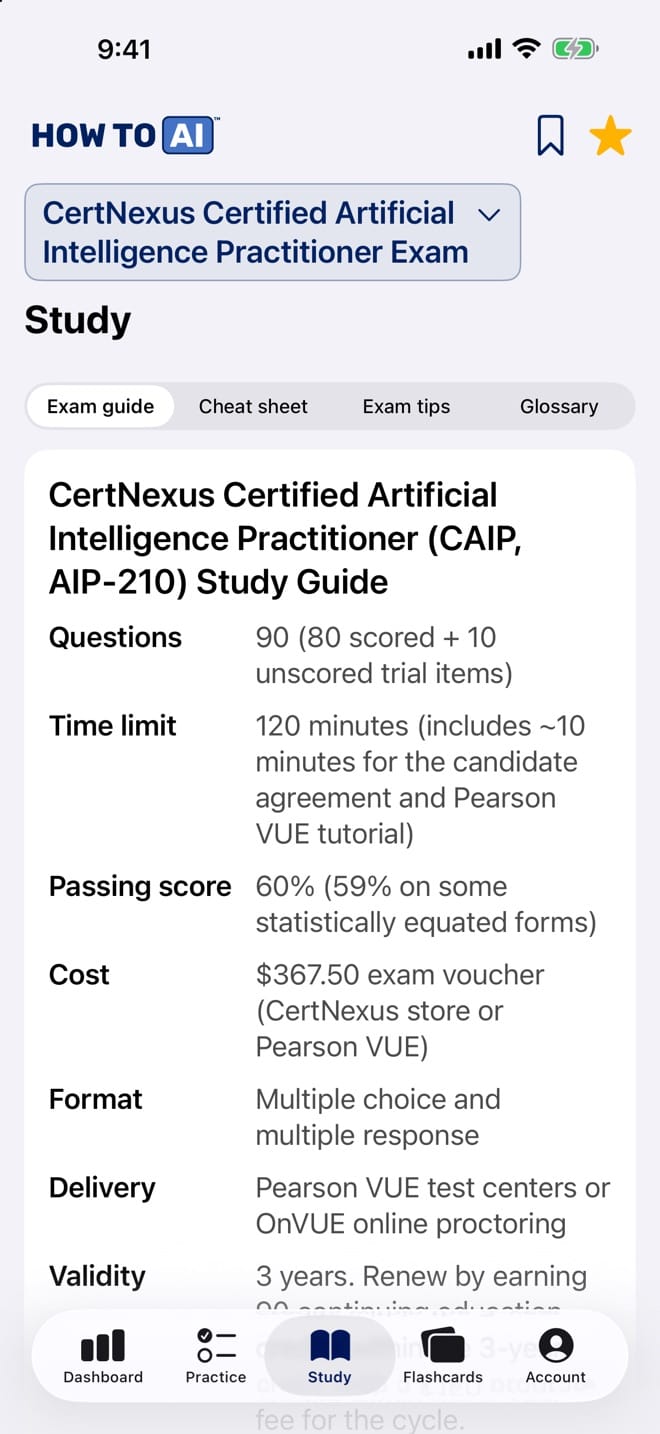
CertNexus Certified Artificial Intelligence Practitioner (CAIP, AIP-210) Study Guide
| Questions | 90 (80 scored + 10 unscored trial items) |
|---|---|
| Time limit | 120 minutes (includes ~10 minutes for the candidate agreement and Pearson VUE tutorial) |
| Passing score | 60% (59% on some statistically equated forms) |
| Cost | $367.50 exam voucher (CertNexus store or Pearson VUE) |
| Format | Multiple choice and multiple response |
| Delivery | Pearson VUE test centers or OnVUE online proctoring |
| Validity | 3 years. Renew by earning 90 continuing education credits within the 3-year cycle, with a $150 program fee for the cycle. |
| Retakes | Every CertNexus exam voucher includes one free retake of the same exam and exam version, using the same voucher code. |
| Prerequisites | None required; 1–3 years of professional ML/data exposure recommended (Python or R, statistics, SQL) |
Exam domains
| Domain | Weight | What it covers |
|---|---|---|
| Understanding the Artificial Intelligence Problem | 26% | Framing business problems as AI/ML problems and knowing when ML fits. Covers matching algorithm families to use cases and ranking them by success probability, the business case for image recognition, NLP, speech recognition, recommenders, diagnostic systems, and robotics, supervised vs unsupervised vs reinforcement learning, communicating goals and KPIs with stakeholders, and spotting ethical concerns before a project starts. |
| Engineering Features for Machine Learning | 20% | Preparing data so models can learn from it. Covers the impact of data quality and size, ETL and transformations (standardization, normalization, log/square-root/logit), working with text, numeric, audio, and video formats, encoding categorical data, imputation, outliers, binning, class imbalance and SMOTE, dimensionality reduction with PCA, avoiding data leakage, and the ethics of feature choices (proxy variables, PII). |
| Training and Tuning ML Systems and Models | 24% | Building and refining models. Covers differentiating classic ML algorithms (regression, trees, ensembles, SVM, k-NN, naive Bayes, clustering) and deep learning architectures (ANN, CNN, RNN/LSTM, GAN), hyperparameter tuning with grid/random search, regularization and early stopping, train/validation/test splits and k-fold cross-validation, evaluation metrics (precision, recall, F1, ROC/AUC, RMSE, silhouette), and diagnosing overfitting vs underfitting. |
| Operationalizing ML Models | 30% | The heaviest domain: getting models into production and keeping them healthy. Covers deployment as REST APIs and containers, batch vs real-time vs edge inference, model registries, versioning and CI/CD, canary/blue-green/shadow rollouts, monitoring for data drift and concept drift, retraining triggers, securing pipelines against adversarial examples, data poisoning, and model inversion/extraction, plus human oversight and accountability in production. |
Who it’s for: Data professionals, analysts, and developers with 1–3 years of hands-on exposure who want a vendor-neutral credential proving they can take a machine-learning solution from business problem to production. AIP-210 is the CertNexus Certified Artificial Intelligence Practitioner exam. CertNexus is an independent certification body that describes itself as a division owned by Logical Operations, Inc.
Study & test-day tips
- Weight your prep like the blueprint: Operationalizing ML Models is 30% of the exam — drift, deployment patterns, and pipeline security pay more than memorizing another algorithm.
- Every domain ends with an ethics/business-risk objective (1.6, 2.5, 3.5, 4.4). Expect fairness, bias, GDPR, and human-oversight questions everywhere, not in one block.
- Think vendor-neutral: answers are concepts and techniques (scikit-learn-style workflows), never a branded cloud service. If an option only works on one cloud, it's probably a distractor.
- Learn the transformation trio cold: standardization (z-scores, for distance/gradient methods), normalization (min-max to [0,1]), and log/square-root/logit transforms (taming skew and bounded proportions).
- Map metrics to business harm: recall when false negatives are costly (disease screening), precision when false positives are costly (spam, fraud alerts), F1 for imbalance, RMSE/MAE for regression, silhouette for clustering.
- Know data drift (input distribution changes) vs concept drift (the input→label relationship changes) and that both are detected by monitoring, fixed by retraining — this is the single most-tested Domain 4 idea.
- Match deep architectures to data shape: CNN for images, RNN/LSTM for sequences and time series, GAN for synthetic data generation, plain feed-forward ANN for tabular patterns.
- For multi-response items the stem tells you how many to choose — pick exactly that many, and eliminate options that fail on a technicality (wrong learning type, leaks the test set, breaks privacy).
- Scenario questions reward the NEXT sensible step in the ML workflow: e.g., high training accuracy + poor test accuracy → reduce overfitting (regularize, simplify, more data), not 'train longer'.
- Security questions hinge on attack vocabulary: adversarial examples (fool a live model), data poisoning (corrupt training data), model inversion (recover training data), model extraction (steal the model via queries).
Cheat sheet
Problem Framing and Learning Types
- Supervised = labeled data (classification, regression); unsupervised = unlabeled (clustering, dimensionality reduction, association); reinforcement = agent + reward signal.
- Classification predicts a category; regression predicts a number; clustering groups without labels; anomaly detection finds rare deviations; forecasting predicts over time.
- Use ML when the pattern is too complex to hand-code, data exists, and some error is tolerable; avoid it when rules are simple, data is absent, or decisions demand full explainability.
- Business cases: image recognition (defect/medical imaging), NLP (sentiment, document routing), speech recognition (transcription, voice UI), recommenders (cross-sell), diagnostic/discovery systems, robotics/autonomous systems.
- Stakeholder communication: define the KPI before modeling, report uncertainty honestly, translate model metrics into business outcomes.
Data Prep and Feature Engineering
- Standardization → mean 0/std 1, needed by SVM, k-NN, PCA, neural nets; min-max normalization → [0,1]; log/square-root transforms tame right skew; logit transforms bounded proportions.
- Categorical encoding: one-hot for nominal (no order), ordinal/label encoding only when order is real; high-cardinality features may need target/frequency encoding or grouping.
- Missing data: impute (mean/median/mode/model-based) or drop; never impute using statistics computed on the test set — that is data leakage.
- Class imbalance: resample (oversample minority / undersample majority), SMOTE for synthetic minority examples, class weights, and evaluate with precision/recall not accuracy.
- PCA reduces dimensionality via orthogonal components ordered by explained variance — fights the curse of dimensionality at the cost of interpretability.
- Quality beats quantity: label noise and sampling bias hurt more than a smaller clean set; proxy variables (e.g., ZIP code) can smuggle protected attributes into features.
Algorithm Selection
- Linear regression → numeric target, linear relationships; logistic regression → binary classification with interpretable coefficients.
- Decision trees are interpretable but overfit alone; random forest = bagging many trees (variance down); gradient boosting/XGBoost = sequential trees correcting errors (often best on tabular data).
- SVM maximizes the margin; the RBF kernel handles non-linear boundaries; sensitive to feature scaling.
- k-NN is instance-based and needs scaling; naive Bayes assumes feature independence and excels on text; k-means needs k up front (elbow/silhouette), hierarchical clustering yields a dendrogram.
- Ensembles: bagging trains in parallel on bootstrap samples (variance ↓); boosting trains sequentially on residuals (bias ↓); stacking blends different model types with a meta-learner.
- Deep learning: CNN = images, RNN/LSTM = sequences (LSTM gates fix vanishing gradients), GAN = generator vs discriminator for synthetic data, transfer learning reuses pretrained networks when data is scarce.
Training, Tuning, and Regularization
- Split train/validation/test (e.g., 70/15/15); tune on validation, report on the untouched test set; use temporal splits for time series.
- k-fold cross-validation averages k train/validate rounds for stable estimates on limited data; stratify folds to preserve class ratios.
- Grid search tries every combination (exhaustive, slow); random search samples the space (better when few hyperparameters matter).
- Regularization fights overfitting: L1/lasso zeroes coefficients (feature selection), L2/ridge shrinks them smoothly, elastic net mixes both; dropout and early stopping do the same job for neural nets.
- High train / low test accuracy = overfitting (simplify, regularize, more data); poor on both = underfitting (more capacity, better features).
- Learning rate too high → divergence/oscillation; too low → slow convergence and stuck-in-local-minima behavior.
Evaluation Metrics
- Confusion matrix: TP/FP/TN/FN — precision = TP/(TP+FP), recall (sensitivity) = TP/(TP+FN), specificity = TN/(TN+FP), F1 = harmonic mean of precision and recall.
- ROC curve plots TPR vs FPR across thresholds; AUC 0.5 = random, 1.0 = perfect; prefer the precision-recall curve when classes are heavily imbalanced.
- Accuracy misleads on imbalanced data — a 99%-negative dataset scores 99% by always predicting negative.
- Regression: MAE = average absolute error (robust to outliers), RMSE penalizes large errors, R² = share of variance explained.
- Clustering: silhouette score (−1 to 1) measures cohesion vs separation without labels.
- Always compare against a baseline (majority class, simple heuristic) before claiming a model works.
Deployment, Monitoring, and ML Security
- Serving patterns: REST API/microservice for real-time, batch scoring for periodic jobs, edge deployment for latency/offline; containers (Docker/Kubernetes) make deployments reproducible and scalable.
- Release safely: canary (small % first), blue-green (instant switch/rollback), shadow (new model scores silently), A/B (compare on live traffic); model registry + versioning enable rollback and audit.
- Monitor in production: input data drift, concept drift, prediction quality, latency; define retraining triggers (scheduled or drift-based) and keep humans in the loop for high-stakes decisions.
- Attacks: adversarial examples perturb inputs to fool a deployed model; data poisoning corrupts training data; model inversion reconstructs training data; model extraction clones a model via repeated queries — defend with input validation, access control, rate limiting, and monitoring.
- Protect the pipeline: least-privilege access, encryption at rest and in transit, secrets management, audit logging; GDPR governs PII throughout training AND inference.
- Ethics in operations: disclose automated decisions, provide recourse/appeal, audit for bias post-deployment, plan incident response and safe decommissioning.
Glossary
- Supervised learning
- Training on labeled examples so the model maps inputs to known outputs; covers classification and regression.
- Unsupervised learning
- Finding structure in unlabeled data — clustering, dimensionality reduction, association rules.
- Reinforcement learning
- An agent learns by acting in an environment and maximizing cumulative reward.
- Feature engineering
- Creating, transforming, and selecting input variables so an algorithm can learn effectively.
- Standardization
- Rescaling a feature to mean 0 and standard deviation 1 (z-scores); required by scale-sensitive algorithms like SVM, k-NN, and PCA.
- Normalization
- Rescaling values to a fixed range, typically [0,1] via min-max scaling.
- Logit transformation
- log(p/(1−p)) — maps proportions in (0,1) onto the real line; the link function of logistic regression.
- One-hot encoding
- Representing a nominal categorical feature as binary columns, one per category, with no implied order.
- Data leakage
- Information from outside the training data (often the test set or the future) contaminating training, inflating measured performance.
- Class imbalance
- One class vastly outnumbering another; handled with resampling, SMOTE, class weights, and precision/recall-based evaluation.
- SMOTE
- Synthetic Minority Over-sampling Technique — creates synthetic minority-class examples by interpolating between neighbors.
- PCA (principal component analysis)
- Unsupervised dimensionality reduction projecting data onto orthogonal components ordered by explained variance.
- Curse of dimensionality
- As feature count grows, data becomes sparse and distance measures lose meaning, degrading model performance.
- Overfitting
- A model memorizes training data (high train, low test performance); countered with regularization, simpler models, or more data.
- Underfitting
- A model too simple to capture the pattern — poor performance on both training and test data.
- Bias-variance trade-off
- Balancing error from overly simple assumptions (bias) against error from sensitivity to training noise (variance).
- Regularization (L1/L2)
- Penalizing large coefficients to prevent overfitting: L1 (lasso) zeroes features out; L2 (ridge) shrinks them smoothly.
- Hyperparameter tuning
- Searching settings that aren't learned from data (tree depth, learning rate, k) via grid or random search on a validation set.
- Cross-validation (k-fold)
- Rotating through k train/validate splits and averaging results for a stable performance estimate.
- Early stopping
- Halting training when validation performance stops improving — cheap regularization for iterative learners.
- Ensemble learning
- Combining multiple models — bagging (parallel, variance ↓), boosting (sequential, bias ↓), stacking (meta-learner) — to beat any single model.
- Random forest
- A bagged ensemble of decision trees using random feature subsets; robust, low-variance tabular workhorse.
- Gradient boosting (XGBoost)
- Sequentially adding trees that correct the ensemble's residual errors; frequently the strongest classic-ML choice on tabular data.
- SVM (support vector machine)
- Classifier that maximizes the margin between classes; kernels like RBF let it learn non-linear boundaries.
- k-nearest neighbors (k-NN)
- Instance-based method that classifies by majority vote of the k closest (scaled) training points.
- k-means
- Clustering that assigns points to k centroids and iterates; choose k with the elbow method or silhouette score.
- Confusion matrix
- A table of true/false positives and negatives that underlies precision, recall, specificity, and F1.
- Precision vs recall
- Precision = share of positive predictions that are right; recall = share of actual positives found. F1 is their harmonic mean.
- ROC curve / AUC
- True-positive vs false-positive rate across thresholds; area under it summarizes ranking quality (0.5 random, 1.0 perfect).
- RMSE / MAE / R²
- Regression metrics: RMSE penalizes big errors, MAE averages absolute errors, R² is the fraction of variance explained.
- ANN / CNN / RNN / LSTM
- Neural architectures: feed-forward nets for tabular patterns, convolutional nets for images, recurrent nets (and LSTM gates) for sequences.
- GAN (generative adversarial network)
- Generator and discriminator trained against each other to produce realistic synthetic data.
- TF-IDF
- Term frequency × inverse document frequency — weights words by how distinctive they are to a document; classic NLP featurization.
- Model registry
- A versioned catalog of trained models with metadata, enabling promotion, rollback, and audit in MLOps.
- Data drift vs concept drift
- Data drift: input distribution shifts. Concept drift: the input→label relationship itself changes. Both degrade deployed models and trigger retraining.
- Canary / blue-green deployment
- Safe release patterns: canary sends a small traffic slice to the new model first; blue-green keeps two environments for instant switchover and rollback.
- Adversarial example
- An input minimally perturbed to make a deployed model misclassify — an evasion attack on live systems.
- Data poisoning
- Corrupting training data so the resulting model misbehaves; defended with data validation and provenance controls.
- Model inversion / extraction
- Inversion reconstructs sensitive training data from a model; extraction clones the model through repeated queries. Rate limiting and access control mitigate both.
- Explainability
- Making model decisions understandable — interpretable models, feature importance, and transparency obligations to affected users.
- Human-in-the-loop
- Keeping human review over consequential automated decisions — a recurring CAIP ethics requirement.
- GDPR
- EU regulation governing personal data — consent, purpose limitation, and data-subject rights apply to training data and model outputs alike.
Put it into practice
Studying is step one — practice questions are where it sticks. Start with free AIP-210 practice questions, then go Pro for the full ~300-question bank, timed mocks, and an AI tutor.
HOW TO // AI is not affiliated with or endorsed by CertNexus or CompTIA. Certified Artificial Intelligence Practitioner (CAIP) and AIP-210 are credentials of CertNexus (a division of Logical Operations); we reference them descriptively. All content is original.
Take this guide with you
The same study guide, cheat sheet and glossary live in HOW TO // AI CERT on iPhone, next to 5,245 original practice questions, timed mock exams, flashcards and an AI tutor powered by Claude. Free to download, with a free question set for every exam.

Practice for every AI & cloud cert
- NVIDIA NCA-AIIO practice questions
- NVIDIA NCA-GENL practice questions
- AWS AIF-C01 practice questions
- AWS MLA-C02 practice questions
- AWS MLA-C01 practice questions
- Microsoft AI-901 practice questions
- Microsoft AI-103 practice questions
- VMware VCP-VCF Administrator practice questions
- CompTIA AI Fundamentals practice questions
- Google Cloud Generative AI Leader practice questions
- Oracle OCI AI Foundations practice questions
- Anthropic CCAO-F practice questions
- Anthropic CCDV-F practice questions
- Anthropic CCAR-F practice questions
- Anthropic CCAR-P practice questions
- All AI & cloud exam prep →
Frequently asked questions
How much does the CertNexus CAIP (AIP-210) exam cost?
$367.50 for the exam voucher, via the CertNexus store or Pearson VUE — the most expensive of the major AI certifications, so readiness before booking matters more than usual.
How many questions is AIP-210 and what passes?
90 questions (80 scored + 10 unscored trial items) in 120 minutes, multiple choice and multiple response. Passing is 60% (59% on some equated forms).
How long is the AIP-210 certification valid?
3 years — renew by retaking the exam or by earning 90 continuing education credits within the 3 years ($150 program fee).
How hard is the CAIP exam?
It is a genuine practitioner exam covering the full ML lifecycle, with Operationalizing ML Models as the heaviest domain (30%). No formal prerequisites, but 1–3 years of hands-on ML/data exposure (Python or R, statistics, SQL) is recommended — beginners should start with a fundamentals cert first.