
Oracle OCI AI Foundations Study Guide & Cheat Sheet
A free study guide for the Oracle OCI AI Foundations exam — exam facts, the domain breakdown, study tips, a topic cheat sheet, and a full glossary. No sign-up needed.
Ready to practice? Take the free Oracle OCI AI Foundations practice quiz → · Get the full exam prep →
Who OCI AI Foundations is for
This is the cheapest way into an AI certification, because Oracle gives away both the course and the exam. That makes it a sensible first credential, especially if your employer runs Oracle Cloud, where it carries the most weight. It is a short online exam with no coding, so treat it as a first step rather than the headline on your CV.
Because it is free, the only thing you are spending is study time, which changes the calculation: the question is not whether it is worth the money but whether these are the hours you want to spend. Our honest review answers that.
How to use this guide
- Start with the domains to see how much is general AI concepts and how much is Oracle’s own services.
- Read the tips for how the questions are worded.
- Use the cheat sheet as a checklist, marking the OCI services you could not describe in a sentence.
- Then test yourself with our free OCI AI Foundations questions, which explain every answer.
Deciding between free and paid beginner certs? Our comparison of the main AI certifications puts this one in context.
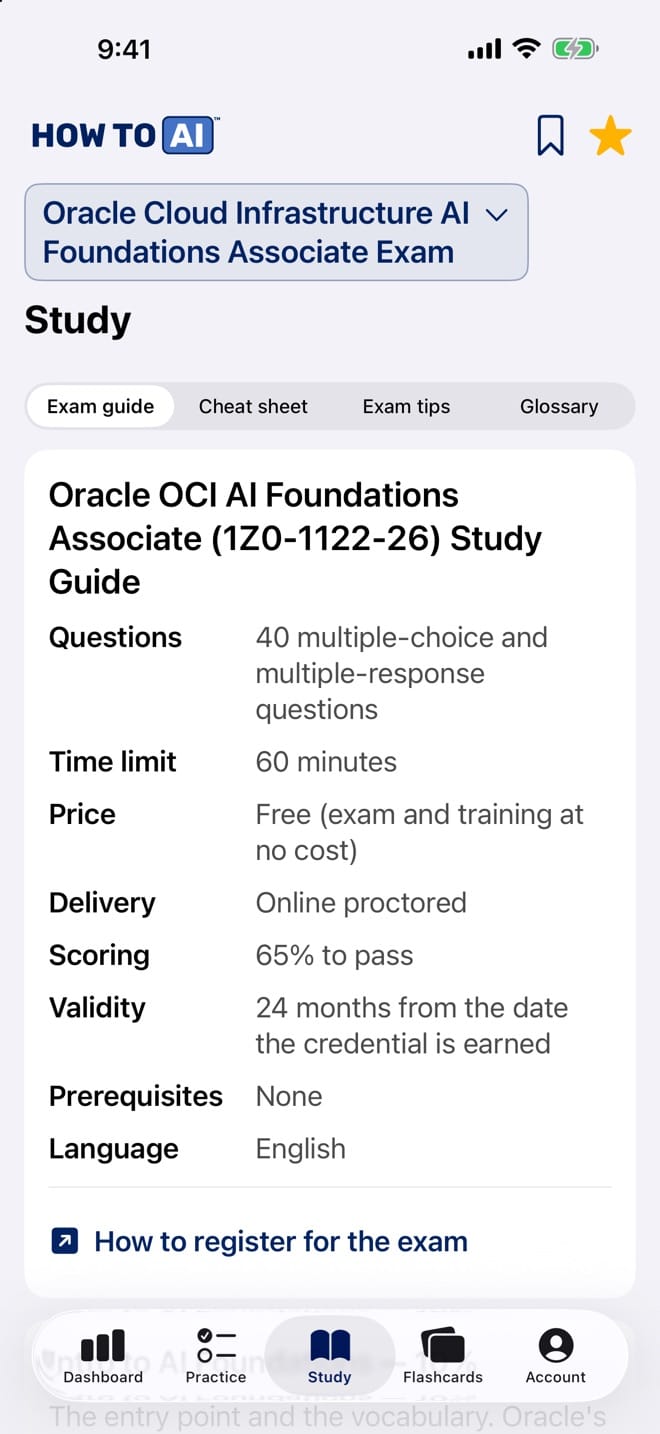
Oracle OCI AI Foundations Associate (1Z0-1122-26) Study Guide
| Questions | 40 multiple-choice and multiple-response questions |
|---|---|
| Time limit | 60 minutes |
| Price | Free (exam and training at no cost) |
| Delivery | Online proctored |
| Scoring | 65% to pass |
| Validity | 24 months from the date the credential is earned |
| Prerequisites | None |
| Language | English |
Exam domains
| Domain | Weight | What it covers |
|---|---|---|
| Intro to AI Foundations | 10% | The entry point and the vocabulary. Oracle's objectives are AI basics, AI applications and the types of data AI works with, and the distinction between AI, machine learning and deep learning. Straightforward once the terms are straight, and the fastest marks on the exam. |
| Intro to ML Foundations | 15% | How machines learn from data, before any deep learning specifics. Oracle's objectives cover machine learning basics, supervised learning for regression and classification, unsupervised learning, and reinforcement learning. Expect definitional questions plus short scenarios asking which learning type or task a described problem actually is. |
| Intro to DL Foundations | 15% | Neural networks and the architectures built from them. Oracle's objectives cover deep learning fundamentals, convolutional neural networks for images, and sequence models including RNNs and LSTMs. The questions stay conceptual: what an architecture is for, and which one suits a described shape of data. |
| Intro to Generative AI & LLMs | 15% | How generative AI and large language models work and how they are adapted. Oracle's objectives cover a generative AI overview, large language model fundamentals, transformer fundamentals, prompt engineering and instruction tuning, and LLM fine-tuning. Note that Oracle files transformers here rather than under deep learning. |
| Get started with OCI AI Portfolio | 15% | A survey of what Oracle offers and when to reach for each piece. Oracle's objectives cover an overview of OCI AI services, OCI machine learning services such as OCI Data Science, and OCI AI infrastructure including GPU compute, plus responsible AI, which Oracle files under this topic rather than under generative AI. |
| OCI Generative AI and Oracle 23ai | 10% | Oracle's own generative AI surface. Oracle's objectives cover the OCI Generative AI services, Select AI in Autonomous Database for querying data in natural language, and Oracle Vector Search for similarity search over embeddings stored alongside your data. |
| Intro to OCI AI Services | 20% | The heaviest topic on the exam. Oracle's objective is to explore the OCI AI services and their APIs: OCI Language, OCI Vision, OCI Document Understanding and OCI Speech. Know what each service does, what input it takes, and which one fits a described business scenario. |
Who it’s for: Anyone wanting foundational AI/ML knowledge plus familiarity with Oracle Cloud Infrastructure AI services. It is an accessible, free entry-level certification suited to students, business users, and technical professionals beginning their AI journey on OCI.
Study & test-day tips
- Intro to OCI AI Services is the heaviest topic at 20 percent, and with Get started with OCI AI Portfolio at 15 percent, OCI's own services are 35 percent of the exam. Prioritize knowing what OCI Language, Vision, Speech and Document Understanding each do and when to choose one over another.
- Be able to clearly separate AI vs. machine learning vs. deep learning vs. generative AI, since many questions test whether you can place a concept at the right level.
- Memorize the three learning paradigms (supervised, unsupervised, reinforcement) and map each to its typical tasks: regression and classification are supervised, clustering is unsupervised.
- For deep learning, connect each architecture to its strength: CNNs for images, RNNs/LSTMs for sequential data, and transformers for language and modern LLMs.
- Know the LLM workflow vocabulary cold: prompt engineering, fine-tuning, instruction tuning, embeddings, vector search, and retrieval-augmented generation (RAG).
- Understand that embeddings are numeric vector representations and that vector search powers semantic retrieval, which is the foundation of RAG.
- Distinguish OCI Generative AI (managed LLM service) from OCI Generative AI Agents (agentic apps with RAG over your data) and from OCI Data Science (build, train, deploy custom models).
- Remember the Oracle Database 23ai AI features (Oracle now calls the release Oracle AI Database 26ai; the exam topics still say 23ai): AI Vector Search for similarity search inside the database and Select AI for natural-language querying of your data.
- Take the free official Oracle training course before the exam; it is aligned directly to the objectives and the questions track its terminology closely.
- You need 65% across 40 questions in 60 minutes, so pace yourself at roughly a minute and a half per question, flag uncertain items, and answer every question since there is no penalty for guessing.
Cheat sheet
AI Concept Hierarchy
- Artificial Intelligence (AI): broad field of machines performing tasks that mimic human intelligence.
- Machine Learning (ML): subset of AI where systems learn patterns from data instead of explicit rules.
- Deep Learning (DL): subset of ML using multi-layer neural networks to learn complex representations.
- Generative AI: models that create new content (text, images, code) from learned patterns.
- Responsible AI: building systems that are fair, transparent, accountable, and respect privacy.
Machine Learning Paradigms & Tasks
- Supervised learning: trains on labeled data; used for regression and classification.
- Unsupervised learning: finds structure in unlabeled data; used for clustering.
- Reinforcement learning: an agent learns by trial and error via rewards and penalties.
- Regression: predicts a continuous numeric value (e.g., price, temperature).
- Classification: predicts a discrete category or label (e.g., spam vs. not spam).
- Clustering: groups similar data points without predefined labels.
Deep Learning Architectures
- Neural network: layers of interconnected nodes (neurons) that learn weights from data.
- CNN (Convolutional Neural Network): excels at images and computer vision tasks.
- RNN / LSTM: handles sequential data such as text and time series; LSTMs retain longer context.
- Transformer: attention-based architecture that underpins modern LLMs.
- Training vs. inference: training learns model parameters; inference applies the model to new data.
Generative AI & LLM Toolkit
- Large Language Model (LLM): transformer model trained on vast text to generate and understand language.
- Prompt engineering: crafting inputs to guide an LLM toward the desired output.
- Fine-tuning: further training a pretrained model on domain-specific data.
- Instruction tuning: fine-tuning a model to follow natural-language instructions.
- Embeddings + vector search: numeric vectors enabling semantic similarity search.
- RAG (Retrieval-Augmented Generation): retrieves relevant data to ground an LLM's responses.
OCI AI Portfolio & Infrastructure
- OCI AI Services: ready-to-use pretrained (and customizable) services via API.
- OCI Data Science: managed platform to build, train, deploy, and manage ML models.
- OCI Generative AI: managed service offering pretrained and fine-tunable foundation models.
- OCI Generative AI Agents: build agentic apps that use RAG over your enterprise data.
- AI infrastructure: GPU-based compute, including NVIDIA GPUs, for training and inference.
OCI AI Services & Database 23ai
- OCI Language: text analysis such as sentiment, entities, language detection, and translation.
- OCI Vision: image analysis including object detection, classification, and text/OCR extraction.
- OCI Speech: converts spoken audio into text (speech-to-text transcription).
- OCI Document Understanding: extracts text, tables, and key-value data from documents.
- OCI Data Science: a managed platform to build, train and deploy custom machine learning models.
- Oracle Database 23ai (now Oracle AI Database 26ai): AI Vector Search for similarity search and Select AI for natural-language queries.
Glossary
- Artificial Intelligence (AI)
- The broad field of building machines and software that perform tasks normally requiring human intelligence, such as reasoning, perception, and language.
- Machine Learning (ML)
- A subset of AI in which systems learn patterns from data to make predictions or decisions without being explicitly programmed with rules.
- Deep Learning (DL)
- A subset of machine learning that uses multi-layer neural networks to automatically learn complex representations from large amounts of data.
- Supervised Learning
- A learning approach that trains models on labeled examples so they can predict outputs for new inputs; used for regression and classification.
- Unsupervised Learning
- A learning approach that discovers structure or groupings in unlabeled data, commonly used for clustering and dimensionality reduction.
- Reinforcement Learning
- A learning approach where an agent learns optimal actions by interacting with an environment and receiving rewards or penalties.
- Regression
- A supervised learning task that predicts a continuous numeric value, such as a price or temperature.
- Classification
- A supervised learning task that assigns inputs to discrete categories or labels, such as spam versus not spam.
- Clustering
- An unsupervised learning task that groups similar data points together without using predefined labels.
- Neural Network
- A model made of layers of interconnected nodes (neurons) whose weighted connections are learned from data.
- Convolutional Neural Network (CNN)
- A neural network architecture specialized for grid-like data such as images, widely used in computer vision tasks.
- Recurrent Neural Network (RNN)
- A neural network designed to process sequential data by maintaining state across steps in the sequence.
- Long Short-Term Memory (LSTM)
- A type of recurrent neural network that uses gating to retain information over longer sequences and mitigate vanishing gradients.
- Transformer
- An attention-based neural network architecture that processes sequences in parallel and underpins modern large language models.
- Large Language Model (LLM)
- A transformer-based model trained on massive text corpora to understand and generate human-like language.
- Generative AI
- AI that creates new content such as text, images, audio, or code based on patterns learned from training data.
- Prompt Engineering
- The practice of designing and refining input prompts to guide a language model toward desired and accurate outputs.
- Fine-Tuning
- The process of further training a pretrained model on domain- or task-specific data to improve its performance.
- Instruction Tuning
- Fine-tuning a model on instruction-and-response examples so it more reliably follows natural-language instructions.
- Embeddings
- Numeric vector representations of text or other data that capture semantic meaning for comparison and search.
- Vector Search
- Searching for items by similarity of their embedding vectors, enabling semantic rather than keyword matching.
- Retrieval-Augmented Generation (RAG)
- A technique that retrieves relevant external data and supplies it to an LLM to ground and improve its responses.
- Responsible AI
- Principles and practices for building AI that is fair, transparent, accountable, secure, and respectful of privacy.
- Inference
- The stage where a trained model is applied to new input data to produce predictions or generated output.
- OCI Generative AI
- A fully managed OCI service offering access to pretrained and fine-tunable foundation models through an API.
- OCI Generative AI Agents
- An OCI offering for building agentic, LLM-powered applications that use retrieval-augmented generation over enterprise data.
- OCI Data Science
- A managed OCI platform for data scientists to build, train, deploy, and manage machine learning models.
- OCI Language
- An OCI AI service for text analysis, including sentiment analysis, entity and key-phrase extraction, language detection, and translation.
- OCI Vision
- An OCI AI service that analyzes images for object detection, image classification, and text extraction (OCR).
- OCI Speech
- An OCI AI service that transcribes spoken audio into text using automatic speech recognition.
- OCI Document Understanding
- An OCI AI service that extracts text, tables, and key-value information from documents such as invoices and forms.
- Oracle Database 23ai AI Vector Search
- A capability in Oracle Database 23ai that stores embeddings and performs similarity (vector) search alongside relational data. Oracle AI Database 26ai replaced 23ai through the October 2025 release update; the 1Z0-1122-26 exam topics still use the 23ai name.
- Select AI
- An Oracle Database feature that lets users query their data using natural language, which is translated into SQL.
HOW TO // AI is not affiliated with or endorsed by Oracle. Oracle Cloud Infrastructure AI Foundations Associate and 1Z0-1122-26 are certifications/trademarks of Oracle Corporation; we reference them descriptively. All questions are original.
Take this guide with you
The same study guide, cheat sheet and glossary live in HOW TO // AI CERT on iPhone, next to 5,197 original practice questions, timed mock exams, flashcards and an AI tutor powered by Claude. Free to download, with a free question set for every exam.

Practice for every AI & cloud cert
- NVIDIA NCA-AIIO practice questions
- NVIDIA NCA-GENL practice questions
- AWS AIF-C01 practice questions
- AWS MLA-C01 practice questions
- AWS MLA-C02 practice questions
- Microsoft AI-901 practice questions
- Microsoft AI-103 practice questions
- VMware VCP-VCF Administrator practice questions
- CompTIA AI Fundamentals practice questions
- Google Cloud Generative AI Leader practice questions
- CertNexus AIP-210 practice questions
- Anthropic CCAO-F practice questions
- Anthropic CCDV-F practice questions
- Anthropic CCAR-F practice questions
- Anthropic CCAR-P practice questions
- All AI & cloud exam prep →
Frequently asked questions
How much does the Oracle OCI AI Foundations exam cost?
Nothing — both the exam (1Z0-1122-26) and Oracle's official training are free, which makes it the cheapest legitimate AI certification available.
How many questions is OCI AI Foundations and what passes?
40 multiple-choice and multiple-response questions in 60 minutes, with 65% required to pass — one of the shortest exams among the major AI certifications.
Does OCI AI Foundations have prerequisites?
None. It is an associate-level foundations exam covering AI, machine learning, deep learning, generative AI, and Oracle's OCI AI services at a conceptual level.
Is the OCI AI Foundations certification worth it?
At $0 and 40 questions, the effort-to-credential ratio is unbeatable — a reasonable first cert to build confidence, or an easy add-on if your employer uses Oracle. For broader market recognition, pair it with AWS AI Practitioner or Azure AI Fundamentals.