
Claude Associate Study Guide & Cheat Sheet (CCAO-F)
A free study guide for Anthropic’s entry-level Claude exam. No coding required. Exam facts, all seven domains with official weights, and the reason most people prepare for this one backwards. No sign-up needed.
Ready to practice? Take the free CCAO-F practice quiz →
How this guide was made. I have never seen the CCAO-F exam. I can’t, because Anthropic restricts registration to employees of partner companies with 10 or more staff, and I don’t qualify. Everything below comes from Anthropic’s published exam guide, which is free and public. No exam recall. No dumps. Ever.
Exam facts
| Exam code | CCAO-F |
|---|---|
| Price | $99 USD, the cheapest of the four |
| Questions | 60 |
| Time | 120 minutes |
| Passing score | 720 on a scaled range of 100 to 1,000 |
| Prerequisites | None. No software development or API experience needed |
| Validity | 12 months, then a free non-proctored renewal |
| Counts toward partner tier | No. The only one of the four that does not |
That last row matters if your firm is pushing certifications to climb Partner Network tiers. The Associate does not count toward tier standing. The other three do.
Who it is for
Anthropic’s certification page describes the audience as consultants, sellers and delivery leads who guide customers toward the right Claude use cases. The exam guide is broader: professionals in operations, marketing, project management, education and communications, with limited to moderate technical expertise.
The guide places the candidate between casual AI prompt users and technical AI practitioners. If you use Claude every day at work but do not write code against the API, this is your exam.
The domain breakdown
| Domain | Weight | Roughly |
|---|---|---|
| Output Evaluation and Validation | 21% | ~13 questions |
| Workflow Integration and Solution Design | 16% | ~10 questions |
| Governance, Risk, and Responsible Use | 15% | ~9 questions |
| Prompting and Task Execution | 14% | ~8 questions |
| Product and Model Selection | 12% | ~7 questions |
| Configuration and Knowledge Management | 12% | ~7 questions |
| Troubleshooting and Optimization | 10% | ~6 questions |
Read that ordering again
The heaviest domain is not prompting. It is evaluating and validating what Claude produced, at 21%. More than one question in five is about catching a mistake the model made.
Prompting is fourth, at 14%.
This exam tests judgment about AI rather than skill at using it. Most people prepare for it backwards, drilling prompt techniques when the marginal point sits in knowing when to distrust an answer. Spend your extra hour on the question how would I catch this if Claude got it wrong.
Output Evaluation and Validation (21%)
- Evaluating outputs for accuracy and completeness
- Identifying hallucinations, inconsistencies and biases
- Applying fact-checking and validation techniques
- Determining when human review or extra verification is required
- Editing, adapting, refining and comparing outputs for the intended audience
- Organizing and curating information, and choosing output formats
Workflow Integration and Solution Design (16%)
- Using Claude to analyze requirements and use cases
- Research, planning and process optimization
- Supporting solution design, development and iteration
- Integrating Claude into existing workflows
- Communicating Claude’s value and its limitations to stakeholders
Governance, Risk, and Responsible Use (15%)
- Identifying appropriate and inappropriate use cases
- Data sensitivity, regulatory and privacy considerations
- Following organizational AI policies and governance standards
- Ethical implications of AI usage
The remaining four
Prompting and Task Execution (14%). Effective prompts for business and technical tasks, task decomposition, iterating to improve quality, and adapting strategy by task type across analysis, research, drafting and brainstorming.
Product and Model Selection (12%). Choosing between Claude product features like Projects, research mode, chat and artifacts. Differentiating Haiku, Sonnet and Opus. Aligning model choice to cost, speed and quality. Understanding context limits and memory.
Configuration and Knowledge Management (12%). Configuring Claude Projects with instructions and knowledge sources. Managing uploaded knowledge and connectors such as Google Drive and Gmail. Writing system-level instructions. Maintaining and updating configurations over time.
Troubleshooting and Optimization (10%). Diagnosing underperforming prompts and poor outputs, adjusting based on results, and optimizing workflows for efficiency.
The answer pattern
Anthropic publishes three sample questions, and they point the same direction every time. The correct answer is the cautious, policy-compliant, verify-before-you-trust option.
- Claude’s summary cites a specific regulation subsection. Verify it against the official text before sharing, because models fabricate specific details.
- High-volume customer replies where speed and cost dominate. Use a faster, lower-cost model.
- Policy restricts sharing personal data. Remove or anonymize the identifiers, then proceed.
Notice what the third answer is not. It is neither do not use Claude nor upload it anyway. The graded skill is finding the path that preserves the work and complies. When two answers both technically work, pick the one that adds a check.
How to prepare
Anthropic’s prep path for this exam maps one to one onto the seven domains, which makes it the tightest course-to-blueprint fit of the four. Partners can work it directly.
From the free public catalog, three courses do most of the work: Claude 101, AI Fluency: Framework & Foundations, and AI Capabilities and Limitations. That last one serves the 21% domain directly and is the one people skip.
Then build two real Claude Projects with knowledge sources and system instructions. Domain 5 is 12% of the exam and it is much easier to answer from having done it. For a schedule, follow the 3-week CCAO-F study plan.
Put it into practice
Free CCAO-F practice questions, weighted to the official blueprint, with a plain-English explanation on every one.
Keep reading: All four Claude exams explained · The developer exam · Is it worth it?
HOW TO // AI is not affiliated with or endorsed by Anthropic. CCAO-F, Claude Certified Associate and Claude are trademarks of Anthropic PBC; we reference them descriptively. All content is original and built from Anthropic’s published exam blueprint.
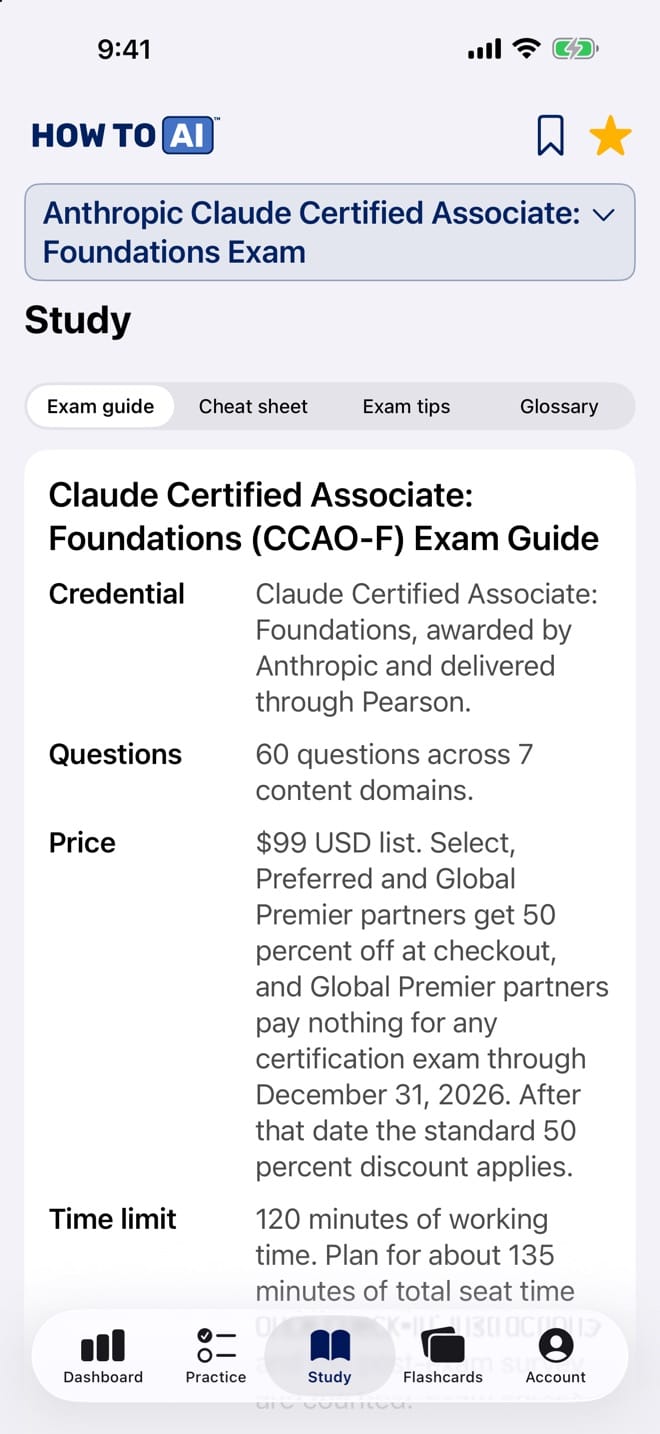
Take this guide with you
The same study guide, cheat sheet and glossary live in HOW TO // AI CERT on iPhone, next to 5,245 original practice questions, timed mock exams, flashcards and an AI tutor powered by Claude. Free to download, with a free question set for every exam.

Practice for every AI & cloud cert
- NVIDIA NCA-AIIO practice questions
- NVIDIA NCA-GENL practice questions
- AWS AIF-C01 practice questions
- AWS MLA-C02 practice questions
- AWS MLA-C01 practice questions
- Microsoft AI-901 practice questions
- Microsoft AI-103 practice questions
- VMware VCP-VCF Administrator practice questions
- CompTIA AI Fundamentals practice questions
- Google Cloud Generative AI Leader practice questions
- Oracle OCI AI Foundations practice questions
- CertNexus AIP-210 practice questions
- Anthropic CCDV-F practice questions
- Anthropic CCAR-F practice questions
- Anthropic CCAR-P practice questions
- All AI & cloud exam prep →