
Claude Architect Study Guide & Cheat Sheet (CCAR-F)
A free study guide for Anthropic’s Claude Certified Architect: Foundations exam. Exam facts, the full domain breakdown with official weights, the six scenarios, and the five principles that separate a pass from a near miss. No sign-up needed.
Ready to practice? Take the free CCAR-F practice quiz →
How this guide was made. I have never seen the CCAR-F exam. I can’t, because Anthropic restricts registration to employees of partner companies with 10 or more staff, and I don’t qualify. Everything below comes from Anthropic’s published exam guide, which is free and public, and from named first-hand accounts. No exam recall. No dumps. Ever.
Exam facts
| Exam code | CCAR-F |
|---|---|
| Full name | Claude Certified Architect: Foundations |
| Price | $125 USD (50% off for Select and Preferred partners; free for Global Premier through December 31, 2026, then 50% off) |
| Questions | 60, multiple choice and multiple response |
| Time | 120 minutes (plan about 135 minutes of seat time) |
| Passing score | 720 on a scaled range of 100 to 1,000 |
| Delivery | Proctored, online through Pearson OnVUE or at a test center |
| Prerequisites | None |
| Validity | 12 months, then a free non-proctored renewal |
| Retakes | 14 days, then 30, then 90. Four attempts per rolling 12 months |
| Guide version | v1.0, July 2026 |
This is the original Claude certification. It launched in March 2026 alongside the Claude Partner Network and was the only one available for four months, which is why almost every community write-up you will find is about this exam.
Who it is for
Anthropic describes the ideal candidate as a solution architect who designs and implements production applications with Claude, typically with six or more months of practical experience building with the Claude API, the Agent SDK, Claude Code, and MCP.
Read that list carefully. This is a hands-on exam. You are expected to have configured a real repository, not just read about it.
The six scenarios
CCAR-F is built differently from the other three exams. Instead of standalone questions, it uses scenarios. Six exist, and four appear on any given exam form. You will not know which four until you sit down, so prepare for all six.
- Customer Support Resolution Agent
- Code Generation with Claude Code
- Multi-Agent Research System
- Developer Productivity with Claude
- Claude Code for Continuous Integration
- Structured Data Extraction
A useful exercise before exam day: sketch an architecture for each of the six from scratch. If you can do that, the scenario framing stops being a surprise.
The domain breakdown
These weights come straight from Anthropic’s exam guide. Use them as a study budget.
| Domain | Weight | Roughly |
|---|---|---|
| Agentic Architecture & Orchestration | 27% | ~16 questions |
| Claude Code Configuration & Workflows | 20% | ~12 questions |
| Prompt Engineering & Structured Output | 20% | ~12 questions |
| Tool Design & MCP Integration | 18% | ~11 questions |
| Context Management & Reliability | 15% | ~9 questions |
1. Agentic Architecture & Orchestration (27%)
The largest domain by a clear margin. You need to be comfortable with:
- Designing and implementing agentic loops for autonomous execution
- Orchestrating multi-agent systems with coordinator and subagent patterns
- Configuring subagent invocation, context passing, and spawning
- Multi-step workflows with enforcement and handoff patterns
- Applying Agent SDK hooks to intercept tool calls and normalize data
- Task decomposition for complex workflows
- Managing session state, resumption, and forking
Worth knowing: a subagent inherits its own system prompt, CLAUDE.md and git status, but not the parent’s message history. Only its final response returns to the parent, as a tool result. That is the whole reason subagents work as a context isolation mechanism.
2. Claude Code Configuration & Workflows (20%)
- Configuring CLAUDE.md files with the right hierarchy, scoping and modular organization
- Creating custom slash commands and skills
- Path-specific rules for conditional convention loading
- Knowing when to use plan mode versus direct execution
- Iterative refinement techniques
- Integrating Claude Code into CI/CD pipelines
Memorize these. The CLAUDE.md hierarchy runs user level at ~/.claude/CLAUDE.md, then project level at .claude/CLAUDE.md or a root CLAUDE.md. Keep files under about 200 lines. For headless CI, the flag is -p, as in claude -p "Analyze this pull request for security issues". Modular rules live in .claude/rules/*.md and a paths: frontmatter key scopes them to globs.
3. Prompt Engineering & Structured Output (20%)
- Designing prompts with explicit criteria to cut false positives
- Few-shot prompting for output consistency
- Enforcing structured output using tool use and JSON schemas
- Validation, retry and feedback loops for extraction quality
- Efficient batch processing strategies
- Multi-instance and multi-pass review architectures
Do not skip this one. A verified passer who scored 886 out of 1,000 overall got only 50% on this domain. It is 20% of the exam, and the trap is assuming that because you prompt every day you have it covered. The exam tests structured output enforcement, not conversational prompting. Anthropic’s own guide calls tool use with JSON schemas the most reliable approach for guaranteed schema-compliant output.
4. Tool Design & MCP Integration (18%)
- Designing tool interfaces with clear descriptions and boundaries
- Structured error responses for MCP tools, using the
isErrorflag - Distributing tools across agents and configuring tool choice
- Integrating MCP servers into Claude Code and agent workflows
- Selecting built-in tools: Read, Write, Edit, Bash, Grep, Glob
The highest-leverage field in tool design is the description. When tool selection is unreliable, the exam’s own sample answer says the best first move is expanding the tool descriptions with input formats, example queries, edge cases and boundaries. Ahead of adding few-shot examples. Ahead of a routing layer. Ahead of consolidating the tools into one.
5. Context Management & Reliability (15%)
- Preserving critical information across long interactions
- Escalation and ambiguity resolution patterns
- Error propagation across multi-agent systems
- Managing context in large codebase exploration
- Human review workflows and confidence calibration
- Preserving provenance and handling uncertainty in multi-source synthesis
The five principles that make it click
These come from a candidate who passed with 843 out of 1,000 after about 60 hours of study, and published them free. They are the best study artifact available for this exam, and they generalize across every scenario.
- Constrain, do not add. More tools, more agents, or a bigger context window is almost always the wrong answer.
- Prompts suggest. Systems enforce. If a rule must always hold, meaning money, compliance, or ordering, put it in code or a hook rather than asking the model nicely.
- Fix the earliest layer. Most wrong answers are reasonable fixes applied too late in the pipeline.
- Match the fix to the failure. Vague rule needs explicit criteria. Inconsistent output needs few-shot. Invalid JSON needs a schema. Valid but wrong needs semantic validation.
- Do not collapse states, and escalate on policy rather than vibes. A tool failing is not the same as finding nothing. Escalate on policy and workflow triggers, never on sentiment or model confidence.
The meta-lesson underneath all five: you are building a reliable system around a fallible model, so fine-tune it and tell it to be more careful are almost never correct.
One important calibration
The same passer added a follow-up worth holding onto. Correct answers, he said, usually felt reasonable, efficient and balanced, not too aggressive and not too conservative. Choosing the answer that looks most guaranteed is not always right.
So principle 1 and principle 2 apply to rules that must always hold. They are not a license to pick the most locked-down option on every question. If an answer bolts a heavyweight control onto a low-stakes failure, it is probably the distractor.
How to prepare
Start with the official exam guide PDF, which Anthropic links from its Partner Academy certification page. It contains the full blueprint plus 12 sample questions with answer rationales, more than any of the other three exams. Work all twelve and write out your reasoning for each.
Then build. Anthropic’s own prep advice for this exam is a list of verbs: build an agent with the Agent SDK, configure Claude Code for a real project, design and test MCP tools, build a structured data extraction pipeline, practice prompt engineering, study context management patterns, review escalation and human-in-the-loop patterns. This is not a reading exam.
One gap to close yourself. The courses Anthropic lists on its CCAR-F prep page do not cover Agent SDK orchestration, subagents, hooks or session forking in any depth. That is 27% of the exam. Fill it with the free Introduction to subagents course, the Agent SDK agent loop docs, and actually building one.
Free official courses worth your time: Claude Code in Action, Introduction to MCP, and Building with the Claude API.
Then work a day-by-day plan: How to pass CCAR-F in four weeks.
Put it into practice
Studying is step one. Practice questions are where it sticks. Start with free CCAR-F questions, then go Pro for the full bank, timed mocks, and an AI tutor.
Keep reading: CCAR-F vs CCAR-P: which is harder? · The CCDV-F developer guide · All four Claude exams explained
HOW TO // AI is not affiliated with or endorsed by Anthropic. CCAR-F, Claude Certified Architect, Claude and Claude Code are trademarks of Anthropic PBC; we reference them descriptively. All content is original and built from Anthropic’s published exam blueprint.
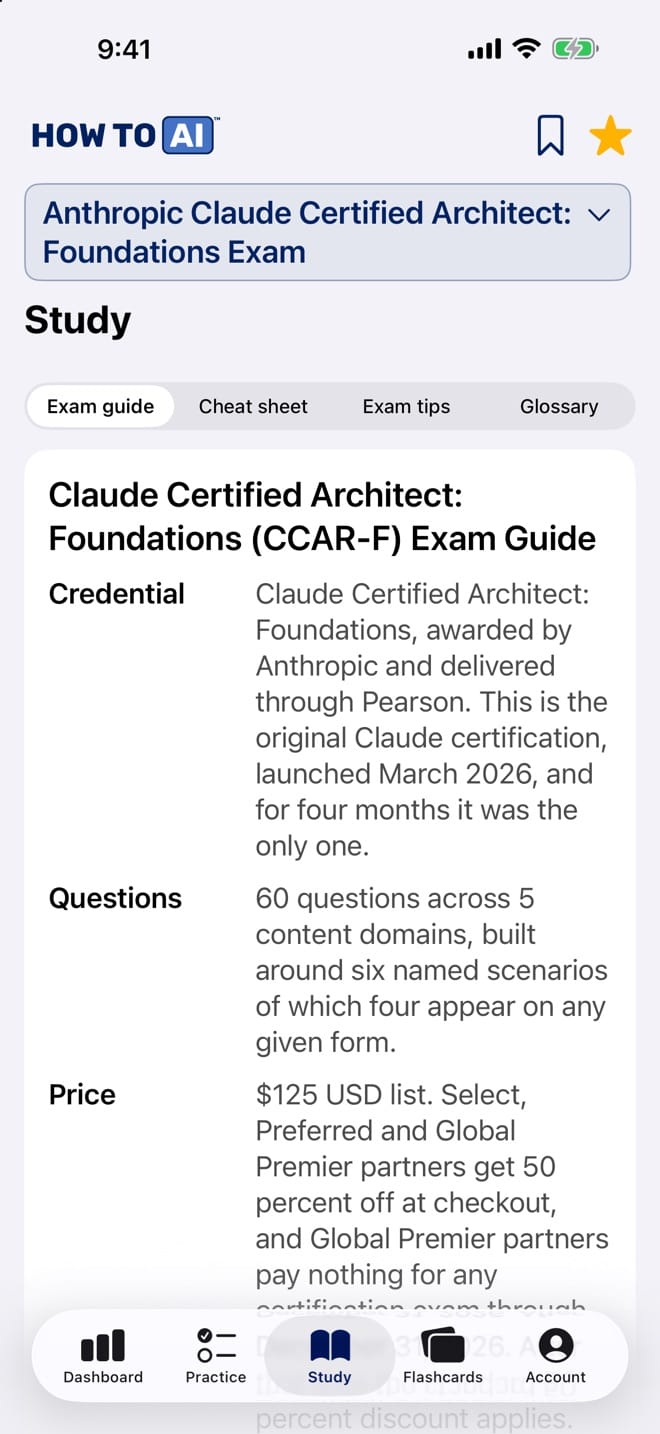
Take this guide with you
The same study guide, cheat sheet and glossary live in HOW TO // AI CERT on iPhone, next to 5,245 original practice questions, timed mock exams, flashcards and an AI tutor powered by Claude. Free to download, with a free question set for every exam.

Practice for every AI & cloud cert
- NVIDIA NCA-AIIO practice questions
- NVIDIA NCA-GENL practice questions
- AWS AIF-C01 practice questions
- AWS MLA-C02 practice questions
- AWS MLA-C01 practice questions
- Microsoft AI-901 practice questions
- Microsoft AI-103 practice questions
- VMware VCP-VCF Administrator practice questions
- CompTIA AI Fundamentals practice questions
- Google Cloud Generative AI Leader practice questions
- Oracle OCI AI Foundations practice questions
- CertNexus AIP-210 practice questions
- Anthropic CCAO-F practice questions
- Anthropic CCDV-F practice questions
- Anthropic CCAR-P practice questions
- All AI & cloud exam prep →