
HOW TO // AI — CERT · ANTHROPIC CCAR-P
Pass the Claude Certified Architect Professional Exam (CCAR-P)
315 original practice questions weighted to Anthropic’s official CCAR-P blueprint, with a plain-English explanation on every single one.
Start the free quiz, no signup →5 questions free right now · 15 more with your email · full bank from $12/mo
Claude AI Tutor included with Pro. Miss a question and it explains exactly why, in plain English, until it clicks.
How these questions were made. I have never seen the CCAR-P exam. I can’t, because Anthropic restricts registration to employees of partner companies with 10 or more staff, and I don’t qualify. Every question here was written from Anthropic’s published exam blueprint, which is free and public, and each one cites the domain and weight it maps to. No exam recall. No dumps. Ever.
CCAR-P is Anthropic’s most advanced Claude exam, and the most expensive at $175. It has no prerequisite, so you can take it without holding Foundations. A verified passer describes it as noticeably easier than Foundations, because it trades technical depth for architecture judgment.
Practice questions are the fastest way to get ready. They show you how concepts get tested, surface your gaps, and make exam day feel familiar.
What is on the CCAR-P exam
| Exam | CCAR-P: Claude Certified Architect: Professional |
|---|---|
| Questions | 63, multiple choice and multiple response |
| Time | 120 minutes |
| Passing score | 720 on a scaled range of 100 to 1,000 |
| Price | $175 USD, 50% off for Select and Preferred partners, free for Global Premier through December 31, 2026 |
| Prerequisites | None |
| Validity | 12 months, then a free non-proctored renewal |
| Who can register | Partner company employees only |
Our question set is weighted to the official blueprint:
| Domain | Weight | What it covers |
|---|---|---|
| Integration | 19% | Capability bloat, authentication and authorization gaps, accuracy versus latency, observability at scale, RAG pipeline design, retrieval strategy. |
| Solution Design & Architecture | 17% | Business problems into Claude solutions, end-to-end architectures, workflow versus agentic versus augmented LLM patterns. |
| Evaluation, Testing & Optimization | 16% | Metrics across accuracy, latency, cost and safety. Eval datasets, A/B testing, diagnosing failures, observability. |
| Governance, Safety & Risk Management | 14% | Guardrails, failure modes, human-in-the-loop validation, GDPR and HIPAA and FedRAMP, bias and transparency. |
| Stakeholder Communication & Lifecycle | 14% | Discovery, communicating trade-offs, expectation and SLA alignment, documentation, lifecycle support. |
| Claude Models, Prompting & Context Engineering | 13% | Model selection trade-offs, system prompts, few-shot and chain-of-thought, context optimization, caching and Skills. |
| Developer Productivity & Operational Enablement | 7% | Configuring Claude tooling for teams, improving developer workflows, debugging support. |
Worth knowing. Governance and stakeholder work is 28% of this exam combined, and it is where engineers under-prepare. A verified passer said the technical tooling questions were the intuitive ones and that the governance and security trade-off scenarios were what actually needed study.
Take the free practice quiz
Start with 5 free questions, read the explanation after each, then unlock 15 more with your email. No account needed to begin.
FREE PRACTICE QUIZ
Try 5 free CCAR-P practice questions
Answer at your own pace. Every question shows the correct answer and a plain-English explanation — that's where the learning happens. Unlock 15 more questions free at the end.
Read the 5 free CCAR-P questions as text, with answers and explanations
A customer-facing assistant streams its answers token by token. After a release, end-to-end completion time is statistically unchanged, but users consistently report that the new version 'feels slower.' The team must add one latency metric to the service SLA.Which latency metric most directly captures what these users are experiencing?
- A. Time to first token (TTFT), measured from request submission to the first streamed token.
- B. Baseline latency for the complete response, averaged across all requests over the release window.
- C. Output tokens per minute (OTPM) consumed against the organization's rate limit for this model class.
- D. Average input tokens per request, tracked per endpoint.
Answer: A. With streaming, perceived responsiveness is governed by how quickly the first token appears, which is exactly what TTFT measures; a longer preamble, a bigger cached prefix miss, or added pre-screening can push TTFT out while leaving total time flat. B is the whole-response measure the team has already confirmed is unchanged, so it cannot explain the complaint. C is a throughput figure used for rate-limit accounting, not a user-perceived latency measure. D is an input-size measure that correlates loosely with latency but is not a latency metric at all.
An internal agent has a stated objective of 'responses in under four seconds.' Mean latency is 2.1 seconds and the team keeps lowering it, yet a steady stream of complaints continues from users who wait far longer.How should the latency objective be expressed so that it reflects the experience users are complaining about?
- A. Keep tracking mean latency and continue driving it down.
- B. Track total tokens generated per response as a proxy for how long each response took the model to produce.
- C. Express the objective as a percentile, such as p95 under four seconds, and track the tail explicitly.
- D. Express the objective as the maximum latency observed anywhere in the month.
Answer: C. Complaints come from the tail of the distribution, and a percentile objective is the standard way to make the tail a first-class, actionable target. A keeps optimizing the statistic that is already hiding the problem. B is a proxy that ignores queueing, retrieval, tool round trips, and time to first token. D is technically a tail measure but a single outlier failing the whole month makes it unactionable and encourages gaming rather than improvement.
An invoice-extraction pipeline emits fourteen fields per document. The only accuracy metric is whole-document exact match, currently at 61 percent. The team cannot tell where to spend its next sprint.Which change to the metric set best restores diagnostic value?
- A. Replace exact match with an LLM-graded one-to-five quality score for each document.
- B. Keep document-level exact match but sample far fewer documents so a human can review each one closely.
- C. Report per-field accuracy for all fourteen fields alongside the existing document-level pass rate.
- D. Replace exact match with a fuzzy string-similarity threshold applied to all fields concatenated together.
Answer: C. Decomposing a composite pass rate into per-field rates shows immediately which two or three fields are dragging the document score down, while keeping the document-level number as the business-facing metric. A swaps a deterministic, code-gradable signal for a noisier and more expensive one on a task where exact match works. B reduces volume and leans on human grading, both of which run against documented eval guidance. D concatenates the fields, which destroys exactly the per-field attribution the team needs.
A team proposes that its only safety control be a carefully written system prompt instructing the model to refuse prohibited requests.What is the principal weakness of that design?
- A. It is a single layer, where guidance calls for chained safeguards: input validation, screening, action gating, and monitoring.
- B. System prompts cannot contain safety instructions, which must instead be supplied through tool definitions and their descriptions.
- C. System prompt instructions are ignored entirely once tool use is enabled, so the policy never applies.
- D. A long system prompt raises cost, and cost is the primary safety concern for a high-volume design.
Answer: A. Prompt-level instruction is a legitimate layer and the documented guidance includes it, but it is one layer and it is the layer an adversarial input is specifically trying to talk past. The documented posture is chained safeguards in depth: validate input, screen it, gate sensitive actions, and monitor continuously. B and C are simply untrue. D confuses a cost consideration with a safety argument.
Monitoring shows a small number of accounts repeatedly submitting variations of the same prohibited request, probing for a phrasing that gets through.Which documented control addresses this pattern specifically?
- A. Raise the model's effort setting so it reasons more carefully about each request.
- B. Rewrite the system prompt after each incident to name the specific phrasing that was attempted and forbid that exact phrasing explicitly.
- C. Disable the assistant for all users until the pattern stops.
- D. Respond to repeat offenders by throttling or banning the accounts and informing them that their actions violate the usage policies.
Answer: D. Adjusting responses for repeat offenders, including throttling or banning them and telling them why, is a documented mitigation aimed precisely at systematic probing, which is an account-behavior problem rather than a per-message one. A does not change what the model is permitted to do. B is an endless game of catch-up against paraphrase and grows the prompt without bound. C punishes every legitimate user for the behavior of a few.
Want more? Finish the quiz above to unlock 15 more free questions, or open the full CCAR-P practice app.
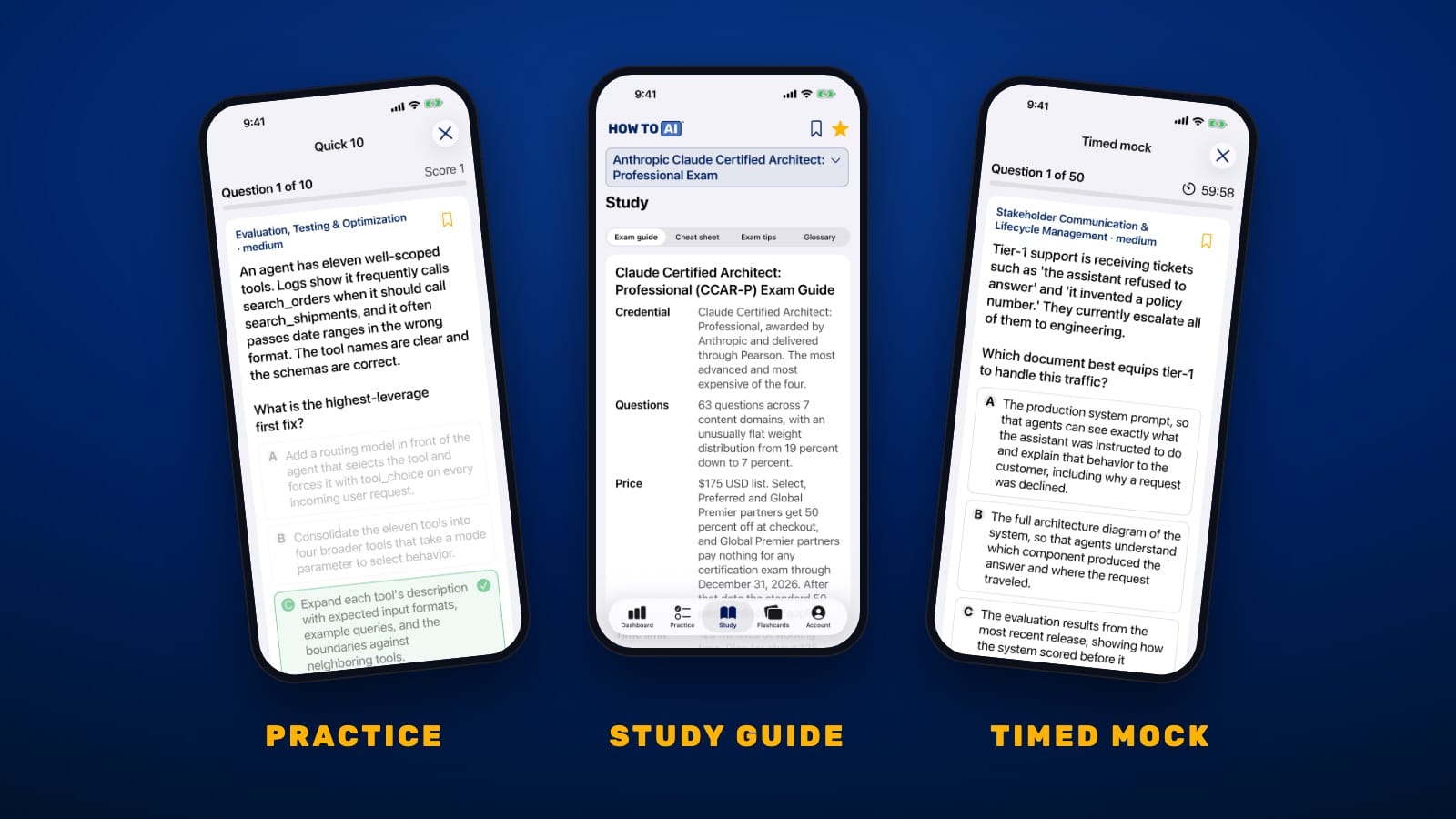
Study this exam on your phone
HOW TO // AI CERT has 5,245 original practice questions across 15 AI and cloud certifications, with plain-English explanations on every answer, full timed mock exams, weak-area drills, and an AI tutor powered by Claude. Free to download, with a free question set for every exam.

🤖 An AI Tutor on every question, powered by Claude
Stuck? Ask the AI Tutor. It explains the concept, shows why your pick was tempting but wrong, and answers follow-ups. Included with Pro.
🎓 Want the full question bank?
HOW TO // AI — CERT unlocks the complete CCAR-P bank, timed mock exams, flashcards, spaced-repetition review, and the AI tutor. Free to start, Pro from $12/month, and one subscription covers every cert.
Free CCAR-P study guide & cheat sheet
Prefer to study first? The free CCAR-P study guide has the full exam breakdown, every domain with its official weight, and a topic cheat sheet. No sign-up.
How to prepare
Read Anthropic’s official CCAR-P exam guide PDF first, since it carries the complete blueprint plus sample questions with answer rationales. Take a practice set above, then focus your studying on the domains where you missed questions. The free courses at academy.claude.com cover the Claude API, Claude Code, MCP and agent skills at no cost.
Not sure this is the right exam for you? Compare all four: Claude certification explained. Weighing the two architect exams? CCAR-F vs CCAR-P.
HOW TO // AI is not affiliated with or endorsed by Anthropic. CCAR-P, Claude Certified Architect: Professional, Claude and Claude Code are trademarks of Anthropic PBC; we reference them descriptively. All questions are original and written from Anthropic’s published exam blueprint.
Practice for every AI & cloud cert
- NVIDIA NCA-AIIO practice questions
- NVIDIA NCA-GENL practice questions
- AWS AIF-C01 practice questions
- AWS MLA-C02 practice questions
- AWS MLA-C01 practice questions
- Microsoft AI-901 practice questions
- Microsoft AI-103 practice questions
- VMware VCP-VCF Administrator practice questions
- CompTIA AI Fundamentals practice questions
- Google Cloud Generative AI Leader practice questions
- Oracle OCI AI Foundations practice questions
- CertNexus AIP-210 practice questions
- Anthropic CCAO-F practice questions
- Anthropic CCDV-F practice questions
- Anthropic CCAR-F practice questions
- All AI & cloud exam prep →
Frequently asked questions
Who can take the CCAR-P exam?
Anthropic makes its Claude certification exams available to members of the Claude Partner Network, so in practice you need to work at a partner company to register. Anyone can still use these practice questions to learn the material.
How is the CCAR-P exam delivered?
Every Claude certification exam is proctored and delivered through Pearson Professional Assessments, and you verify your identity before the exam starts. Check the details in the Claude Partner Network portal when you book.
Are these real CCAR-P exam questions?
No. They are original questions written by HOW TO // AI to match the published exam topics, each with a plain-English explanation. Real exam questions are confidential, and we don't use leaked "dump" material.
Is HOW TO // AI affiliated with Anthropic?
No. HOW TO // AI is independent and is not affiliated with or endorsed by Anthropic. Claude and the certification names are Anthropic's trademarks, referenced descriptively.
Can I try CCAR-P practice questions for free?
Yes. The quiz on this page gives you 5 free CCAR-P questions with explanations, no sign-up needed, and you can unlock 15 more free by adding your email at the end. The full question bank, timed mock exams and an AI tutor are in the HOW TO // AI — CERT app.