
HOW TO // AI — CERT · ANTHROPIC CCAR-F
Pass the Claude Certified Architect Foundations Exam (CCAR-F)
315 original practice questions weighted to Anthropic’s official CCAR-F blueprint, with a plain-English explanation on every single one.
Start the free quiz, no signup →5 questions free right now · 15 more with your email · full bank from $12/mo
Claude AI Tutor included with Pro. Miss a question and it explains exactly why, in plain English, until it clicks.
How these questions were made. I have never seen the CCAR-F exam. I can’t, because Anthropic restricts registration to employees of partner companies with 10 or more staff, and I don’t qualify. Every question here was written from Anthropic’s published exam blueprint, which is free and public, and each one cites the domain and weight it maps to. No exam recall. No dumps. Ever.
CCAR-F is the original Claude certification. It launched in March 2026 alongside the Claude Partner Network and was the only one available for four months, so almost every community write-up you will find is about this exam. It is scenario-based: you get a broken agentic system and four plausible fixes, and you pick the one a good architect would actually choose.
Practice questions are the fastest way to get ready. They show you how concepts get tested, surface your gaps, and make exam day feel familiar.
What is on the CCAR-F exam
| Exam | CCAR-F: Claude Certified Architect: Foundations |
|---|---|
| Questions | 60, multiple choice and multiple response |
| Time | 120 minutes |
| Passing score | 720 on a scaled range of 100 to 1,000 |
| Price | $125 USD, 50% off for Select and Preferred partners, free for Global Premier through December 31, 2026 |
| Prerequisites | None |
| Validity | 12 months, then a free non-proctored renewal |
| Who can register | Partner company employees only |
Our question set is weighted to the official blueprint:
| Domain | Weight | What it covers |
|---|---|---|
| Agentic Architecture & Orchestration | 27% | Agentic loops, coordinator and subagent patterns, Agent SDK hooks, session state, resumption and forking. |
| Claude Code Configuration & Workflows | 20% | CLAUDE.md hierarchy and scoping, custom skills, path-specific rules, plan mode, CI/CD integration. |
| Prompt Engineering & Structured Output | 20% | Explicit criteria, few-shot, enforcing schemas through tool use, validation and retry loops, batch strategies. |
| Tool Design & MCP Integration | 18% | Tool interfaces and descriptions, structured errors with isError, tool choice, MCP servers, built-in tools. |
| Context Management & Reliability | 15% | Long-interaction context, escalation patterns, error propagation, large codebase exploration, human review. |
Worth knowing. One domain trips people up more than any other. A candidate who scored 886 overall got only 50% on Prompt Engineering and Structured Output. It is 20% of the exam, and it tests structured output enforcement rather than conversational prompting.
Take the free practice quiz
Start with 5 free questions, read the explanation after each, then unlock 15 more with your email. No account needed to begin.
FREE PRACTICE QUIZ
Try 5 free CCAR-F practice questions
Answer at your own pace. Every question shows the correct answer and a plain-English explanation — that's where the learning happens. Unlock 15 more questions free at the end.
Read the 5 free CCAR-F questions as text, with answers and explanations
A support engineering team is building an autonomous ticket-triage agent on the Claude Agent SDK. Their logs show the agent calling Read, Grep, and a custom CRM lookup repeatedly, but the developers cannot articulate what actually ends a run. They want to instrument the end of each run so they can record cost and outcome.In the Agent SDK's agent loop, which condition causes the loop to terminate and a ResultMessage to be emitted under normal completion?
- A. Claude produces a response that contains no tool call requests
- B. The configured max_turns value is reached
- C. Every tool listed in allowed_tools has been invoked at least once
- D. The response carries stop_reason set to tool_use
Answer: A. The loop is: receive prompt, evaluate and respond, execute tools, repeat. It ends when Claude returns output containing no tool calls, at which point the SDK yields the final AssistantMessage followed by a ResultMessage. B describes a limit that terminates the run abnormally with the error_max_turns subtype, not normal completion. C is invented; the agent calls only the tools it needs. D is backwards: stop_reason tool_use means Claude wants a tool result and the loop must continue.
During an architecture review, a product manager asks the architect to explain what the team's dashboards mean when they report that a run took 'nine turns'. The dashboard is fed from the SDK's message stream.Which description of a turn in the agent loop is accurate?
- A. One user prompt and the single assistant reply it produces, regardless of tool activity
- B. One round trip: Claude emits tool calls, the SDK runs them, results feed back
- C. One HTTP request to the Messages API, including any streaming events it emits
- D. One complete session from the init SystemMessage through to the ResultMessage
Answer: B. A turn is one round trip through the loop: Claude emits tool calls, the SDK runs them, and the results return to Claude automatically without yielding control to your code. A describes a single conversational exchange, which can span many turns. C conflates a turn with an API call; a turn can involve several tool executions and the loop continues without new user input. D describes a whole session, which normally contains many turns.
A small startup wants an agent that can execute code and browse files, but has no platform team, no container orchestration, and no appetite for operating sandboxes. They want to call an HTTP endpoint and get agent behavior back.Which option matches this constraint?
- A. Managed Agents, where Anthropic hosts both the agent and the sandbox
- B. The Claude Agent SDK deployed on their own container platform
- C. The Claude Code CLI run headlessly on a developer laptop as a scheduled job
- D. The client SDK with a hand-written loop calling a self-hosted execution environment
Answer: A. Managed Agents is the hosted REST option where Anthropic operates the agent loop and the sandbox, which is precisely the requirement. B still requires the team to run and scale the process. C puts production workload on an unmanaged laptop with no availability story. D is the most operational work of all, since they must build both the loop and the execution environment.
Developer Productivity with ClaudeA developer wants Claude Code to follow their personal commit-message style in every repository they work in on their own laptop, without adding anything to any project's version control. Where should that instruction live?
- A. In `~/.claude/CLAUDE.md`
- B. In a root `CLAUDE.md` committed to each repository they work in
- C. In a `memory` key inside `.claude/settings.local.json`
- D. In a managed policy `CLAUDE.md` installed by the organization's device management
Answer: A. A is correct: the user-level memory file at `~/.claude/CLAUDE.md` loads in every session on that machine and lives outside any repository, which is exactly the stated requirement. B fails because a root `CLAUDE.md` is checked into version control and imposes one person's preference on the whole team, and it would have to be repeated per repository. C fails because `settings.json` files carry configuration keys such as permissions and hooks; memory instructions are not a settings key. D fails on scope and ownership: managed policy memory is administrator-controlled, applies to everyone on the fleet, and is not something an individual developer installs for a personal preference.
A developer needs to record their personal sandbox URL and a few local-only paths for one project, without those details reaching teammates through version control. Which file is intended for this?
- A. `.claude/settings.json` at the project root
- B. `~/.claude/CLAUDE.md` in the developer's home directory
- C. A rule file at `.claude/rules/local.md`
- D. `CLAUDE.local.md` at the project root, gitignored
Answer: D. D is correct: `CLAUDE.local.md` exists for private, per-project preferences, loads alongside the project memory file, and is meant to be gitignored. A fails because the shared project settings file is checked in and is configuration, not memory. B fails on scope: a user-level memory file applies to every project on the machine, so project-specific sandbox details would leak into unrelated work. C fails because `.claude/rules/` is normally committed and shared with the team, which is the opposite of the requirement.
Want more? Finish the quiz above to unlock 15 more free questions, or open the full CCAR-F practice app.
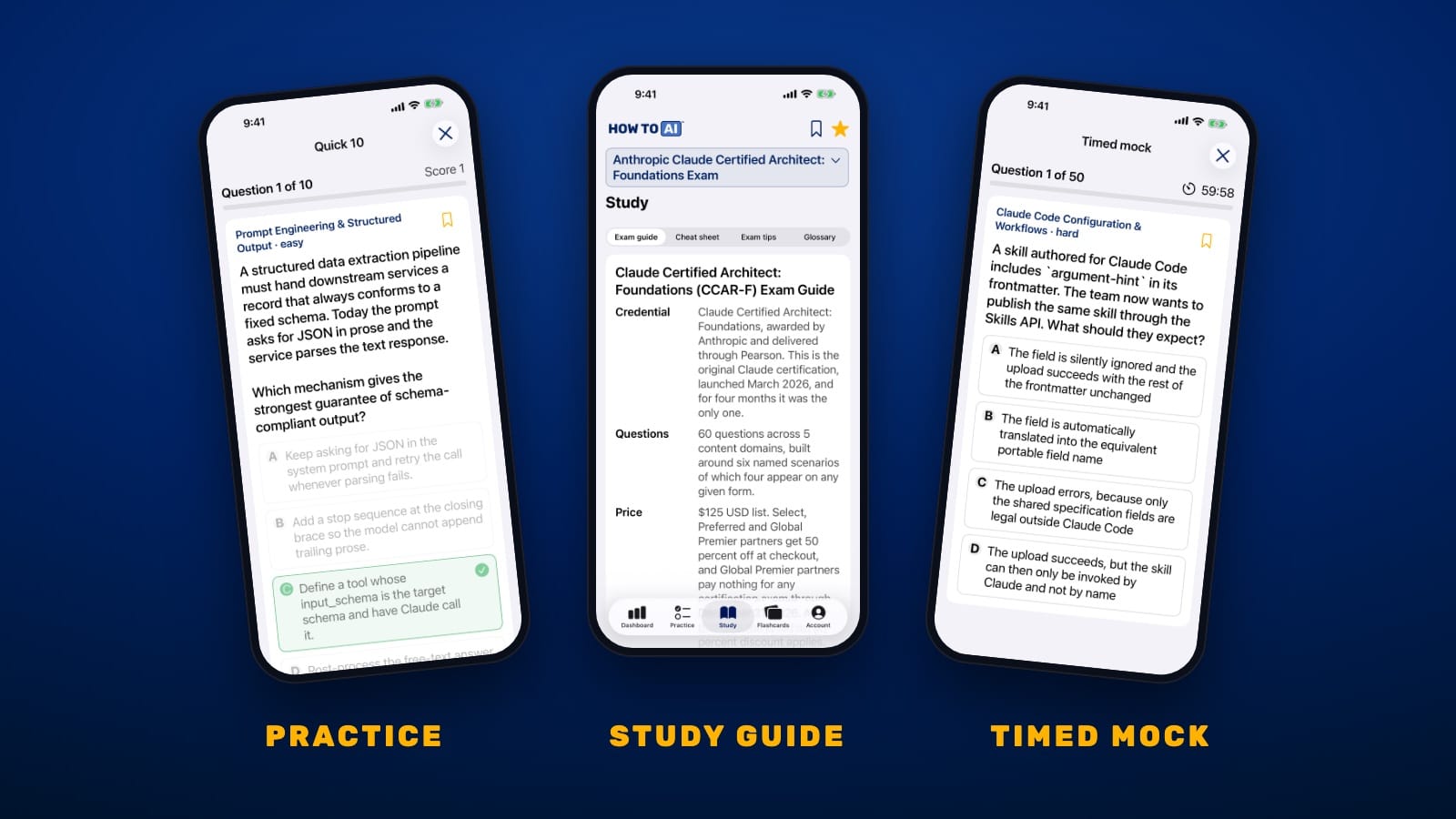
Study this exam on your phone
HOW TO // AI CERT has 5,245 original practice questions across 15 AI and cloud certifications, with plain-English explanations on every answer, full timed mock exams, weak-area drills, and an AI tutor powered by Claude. Free to download, with a free question set for every exam.

🤖 An AI Tutor on every question, powered by Claude
Stuck? Ask the AI Tutor. It explains the concept, shows why your pick was tempting but wrong, and answers follow-ups. Included with Pro.
🎓 Want the full question bank?
HOW TO // AI — CERT unlocks the complete CCAR-F bank, timed mock exams, flashcards, spaced-repetition review, and the AI tutor. Free to start, Pro from $12/month, and one subscription covers every cert.
Free CCAR-F study guide & cheat sheet
Prefer to study first? The free CCAR-F study guide has the full exam breakdown, every domain with its official weight, and a topic cheat sheet. No sign-up.
How to prepare
Read Anthropic’s official CCAR-F exam guide PDF first, since it carries the complete blueprint plus sample questions with answer rationales. Take a practice set above, then focus your studying on the domains where you missed questions. The free courses at academy.claude.com cover the Claude API, Claude Code, MCP and agent skills at no cost.
Not sure this is the right exam for you? Compare all four: Claude certification explained. Weighing the two architect exams? CCAR-F vs CCAR-P.
HOW TO // AI is not affiliated with or endorsed by Anthropic. CCAR-F, Claude Certified Architect: Foundations, Claude and Claude Code are trademarks of Anthropic PBC; we reference them descriptively. All questions are original and written from Anthropic’s published exam blueprint.
Practice for every AI & cloud cert
- NVIDIA NCA-AIIO practice questions
- NVIDIA NCA-GENL practice questions
- AWS AIF-C01 practice questions
- AWS MLA-C02 practice questions
- AWS MLA-C01 practice questions
- Microsoft AI-901 practice questions
- Microsoft AI-103 practice questions
- VMware VCP-VCF Administrator practice questions
- CompTIA AI Fundamentals practice questions
- Google Cloud Generative AI Leader practice questions
- Oracle OCI AI Foundations practice questions
- CertNexus AIP-210 practice questions
- Anthropic CCAO-F practice questions
- Anthropic CCDV-F practice questions
- Anthropic CCAR-P practice questions
- All AI & cloud exam prep →
Frequently asked questions
Who can take the CCAR-F exam?
Anthropic makes its Claude certification exams available to members of the Claude Partner Network, so in practice you need to work at a partner company to register. Anyone can still use these practice questions to learn the material.
How is the CCAR-F exam delivered?
Every Claude certification exam is proctored and delivered through Pearson Professional Assessments, and you verify your identity before the exam starts. Check the details in the Claude Partner Network portal when you book.
Are these real CCAR-F exam questions?
No. They are original questions written by HOW TO // AI to match the published exam topics, each with a plain-English explanation. Real exam questions are confidential, and we don't use leaked "dump" material.
Is HOW TO // AI affiliated with Anthropic?
No. HOW TO // AI is independent and is not affiliated with or endorsed by Anthropic. Claude and the certification names are Anthropic's trademarks, referenced descriptively.
Can I try CCAR-F practice questions for free?
Yes. The quiz on this page gives you 5 free CCAR-F questions with explanations, no sign-up needed, and you can unlock 15 more free by adding your email at the end. The full question bank, timed mock exams and an AI tutor are in the HOW TO // AI — CERT app.