
Sooner or later, several people on your team will ask the same question in the same month: “Which AI certification should I get?” If you’re like most IT managers I talk with, you’ll give each of them a slightly different answer, or approve whatever they ask for. A year later you’ll have a handful of certificates scattered across the team and no real AI certification coverage for the IT team as a whole.
That’s the difference between an individual choosing a cert and a manager planning one. If you’re an individual IT pro deciding for yourself, the best AI certification for IT pros and sysadmins is the better read. This post is for the person who has to decide which certifications the team needs, in what order, and who gets them first.
What certifications do, and don’t do, for AI readiness
Certifications aren’t the same as skill. Someone can pass an exam and still struggle to use AI well on real work, which is why structured hands-on training comes first, as covered in from “everyone has tried ChatGPT” to a trained team.
What certifications add is structure and an outside benchmark. They give people a defined body of knowledge to work through, a deadline, and a credential that leadership and customers recognize. For a readiness score, they’re also evidence: proof that key roles have a verified baseline, not just enthusiasm.
Here’s how the assessment asks the question, and the 0 to 4 ladder I score it against:
K2. How many of your IT staff hold current cloud or AI certifications?
- None
- A few cloud certifications; no AI-related ones
- Several cloud certifications; one or two AI-related
- AI-related certifications held by people in key roles (cloud, security, data)
- Certification paths are funded, tracked, and tied to role expectations
Notice what level 3 asks for: not a count of certificates, but coverage of the roles that matter. Two well-placed certifications beat ten random ones. And level 4 is about the system, not the certificates: funded, tracked, and connected to what each role is expected to know.
A decision rule for picking certifications
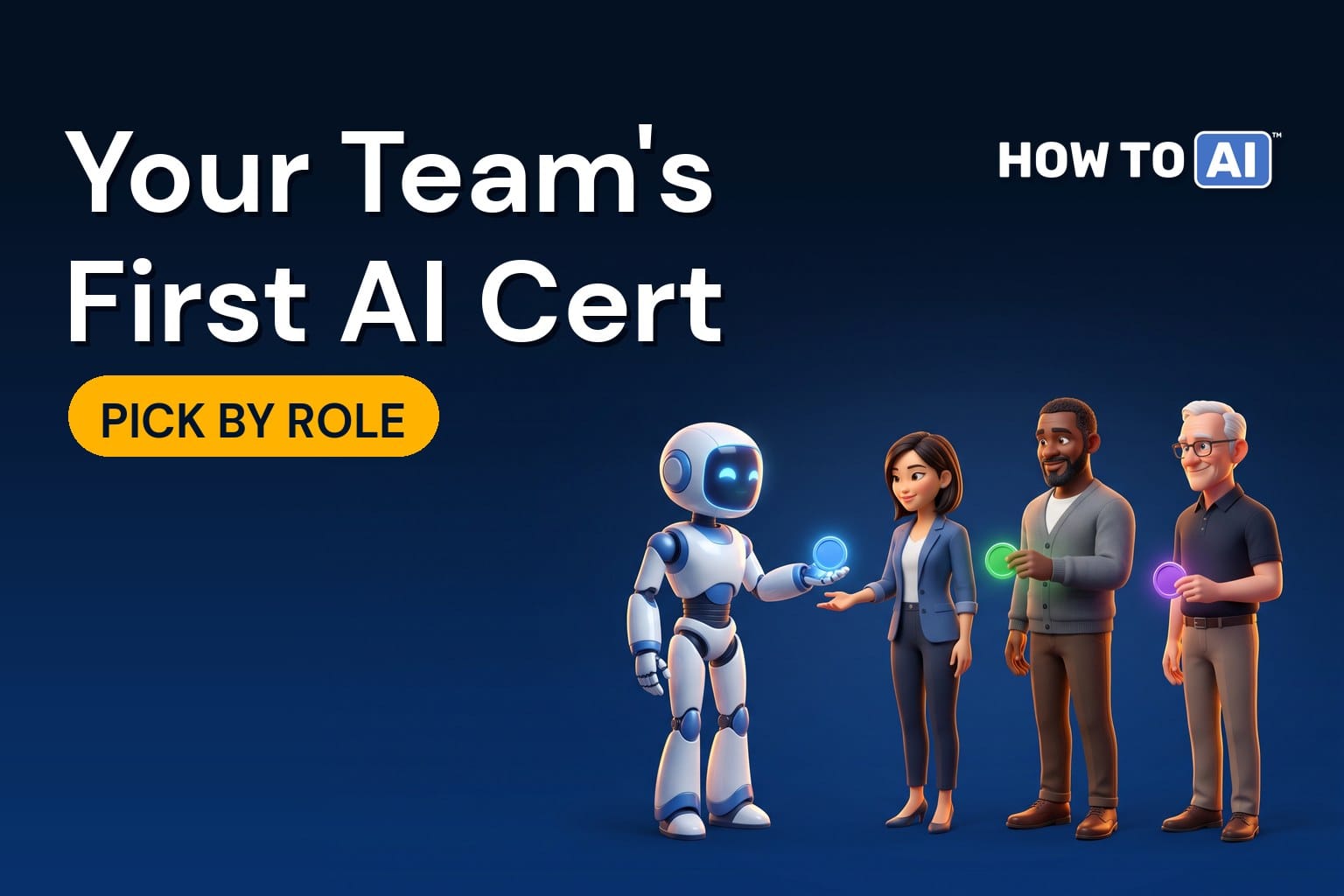
Here’s the rule I give teams: certify by role, on the platform you actually run. A Microsoft-centric organization gets more value from Microsoft AI certifications than from another vendor’s, however well regarded. Vendor-neutral certifications have a place, but they come after coverage on your own platform.
Then apply two limits. Fundamentals certifications for many people; associate-level certifications for the few who will build. And one certification per person at a time, tied to a real project where possible, so the knowledge gets used while it’s fresh.
Matching certifications to roles
These are the pairings I suggest most often. The cert names change as vendors update their programs, so treat this as a starting point and check the current details on the vendor’s own pages, or in our ranked guide to which AI certification to get.
- IT leads, architects, and anyone who advises the business: a fundamentals certification on your main platform, such as AWS AI Practitioner, Azure AI Fundamentals, or Google Cloud Generative AI Leader. These cover what AI can and can’t do, responsible AI, and the platform’s AI services. If you’re deciding between the first two, AWS AI Practitioner vs. Azure AI Fundamentals compares them directly.
- Cloud and infrastructure engineers who will build: an associate-level AI or machine learning engineering certification on your platform, such as the AWS Machine Learning Engineer Associate. It’s a serious commitment; is the AWS ML Engineer Associate worth it covers whether it fits.
- Security: an AI-focused security certification such as CompTIA SecAI+, alongside a fundamentals cert on your platform so they understand the services they’re securing.
- Data roles: a platform certification for your data stack, such as the Databricks Generative AI Engineer Associate if that’s where your data lives.
- Project and program managers: a leader-level or management certification, such as Google Cloud Generative AI Leader or PMI-CPMAI, depending on your environment.
Vendor-neutral options such as NVIDIA’s NCA-GENL or CertNexus CAIP are useful for people who work across platforms or want a deeper grounding in concepts. They’re a good second certification, rarely the right first one for a team.
The asset: a team certification matrix
Build this as a simple table in a shared spreadsheet. One row per role, not per person:
- Role: for example, “Cloud engineer.”
- Target certification: the one certification this role should hold first.
- Why: one sentence tying it to a real need, such as “we’re building our first automation on Bedrock next quarter.”
- Priority: 1, 2, or 3.
- Person or people: who in the role will pursue it.
- Target quarter: when they’ll sit the exam.
- Funded: exam fee, study materials, and study time approved, yes or no.
- Status: not started, studying, scheduled, passed.
- Renewal date: many AI certifications expire; track it here.
Then sequence it. A pattern that works for many mid-size teams:
- First quarter: a fundamentals certification for the IT lead and the security lead. They’re the people the business asks first.
- Second quarter: an associate-level certification for the one or two people who will build. Pair it with an actual build project.
- Third quarter: fundamentals for the rest of the people who advise the business, plus the security-specific certification.
- Fourth quarter: review the matrix, note what changed in your plans, and set next year’s targets.
After a year you’ll have AI-related certifications in your key roles, which is level 3, and a tracked, funded plan, which is most of level 4.
Funding and tracking: what level 4 actually requires
Level 4 needs three things: a budget line for certifications, protected study time, and a link between each certification and role expectations. That last one is the part most teams skip. If a cloud engineer is expected to hold a specific certification within their first year in the role, write it into the role description. It turns certification from a perk into a plan. The budget side of this is covered in the case for a standing AI training budget.
Track renewals as carefully as you track the certifications themselves. Renewal rules vary widely by vendor; do AI certifications expire? covers the rules, and the free AI certification renewal tracker can hold the dates.
If you’d rather give the whole team structured exam practice in one place, that’s what HOW TO // AI CERT for Teams is built for.
Mistakes I see at this stage
Certifications as rewards. Approving a certification because someone asked, or as a thank-you, produces a collection instead of coverage. Tie every approval to the matrix.
Everyone takes the same fundamentals exam. It feels fair and efficient. It leaves your builders without depth and your security team without anything specific to their job.
Certifying on a platform you don’t run. A popular certification on the wrong platform teaches concepts your team can’t apply at work.
No study time. Expecting people to study on evenings and weekends works for a few motivated people and fails for the rest.
Ignoring the gap between passing and doing. Pair every associate-level certification with a real project within the same quarter, or the knowledge fades before it’s used.
Where does your team actually stand?
Certification coverage is one of 24 questions in the AI Readiness assessment, which covers six dimensions: data, security, infrastructure, skills, use cases, and governance. The free version is 10 questions and gives you a score in a few minutes.
Get your free AI Readiness Score →
Want to see what the full assessment covers first? Flip through a complete 38-page sample report.
Related guides
- From “Everyone Has Tried ChatGPT” to a Trained Team
- The Case for a Standing AI Training Budget
- The 6-Dimension AI Readiness Framework, Explained
- The AI Readiness Checklist: 24 Questions to Answer Before Spending a Dollar
- The AI Readiness Assessment for IT Teams: What It Covers and Why Scores Beat Opinions
Frequently asked questions
Which AI certification should an IT team get first?
Certify by role, on the platform you actually run. A fundamentals certification for leads, architects, and anyone who advises the business; an associate-level AI or machine learning certification for the one or two people who will build; and an AI security certification for security staff.
Do certifications prove AI skill?
Not on their own. Passing an exam isn't the same as using AI well on real work. What certifications add is structure, a deadline, and an outside benchmark, which is why they work best paired with hands-on training and a real project in the same quarter.
What is a team certification matrix?
A table with one row per role listing the target certification, why it matters, priority, who will pursue it, target quarter, whether it's funded, status, and renewal date. It turns certification from individual requests into a plan.
Do AI certifications expire?
Many do, and renewal rules vary widely by vendor. Record renewal dates in your certification matrix, and check each vendor's current renewal policy on its own site rather than relying on second-hand summaries.