
HOW TO // AI CERT · MICROSOFT AI-103
AI-103 Practice Questions: Free Practice Test With Explanations
300 original practice questions weighted to the official AI-103 skills outline, with a plain-English explanation on every single one.
Start the free quiz, no signup →5 questions free right now · 15 more with your email · full bank from $12/mo
Claude AI Tutor included with Pro: miss a question and it explains exactly why, in plain English, until it clicks.
Yes, you can take an AI-103 practice test free. The quiz below gives you 5 original AI-103 practice questions with explanations and no sign-up, and 15 more unlock with your email. Microsoft also offers a free official practice assessment. This page covers both, compares every AI-103 practice exam option (including why dumps and “free download” PDFs are a bad bet), and adds the exam at a glance, the five domains, a cheat sheet built from Microsoft’s published skills outline, and how to use sample questions so they actually raise your score.
AI-103 (Developing AI Apps and Agents on Azure) leads to the Microsoft Certified: Azure AI Apps and Agents Developer Associate credential. It is built for developers who use Python and Microsoft Foundry to ship generative AI apps and agents, and it replaced AI-102, which Microsoft retired on June 30, 2026.
AI-103 at a glance
| Exam | AI-103: Developing AI Apps and Agents on Azure |
|---|---|
| Credential | Microsoft Certified: Azure AI Apps and Agents Developer Associate |
| Level | Associate (Microsoft labels it Intermediate) |
| Price | $165 US (priced by country; tax not included) |
| Exam time | 120 minutes |
| Questions | Not published for AI-103; Microsoft says most of its exams have 40–60 |
| Passing score | 700 out of 1,000 |
| Delivery | Pearson VUE, online or at a test center |
| Coding | Experience developing apps with Python |
| Microsoft Learn during the exam | Allowed in a split screen; no extra time, and the timer keeps running |
| Retakes | 24 hours after a first failed attempt; later waits vary |
| Renewal | Valid one year, then a free online renewal assessment on Microsoft Learn |
| Skills measured as of | April 16, 2026 |
| Free official practice | Practice assessment on AI Skills Navigator (sign-in required) |
Checked against Microsoft Learn’s AI-103 certification page, AI-103 study guide and exam duration page on October 8, 2026.
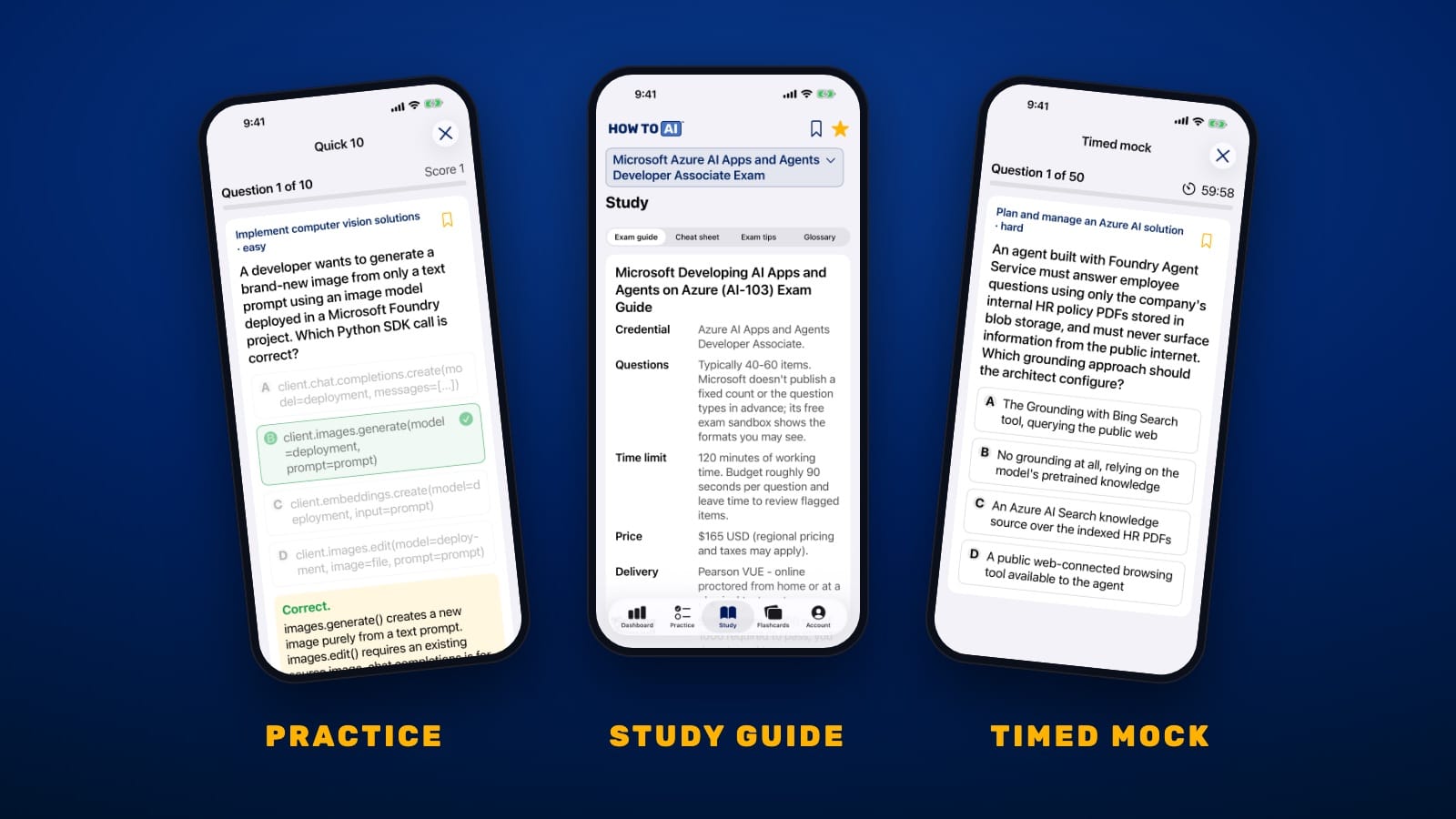
Study this exam on your phone
HOW TO // AI CERT has 5,245 original practice questions across 15 AI and cloud certifications, with plain-English explanations on every answer, full timed mock exams, weak-area drills, and an AI tutor powered by Claude. Free to download, with a free question set for every exam.

AI-103 exam domains
Our question set is weighted to Microsoft’s published skills outline:
| Domain | Weight | What it covers |
|---|---|---|
| Plan and manage an Azure AI solution | 25–30% | Choosing models and Foundry services, setting up deployments and CI/CD, managing quotas and cost, monitoring, security, and responsible AI controls. |
| Implement generative AI and agentic solutions | 30–35% | The heaviest domain: generative apps with RAG and evaluation, single and multi-agent solutions with tools and memory, and tuning and observability. |
| Implement computer vision solutions | 10–15% | Image and video generation and editing, multimodal understanding (captions, visual Q&A, alt text), Content Understanding for images and video, and safety for visual content. |
| Implement text analysis solutions | 10–15% | Entities, summaries and structured JSON from text, sentiment and sensitive content, translation, and speech for agents. |
| Implement information extraction solutions | 10–15% | Retrieval and grounding pipelines (indexing, semantic, hybrid and vector search, OCR) and document extraction with Content Understanding. |
Take the free practice quiz
Start with 5 free questions and read the explanation after each, then unlock 15 more with your email. No account needed to begin.
FREE PRACTICE QUIZ
Try 5 free AI-103 practice questions
Answer at your own pace. Every question shows the correct answer and a plain-English explanation — that's where the learning happens. Unlock 15 more questions free at the end.
Read the 5 free AI-103 questions as text, with answers and explanations
A retail company wants to deploy an assistant on point-of-sale tablets with limited compute and intermittent connectivity, used only for simple intent classification of customer questions. Which type of model from the Foundry model catalog is the best fit?
- A. A frontier large language model such as a flagship general-purpose chat model
- B. An embedding-only model
- C. A text-to-speech model
- D. A small language model (SLM) such as a Phi-family model
Answer: D. SLMs are optimized for low-latency, resource-constrained, and edge/offline-tolerant scenarios like simple classification. A frontier LLM is tempting because it is more capable, but it needs far more compute and connectivity than the device can reliably offer. A speech model and an embedding-only model cannot perform intent classification with text generation/labeling on their own.
A construction company wants a single Foundry model deployment that accepts a photo of a job-site defect plus a text prompt and returns a written defect description. Which model capability must the chosen deployment support?
- A. Text-only completion, with no image input at all
- B. Vector embedding generation, and nothing else
- C. Text-to-speech synthesis of the description
- D. Vision-language (multimodal) input with text output
Answer: D. The scenario requires accepting both an image and text and producing text, which requires a multimodal (vision-language) model. Text-only completion cannot process the image input; text-to-speech and embedding-only models do not generate descriptive natural-language output from images.
A legal firm needs to extract structured metadata (case number, parties, filing date) and a natural-language summary from scanned contracts, combining OCR, classification, and generative summarization in a single pipeline. Which Foundry service is purpose-built for this?
- A. An Azure AI Search indexer with no skillset
- B. The Foundry code interpreter tool
- C. Azure Content Understanding
- D. Azure Language key phrase extraction alone
Answer: C. Content Understanding is designed to analyze multimodal content (documents, images, audio, video) and produce both structured field extraction and generative summaries in one pipeline. A plain Search indexer only indexes existing fields, key phrase extraction alone does not perform OCR or structured extraction from scans, and the code interpreter executes code rather than analyzing documents.
A developer building a RAG chatbot over product manuals finds that pure keyword search misses paraphrased questions, while pure vector search sometimes returns semantically close but factually wrong passages when exact model numbers matter. Which Azure AI Search query configuration best balances both concerns?
- A. Vector-only similarity search over the chunks
- B. Keyword-only (BM25) search over the chunks
- C. Fuzzy full-text matching used on its own
- D. Hybrid search combined with semantic ranking
Answer: D. Hybrid search combines keyword and vector matching, and semantic ranking reorders results for relevance, addressing both paraphrase recall and exact-term precision. Keyword-only search misses paraphrases, vector-only search can miss exact identifiers, and fuzzy full-text search does not address semantic paraphrasing at all.
You need to make a foundation model from the Microsoft Foundry model catalog callable from your Python application. What is the correct sequence of actions?
- A. Download the model weights locally and load them with a custom inference script
- B. Deploy the model to create a live endpoint, then call it using the endpoint and key/credential from your code
- C. Use the model catalog page's web address as the inference endpoint in your Python code, with no deployment step
- D. Fine-tune the model before it can be called by any application
Answer: B. Catalog models are deployed to a hosted or serverless endpoint, and the app then authenticates and sends requests to that endpoint. That is the standard path (the instant access preview, which calls supported models by name without a deployment, is the exception). Downloading weights (A) and treating the catalog's web page as an endpoint (C) are not how catalog models are consumed, and fine-tuning (D) is optional, not a prerequisite.
Want more? Finish the quiz above to unlock 15 more free questions, or open the full AI-103 practice app.
🤖 An AI Tutor on every question, powered by Claude
Stuck? Ask the AI Tutor. It explains the concept, shows why your pick was tempting but wrong, and answers follow-ups. Included with Pro.
🎓 Want the full question bank?
HOW TO // AI CERT unlocks the complete AI-103 bank, timed mock exams, flashcards, spaced-repetition review, and the AI tutor. Free to start, Pro from $12/month (one subscription covers every cert).
How to use AI-103 practice questions
- Take a cold set first. Do a round before you study to find your weak domains, not to get a score.
- Read every explanation, including on questions you got right. A lucky guess is still a gap.
- Map each miss to a domain. Planning and managing (25–30%) plus generative AI and agents (30–35%) add up to more than half the exam, so gaps there cost the most.
- Fix misses hands-on. Many AI-103 objectives ask you to implement, configure, build or integrate something. Reproduce the scenario in Microsoft Foundry instead of rereading notes.
- Practice against the clock. You get 120 minutes. Microsoft Learn is open during the exam, but the timer doesn’t stop while you search, so use it for the odd lookup, not every question.
- Finish with Microsoft’s official practice assessment once you’re passing our timed mocks consistently.
Microsoft’s free official AI-103 practice assessment
Microsoft hosts a free AI-103 practice assessment on AI Skills Navigator; you have to sign in to launch it. Microsoft says its practice assessment questions show the style, wording and difficulty you can expect but are not the questions on the exam. You can also try the question formats in Microsoft’s exam sandbox, since Microsoft doesn’t publish question types in advance. Use both alongside our questions: more original questions from different writers means fewer blind spots.
AI-103 practice test options compared
People search for an AI-103 practice exam, a question bank, sample questions and even “dumps free download”. Here is what each option really gives you:
| Option | Cost | What you get | Use it for |
|---|---|---|---|
| Free quiz on this page | Free: 5 questions with no sign-up, 15 more with your email | Original questions weighted to Microsoft’s skills outline, with an explanation on every answer | A first check of your weak domains |
| HOW TO // AI CERT full bank | Pro from $12 a month or $39 a year, one subscription for every exam we cover | The complete AI-103 question bank, timed mock exams, flashcards and the AI tutor | Daily practice and full timed mocks |
| Microsoft’s practice assessment | Free, sign-in required on AI Skills Navigator | Microsoft’s own practice questions in the style, wording and difficulty of the exam (not the exam’s questions) | A final check before you book |
| Microsoft’s exam sandbox | Free | The exam interface and question types, with no AI-103 content | Getting used to the format |
| Dumps and “free download” PDFs | Free or paid, and risky either way | Claimed real exam questions, often wrong; using braindump material is misconduct under Microsoft’s exam candidate agreement | Nothing. Skip them. |
A good order: our free set cold, then the full bank and timed mocks, then Microsoft’s practice assessment as the last check. Microsoft doesn’t publish a question count for AI-103, so practice your pacing across the full 120 minutes rather than toward a fixed number of questions.
Why not AI-103 dumps?
“Dumps” claim to be real exam questions. Microsoft’s exam candidate agreement lists using braindump material as misconduct, and Microsoft can invalidate your results or bar you from its exams, without refunding fees. Dumps are also often wrong, and memorized answers don’t help when a question is worded differently. Original questions with explanations teach the reasoning the exam tests. More on this in AI-103 dumps: why you don’t need them.
Looking for AZ-103 practice tests?
AZ-103 is a different, older exam. It was Microsoft’s Azure Administrator exam, and Microsoft replaced it with AZ-104 when AZ-103 retired on August 31, 2020. AI-103, the exam on this page, is the current Azure AI apps and agents developer exam. We don’t have AZ-104 practice questions; start with Microsoft’s Azure Administrator Associate page. For the AI exams we do cover, see our free AI exam prep hub.
AI-103 cheat sheet
Summarized from Microsoft’s published AI-103 skills outline (skills measured as of April 16, 2026). These are the published objectives in plain English, not exam questions. The full version with a glossary is in the AI-103 study guide.
Plan and manage an Azure AI solution (25–30%)
- Choose: the right model per task (large, small, multimodal, or a Foundry Tool), the Foundry service for generation, grounding, vector search, agent workflows or multimodal work, the retrieval and indexing method, and memory, tool and knowledge services for agents.
- Set up: Azure infrastructure for AI apps and agents, deployment options, model and agent deployment settings, and CI/CD for Foundry projects.
- Run: quotas, scaling, rate limits and cost; monitoring for performance, drift, safety events, grounding quality and search index health.
- Secure: managed identity, private networking, keyless credentials and role policies.
- Responsible AI: safety filters, guardrails and content moderation; evaluators and safety evaluations; trace logging, provenance metadata and approval workflows; oversight modes and tool-access controls for agents.
Implement generative AI and agentic solutions (30–35%)
- Generative apps: deploy and call large, small, code and multimodal models; implement RAG; design multistep and tool-augmented flows; evaluate for fabrications, relevance, quality and safety; connect apps to a Foundry project with the SDKs.
- Agents: define roles, goals, conversation tracking and tool schemas; combine retrieval, function calling and memory; add tools such as APIs, search and custom functions; orchestrate multiple agents; add approval controls; monitor and run error analysis.
- Optimize: prompt engineering and model parameters; reflection and self-critique loops; tracing, token analytics, safety signals and latency breakdowns; mixing models, flows and rules engines.
Computer vision, text and information extraction (10–15% each)
- Vision: generate images and videos from prompts and reference media; inpainting and mask-based edits; captions, visual Q&A and alt text; Content Understanding for visual and video analysis, including single-task and pro-mode pipelines; filter unsafe images and catch prompt injection hidden in image text.
- Text and speech: entities, topics, summaries and structured JSON output; sentiment, tone and sensitive content; translation with Azure Translator or LLM flows; speech to text and text to speech for agents, custom speech, and speech translation.
- Information extraction: ingest and index documents, images, audio and video; semantic, hybrid and vector search; enrichment skills and OCR in RAG ingestion; Content Understanding analyzers that output structured data or markdown for agents.
How to prepare
Read the official credential page on Microsoft Learn, take a practice set above, then focus on the domains where you missed questions. For a day-by-day schedule, follow how to pass AI-103 in 3 weeks, and check what AI-103 costs before you book. Microsoft recommends registering with a personal Microsoft account, because exam records tied to a work or school account can be lost if you leave. New to Azure AI? Consider Azure AI Fundamentals (AI-901) first; see AI-901 vs AI-103. Coming from the retired exam? Read AI-102 vs AI-103. Still deciding? Is AI-103 worth it? Comparing at the practitioner level, the vendor-neutral CertNexus CAIP (AIP-210) is the other hands-on AI cert worth a look.
HOW TO // AI is not affiliated with or endorsed by Microsoft. AI-103, Azure AI Apps and Agents Developer Associate, and Azure are certifications and trademarks of Microsoft Corporation; we reference them descriptively. All questions are original.
Practice for every AI & cloud cert
- NVIDIA NCA-AIIO practice questions
- NVIDIA NCA-GENL practice questions
- AWS AIF-C01 practice questions
- AWS MLA-C02 practice questions
- AWS MLA-C01 practice questions
- Microsoft AI-901 practice questions
- VMware VCP-VCF Administrator practice questions
- CompTIA AI Fundamentals practice questions
- Google Cloud Generative AI Leader practice questions
- Oracle OCI AI Foundations practice questions
- CertNexus AIP-210 practice questions
- Anthropic CCAO-F practice questions
- Anthropic CCDV-F practice questions
- Anthropic CCAR-F practice questions
- Anthropic CCAR-P practice questions
- All AI & cloud exam prep →
Frequently asked questions
Where can I find a free AI-103 practice test?
The quiz on this page gives you 5 free AI-103 practice questions with explanations and no sign-up, and you can unlock 15 more with your email. Microsoft also offers a free official AI-103 practice assessment on AI Skills Navigator, which needs a sign-in.
Are these real AI-103 exam questions?
No. Every question here is original, written from Microsoft's published AI-103 skills outline. Real exam questions are confidential under Microsoft's exam agreement, and practice questions are meant to teach the reasoning, not preview the exam.
Should I use AI-103 dumps or a free dumps download?
No. Microsoft's exam candidate agreement lists using braindump material as misconduct, and Microsoft can invalidate results or bar you from exams without a refund. Dumps are often wrong anyway, while original questions with explanations teach the skills the exam measures.
How many questions are on AI-103, and what score do I need?
Microsoft doesn't publish a question count for AI-103; it says most of its exams have 40 to 60 questions. You get 120 minutes, need 700 out of 1,000 to pass, and the exam costs $165 in the US, with prices set by country and excluding tax.
Is there an AI-103 cheat sheet?
Yes. This page has a short AI-103 cheat sheet summarizing every domain of Microsoft's published skills outline (skills measured as of April 16, 2026). The free AI-103 study guide has the longer version and a glossary.
Can I use Microsoft Learn during the AI-103 exam?
Yes. AI-103 is an associate exam, so you can open Microsoft Learn in a split screen. No extra time is added and the timer keeps running, and Q&A, practice assessments and your profile are blocked.
Did AI-103 replace AI-102?
Yes. Microsoft retired AI-102 (Azure AI Engineer Associate) on June 30, 2026 and named AI-103 (Azure AI Apps and Agents Developer Associate) as its replacement.
Is AI-103 the same as AZ-103?
No. AZ-103 was Microsoft's Azure Administrator exam, retired on August 31, 2020 and replaced by AZ-104. AI-103 is the current exam for the Azure AI Apps and Agents Developer Associate certification.
How does AI-103 renewal work?
AI-103 is an associate certification, so it is valid for one year. You renew it for free by passing an online renewal assessment on Microsoft Learn, without retaking the paid exam. Microsoft offers renewal once a certification has been available for more than six months.