
CCDV-F Study Guide & Cheat Sheet (Claude Certified Developer: Foundations)
CCDV-F is Anthropic’s Claude Certified Developer: Foundations exam: 53 questions in 120 minutes, a scaled passing score of 720 and a $125 fee, open to Claude Partner Network employees. This free CCDV-F study guide covers all eight domains with Anthropic’s published weights down to the sub-skill, where to get the official exam guide PDF, the free courses worth taking and a cheat sheet of API numbers. No sign-up needed.
Ready to practice? Take the free CCDV-F practice quiz →
How this guide was made. HOW TO // AI has never seen the CCDV-F exam: registration is limited to employees of Claude Partner Network companies. Everything below comes from Anthropic’s published CCDV-F exam guide and Claude API documentation, which are free and public. No exam recall. No dumps. Ever.
CCDV-F exam at a glance
| Exam | Claude Certified Developer: Foundations (CCDV-F) |
|---|---|
| Price | $125 USD. 50% off for Select, Preferred and Global Premier partners, and free for Global Premier through December 31, 2026 (cost details) |
| Questions | 53, multiple choice and multiple response (each item says how many answers to pick). The fewest of the four Claude exams |
| Time | 120 minutes (plan for about 135 minutes of seat time) |
| Passing score | 720 on a scaled range of 100 to 1,000 |
| Delivery | Pearson VUE, online proctored (OnVUE) or at a Pearson test center. Closed book, English only |
| Who can register | Claude Partner Network employees with a recognized company email, age 18 or older (details) |
| Prerequisites | None. Anthropic recommends 1 to 5 years of software engineering and 6+ months hands-on with Claude or similar LLMs |
| Validity | 12 months, then a free on-time renewal (how renewal works) |
| Counts toward partner tier | Yes |
| Official practice exam | Retired June 30, 2026. The exam guide includes 3 sample questions with answers |
| Exam guide version | Version 1.0, effective July 2026 |
Checked against Anthropic’s CCDV-F exam guide (Version 1.0), Partner Academy certification page and certification FAQ on October 8, 2026.
Fifty-three questions is worth noticing. Fewer questions means each one carries more weight, and there is less room to absorb a bad domain.
The official CCDV-F exam guide (PDF)
Anthropic publishes the Claude Certified Developer: Foundations exam guide as a free PDF. It is linked from the Claude certification page on Anthropic Partner Academy, and you don’t need to sign in to open it.
Read it before anything else. Anthropic calls it the authoritative reference for the exam, and it contains the intended audience, the full blueprint with every skill weight, Anthropic’s own preparation advice, 3 sample questions with rationales, how scoring works, and the retake and renewal rules. This page is a study companion to it, not a replacement.
Who it is for
Technical professionals who build, integrate and ship production-grade applications on Claude. AI and ML engineers, technical leads, senior software engineers.
Recommended background: one to five years of software engineering, at least six months hands-on with Claude or a comparable LLM system, proficiency in Python or TypeScript, fluency with REST APIs and CLI tools, and a working understanding of LLM fundamentals, agents, context management and MCP. The guide says it is not for non-technical users or for roles limited to prompt writing.
The domain breakdown
CCDV-F is the only Claude exam that publishes sub-skill weights, to one decimal place. Treat them as a literal budget.
| Domain | Weight | Roughly |
|---|---|---|
| Applications and Integration | 33.1% | ~18 questions |
| Model Selection and Optimization | 16.8% | ~9 questions |
| Agents and Workflows | 14.7% | ~8 questions |
| Prompt and Context Engineering | 11.0% | ~6 questions |
| Tools and MCPs | 10.6% | ~6 questions |
| Security and Safety | 8.1% | ~4 questions |
| Claude Code | 3.1% | ~2 questions |
| Eval, Testing and Debugging | 2.6% | ~1 question |
Question counts are our estimate from the weights; Anthropic says the percentages are approximate.
One third of this exam is a single domain. If you study nothing else, study Applications and Integration.
And note the other end. Claude Code and Eval together are about three questions. Do not spend a week on Claude Code for this exam. That is Architect: Foundations territory, where it is 20%.
Applications and Integration (33.1%), by sub-skill
| Sub-skill | Weight | Scope |
|---|---|---|
| Claude Application Design | 8.6% | How Claude interprets instructions across Claude Code, Desktop, claude.ai, the API and SDKs. Content boundaries, schema design, session hygiene, plugin management |
| Software Engineering Foundations | 7.4% | REST APIs, JSON, async programming, version control, SDLC integration, code review, refactoring |
| Claude API Mechanics | 6.8% | Messages, tools, streaming, vision, thinking, caching, calling Claude through third-party vendors, Messages API data access patterns, the batch API, and realtime versus batch trade-offs |
| Configuration Management | 4.1% | CLAUDE.md files, settings.json, model version pinning, prompt versioning, plugin dependencies |
| Understanding Requirements | 3.4% | Functional and infrastructure requirements from business requirements and solution architecture |
| Systems Life Cycle | 2.8% | Developing, implementing, operating and maintaining IT systems |
Two of the largest sub-skills, Application Design and Software Engineering Foundations, are broad engineering competence rather than Claude trivia. Together they outweigh the entire Agents and Workflows domain.
The other seven domains, with their sub-skill weights
Model Selection and Optimization (16.8%). LLM Fundamentals (5.2%): tokens, context windows, sampling, non-determinism, and model options including fast mode, extended thinking, adaptive thinking and effort levels. Technical Fundamentals (6.1%): integrating with SDKs that wrap REST APIs, and websockets. Model Selection and Tradeoffs (2.7%): Opus versus Sonnet versus Haiku use cases, quality, latency and cost trade-offs, and breaking changes across model releases. Cost and Token Management (2.8%): token tracking, cost modeling, prompt caching and cache check-pointing. Note that the plumbing sub-skill outweighs picking a model.
Agents and Workflows (14.7%). Agent Architecture (4.5%): when to use a workflow versus an agent, manager and supervisor hierarchies, subagents. Agent Construction with Claude (5.3%): the Claude Agent SDK, custom agent loops and harnesses, self-hosted versus Anthropic-hosted deployment, and hooks for deterministic actions. Agent Patterns and Frameworks (4.9%): tool-use loops, sub-agents, memory and context-window management, and frameworks such as Strands, LangGraph and PydanticAI.
Prompt and Context Engineering (11.0%). Prompt Engineering (4.6%): instruction clarity, few-shot examples, system versus user placement, output constraints, iterative refinement, input sanitization. Context Engineering (3.8%): context window management, preventing drift and bloat with tool output pruning and compaction, and isolating context through subagents. Output Handling (2.6%): structured output patterns, response validation, defensive parsing, and skepticism toward confident output.
Tools and MCPs (10.6%). Tool Implementation (4.4%): tool use and function calling, tool descriptions, error handling, client-side versus server-side tools, approval patterns. Agentic Customization (4.1%): the trade-offs among built-in tools, custom tools, Skills and MCPs. MCP Server Development (2.1%): authoring and deploying servers, MCP tools, resources and prompts, and transports such as stdio.
Security and Safety (8.1%). AI Application Security (3.2%): prompt injection, jailbreak defense, untrusted input, data leakage and PII. Guardrails and Safe Deployment (2.3%): guardrail layering, least privilege, secure-by-design. Identity, Secrets and Key Management (1.6%): secrets, credentials and API keys across environments. Claude Hooks (1.0%): using hooks as guardrails to prevent destructive actions.
Claude Code (3.1%). One sub-skill, Claude Code Operation: rules, skills, commands, agents and agent memory, session management, slash commands, headless and streaming modes, auto-mode, the CLAUDE.md hierarchy, repository initialization and settings.json. If those terms are new, our guide to how to use Claude Code covers the basics fast.
Eval, Testing and Debugging (2.6%). One sub-skill, Debugging and Error Handling: identifying error types, choosing a recovery strategy, trace analysis, and telling an integration-layer problem from a model-output problem.
Three patterns from Anthropic’s sample questions
The exam guide includes three sample questions, which Anthropic says are illustrative and not drawn from the live item bank. Each one illustrates a decision rule from the blueprint that is worth knowing cold.
- Large volume, not urgent, cost matters: use the Message Batches API. Batch usage is charged at 50% of standard API prices. A batch holds up to 100,000 requests or 256 MB, most finish within an hour, and results are available when all requests complete or after 24 hours. You are not billed for errored, canceled or expired requests.
- Untrusted fetched content: isolate it and gate actions. Treat retrieved content as untrusted input, keep it separate from trusted instructions, and put guardrails or hooks in front of sensitive actions. The wrong options in the sample rely on things that are not controls: a higher temperature, a polite line in the system prompt, a bigger model. This is indirect prompt injection, a different threat from a direct jailbreak.
- Several applications need the same capability: build an MCP server. Cross-application reuse, maintained independently of any one app, is the MCP trigger. A single app with a single purpose can use a plain tool definition.
Cheat sheet: API numbers worth knowing
These come from Anthropic’s Claude API documentation, checked October 8, 2026, not from the exam guide. The docs change, so check the current version before exam day.
- Stop reasons. Seven:
end_turn,max_tokens,stop_sequence,tool_use,pause_turn,refusalandmodel_context_window_exceeded. The ones needing a specific recovery:pause_turn, where a server-tool loop hit its iteration limit and you send the assistant content back to continue;refusal, where you readstop_detailsand can retry on a fallback model; andmodel_context_window_exceeded, which you treat as truncated. - Tool names must match
^[a-zA-Z0-9_-]{1,128}$. Older study material says 64 characters; the current docs say 128. - tool_choice has four options:
auto(the default when tools are provided),any,toolandnone(the default when no tools are provided).disable_parallel_tool_useis set inside thetool_choiceobject, not as a top-level parameter. Forced options (any,tool) aren’t supported on every model or with manual extended thinking;autoandnonealways work. - Prompt caching allows up to four cache breakpoints. The default lifetime is five minutes, refreshed each time the cache is used, with a one-hour option at extra cost. Five-minute cache writes cost 1.25 times base input, one-hour writes 2 times, and cache reads 0.1 times by default (some newer models price reads even lower).
- Minimum cacheable prompt length varies by model, and below it the request is processed without caching and no error is returned. You can tell because both
cache_creation_input_tokensandcache_read_input_tokenscome back as zero. - Batch API: 50% off, up to 100,000 requests or 256 MB per batch, results within 24 hours.
How to prepare for CCDV-F
Anthropic’s own advice is blunt and worth following: build and operate at least one Claude application that exercises the API, integrates one or more tools, applies prompt and context engineering, and includes simple security and evaluation practices. This exam rewards having shipped something.
Then allocate by the weights above. Spend a third of your remaining time on Applications and Integration, and skim the two smallest domains. The 4-week CCDV-F study plan turns that budget into a schedule, and the free CCDV-F practice questions show which domains need more time.
Free official study material:
- Building with the Claude API on Claude Academy: 67 lessons, about 9 hours, with a completion badge. The core resource for this exam.
- Introduction to Model Context Protocol: about 1 hour, covering MCP tools, resources and prompts.
- Claude Code in Action and Claude Code 101 on Claude Academy, for the 3.1% Claude Code domain.
- The tool use docs, prompt caching and batch processing pages in the Claude API documentation.
- For partners: the Developer: Foundations prep course on Anthropic Partner Academy, a free bundle of 5 courses.
Skip CCDV-F dumps
Every candidate accepts a non-disclosure agreement before the exam starts, and the exam guide says cheating or disclosing exam content can lead to an invalidated result, a revoked credential and a ban from future exams. Original practice questions written from the published guide prepare you without that risk. More on why you don’t need dumps.
Put it into practice
Free CCDV-F practice questions, weighted to the official blueprint, with a plain-English explanation on every one.
Keep reading: How to pass CCDV-F · The CCAR-F architect guide · All four Claude exams explained · What it costs · Is it worth it?
HOW TO // AI is not affiliated with or endorsed by Anthropic. CCDV-F, Claude Certified Developer and Claude are trademarks of Anthropic PBC; we reference them descriptively. All content is original and built from Anthropic’s published exam blueprint.
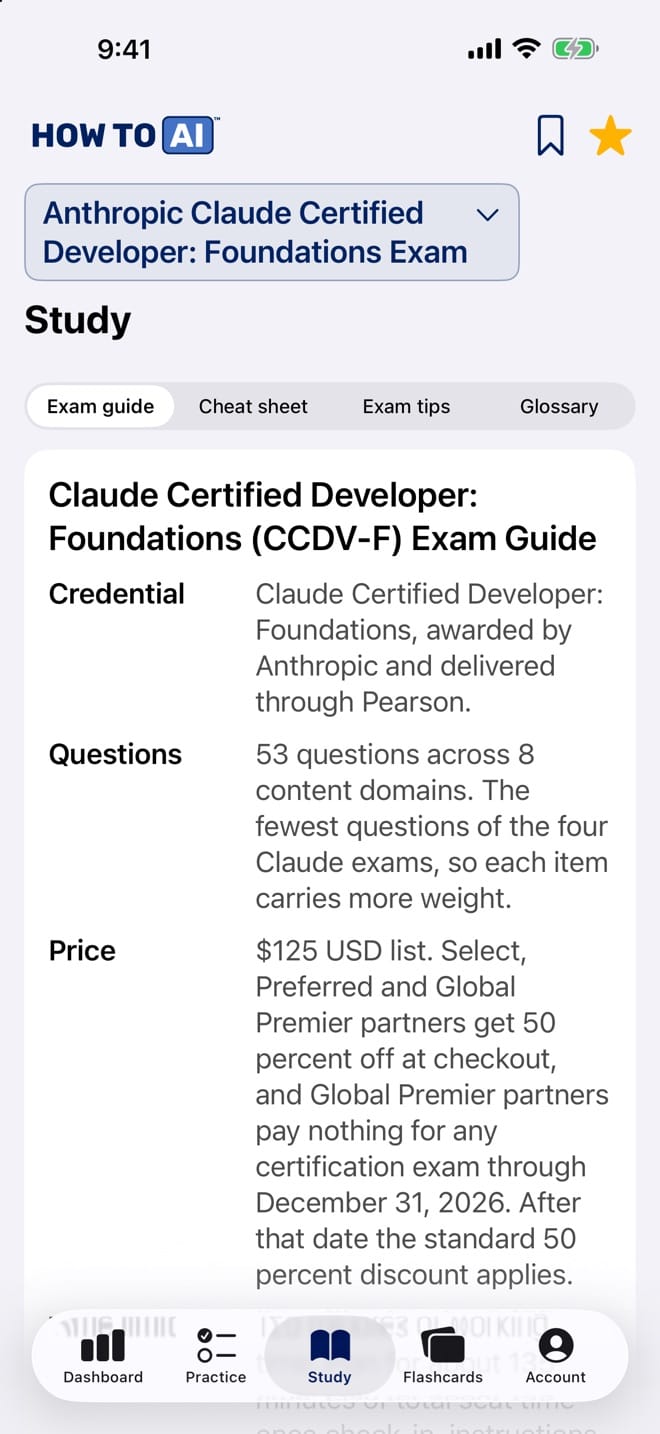
Take this guide with you
The same study guide, cheat sheet and glossary live in HOW TO // AI CERT on iPhone, next to 5,245 original practice questions, timed mock exams, flashcards and an AI tutor powered by Claude. Free to download, with a free question set for every exam.

Practice for every AI & cloud cert
- NVIDIA NCA-AIIO practice questions
- NVIDIA NCA-GENL practice questions
- AWS AIF-C01 practice questions
- AWS MLA-C02 practice questions
- AWS MLA-C01 practice questions
- Microsoft AI-901 practice questions
- Microsoft AI-103 practice questions
- VMware VCP-VCF Administrator practice questions
- CompTIA AI Fundamentals practice questions
- Google Cloud Generative AI Leader practice questions
- Oracle OCI AI Foundations practice questions
- CertNexus AIP-210 practice questions
- Anthropic CCAO-F practice questions
- Anthropic CCAR-F practice questions
- Anthropic CCAR-P practice questions
- All AI & cloud exam prep →
Frequently asked questions
What is the CCDV-F exam?
CCDV-F is the exam code for Claude Certified Developer: Foundations, Anthropic's certification for engineers who build, integrate and ship applications, agents and workflows on Claude. It covers eight domains, with Applications and Integration the largest at 33.1%.
How many questions are on the CCDV-F exam, and what is the passing score?
The CCDV-F exam has 53 multiple-choice and multiple-response items with a 120-minute time limit, the fewest questions of the four Claude exams. You need a scaled score of 720 on a range of 100 to 1,000 to pass.
How much does the CCDV-F exam cost?
CCDV-F costs $125 USD. Select, Preferred and Global Premier partners get 50% off at checkout, and Global Premier partners get 100% off through December 31, 2026. A retake costs the full fee again, with the same discount.
Where can I download the CCDV-F exam guide PDF?
Anthropic links the free Claude Certified Developer: Foundations exam guide PDF from the Claude certification page on Anthropic Partner Academy (anthropic-partners.skilljar.com). It includes the full blueprint with sub-skill weights and 3 sample questions with rationales.
Who can take the CCDV-F exam?
Only people at Claude Partner Network organizations can register, using a company email on a recognized domain, and you must be at least 18. There are no mandatory prerequisites, but Anthropic recommends 1 to 5 years of software engineering and 6+ months with Claude or similar LLMs.
How should I study for CCDV-F?
Read the official exam guide, build and operate at least one Claude application that uses the API and tools, and spend about a third of your time on Applications and Integration. Free courses such as Building with the Claude API on Claude Academy cover most of the blueprint.
Is there an official CCDV-F practice test?
Not anymore. Anthropic retired its practice exam when delivery moved to Pearson VUE on June 30, 2026, and the exam guide now includes 3 sample questions. HOW TO // AI offers free original CCDV-F practice questions written from that guide.
Are there CCDV-F dumps?
Avoid them. Candidates accept a non-disclosure agreement, and Anthropic's exam guide says cheating or disclosing exam content can lead to an invalidated result, a revoked credential and a ban from future exams.