
HOW TO // AI — CERT · NVIDIA NCA-AIIO
Pass the NVIDIA NCA-AIIO — the First Time
300 original practice questions weighted to the official NCA-AIIO blueprint, with a plain-English explanation on every single one.
Start the free quiz — no signup →10 free questions now · 10 more with your email · the full bank from $12 a month
Claude AI Tutor included with Pro — miss a question and it explains exactly why, in plain English, until it clicks.
The NCA-AIIO (NVIDIA-Certified Associate: AI Infrastructure and Operations) is NVIDIA’s entry-level certification for people who run, support, or sell AI infrastructure — data center technicians, DevOps and networking engineers, IT managers, sysadmins, and solution architects. The exam is 50 questions in 60 minutes, taken online with remote proctoring, and costs $125. It’s pass/fail (NVIDIA doesn’t report a score), and the credential is valid for two years.
Practice questions are the highest-leverage way to prepare: they show you how concepts get tested, expose the gaps you didn’t know you had, and make the real exam feel familiar. The free quiz below works like the real thing — multiple choice, one correct answer — and every question comes with an explanation of why the answer is right, which is where the actual studying happens.
How these questions were made. Every question here is original. HOW TO // AI writes them from NVIDIA’s public NCA-AIIO exam guide and maps each one to a domain in its blueprint. They are not real exam questions: real exam content is confidential for every candidate, and we never use exam recall or dumps.
What NVIDIA’s public exam guide covers
Everything in this section comes from NVIDIA’s public exam guide, not from the exam itself.
NVIDIA’s published exam blueprint has three domains. Our question set mirrors these weights, so your practice score roughly tracks how the real exam distributes its questions:
| Domain | Exam weight | What it covers |
|---|---|---|
| AI Infrastructure | 40% | GPU hardware and sizing, clusters, data center networking (InfiniBand, RoCE), power and cooling, DPUs, on-prem vs cloud |
| Essential AI Knowledge | 38% | AI vs ML vs DL, training vs inference, GPU vs CPU architecture, the NVIDIA software stack (CUDA, NGC, TensorRT, Triton), AI use cases |
| AI Operations | 22% | Cluster orchestration and job scheduling (Slurm, Kubernetes), GPU monitoring (DCGM), virtualization (MIG, vGPU) |
Take the free practice quiz
Start with 10 free questions — read the explanation after each — then unlock 10 more with your email. Twenty in all, weighted like the real blueprint.
FREE PRACTICE QUIZ
Try 10 free NCA-AIIO practice questions
Answer at your own pace. Every question shows the correct answer and a plain-English explanation, and that's where the learning happens. Unlock 10 more questions free at the end.
Read the 10 free NCA-AIIO questions as text, with answers and explanations
Why are GPUs generally preferred over CPUs for training deep learning models?
- A. GPUs run at considerably higher clock speeds than server CPUs do
- B. GPUs run operating systems far more efficiently than CPUs do
- C. GPUs have far more system memory available to them than the host CPUs have
- D. GPUs have thousands of cores running the same operation in parallel
Answer: D. Deep learning training is dominated by matrix and tensor operations that can be split across thousands of identical calculations. A GPU's massively parallel architecture executes these simultaneously, while a CPU's smaller number of complex cores is optimized for sequential, branching work: not raw parallel throughput. The other options are false: GPUs trade lower single-thread performance for much greater total throughput, so clock speed is not their advantage; the operating system runs on the host CPU; and GPU memory is usually smaller than host memory (a DGX H100 pairs 80 GB per GPU with 2 TB of system memory).
What is the primary purpose of NVLink in a multi-GPU server?
- A. To manage the GPUs' power delivery and their thermal limits
- B. To encrypt all traffic between the CPU and the system memory
- C. To connect the server directly to the external storage arrays in the rack
- D. To give GPUs a high-bandwidth direct link, much faster than PCIe
Answer: D. NVLink is NVIDIA's direct GPU-to-GPU interconnect. It lets GPUs in the same system exchange data at far higher bandwidth and lower latency than the PCIe bus allows, which matters when a model or its activations are spread across multiple GPUs. NVLink does not manage power or thermals, encrypt traffic between the CPU and system memory, or attach the server to external storage arrays.
A team is building a cluster where a single training job will run across dozens of GPU nodes. Which network characteristic matters most for the fabric connecting those nodes?
- A. Support for legacy 1 GbE management traffic between the nodes
- B. Wireless connectivity between the racks for flexible cabling
- C. Deep packet inspection carried out at the edge of the network
- D. High bandwidth with very low latency, via InfiniBand or RoCE
Answer: D. Distributed training synchronizes gradients between nodes many times per second, so the inter-node fabric must deliver very high bandwidth at very low latency. That is why AI clusters use InfiniBand or RDMA-capable Ethernet (RoCE) rather than ordinary TCP/IP networking.
What is the main role of a DPU (Data Processing Unit), such as NVIDIA BlueField, in an AI data center?
- A. To replace the GPUs entirely when running smaller training jobs
- B. To compile the CUDA code faster than the host CPU is able to
- C. To act as a backup power controller for the entire server rack
- D. To offload networking, storage, and security from the host CPU
Answer: D. A DPU is a programmable processor on the network card that takes over infrastructure workloads (software-defined networking, storage access, and security functions) freeing host CPU cycles for applications and providing isolation between infrastructure and tenant workloads.
A startup needs GPU capacity for a 3-week training experiment and has no existing data center. Which deployment approach best fits this situation?
- A. Purchase a multi-node GPU cluster for on-premises installation
- B. Wait for GPU prices to fall before starting the whole project
- C. Rent GPU instances from a cloud provider for the experiment
- D. Build a new colocation facility fitted with liquid cooling
Answer: C. Cloud infrastructure is elastic: you can provision GPU capacity in minutes, pay only for the weeks you use it, and release it afterward. Buying hardware makes more sense for sustained, predictable workloads where utilization stays high over years, not a short experiment.
Why are liquid-cooling solutions increasingly used for racks of modern AI servers?
- A. Liquid cooling is required before any of the GPUs will even boot
- B. Liquid cooling eliminates the need for electrical power distribution
- C. Dense GPU racks exceed the heat air cooling can remove effectively
- D. Air cooling interferes with the high-speed networking signalling
Answer: C. Modern GPU servers concentrate tens of kilowatts of power in a single rack: far beyond typical enterprise racks. At those densities, air cooling becomes inefficient or insufficient, so facilities turn to liquid cooling (direct-to-chip or rear-door heat exchangers) to remove heat reliably.
In a typical AI training cluster, what is the role of the login (head) node?
- A. It translates GPU instructions into CPU instructions for each job
- B. It stores all of the cluster's training datasets on its own local NVMe disks
- C. It is where users connect, prepare jobs, and submit them to the scheduler
- D. It runs all of the model training computation on behalf of the cluster's users
Answer: C. Login/head nodes are where users land: they hold development tools and the job scheduler interface. Actual training runs on GPU compute nodes; datasets live on shared storage. Keeping heavy work off the login node keeps the cluster responsive for everyone. No node translates GPU instructions into CPU instructions: device code runs on the GPUs themselves.
Which statement correctly describes the relationship between AI, machine learning (ML), and deep learning (DL)?
- A. ML is a subset of DL, which is in turn a subset of the much broader field of AI
- B. AI is a subset of ML, while DL is a separate field unrelated to both
- C. AI, ML, and DL are interchangeable names for the same technique
- D. DL is a subset of ML, which is itself a subset of the broader field of AI
Answer: D. AI is the broad field of making machines act intelligently. Machine learning is the subset where systems learn patterns from data instead of being explicitly programmed. Deep learning is a further subset of ML that uses many-layered neural networks.
Which statement best contrasts AI training with AI inference?
- A. Training requires no data; inference requires the full training dataset
- B. Training answers user requests in real time; inference builds the model
- C. Training happens on CPUs only, whereas inference happens on GPUs only
- D. Training is long-running and throughput-bound; inference is latency-bound
Answer: D. Training iterates over large datasets for hours to weeks to produce model weights: throughput is what matters. Inference applies the finished model to new inputs, where latency and cost-per-prediction usually drive the architecture. Both can use GPUs, but they are sized and optimized differently.
Which combination of factors is most credited with the rapid progress of AI over the last decade?
- A. Quantum computers replacing classical servers in data centers
- B. Cheaper hard drives, faster web browsers, and office software
- C. Massive datasets, affordable GPU compute, and better algorithms
- D. One single breakthrough algorithm that was discovered in 2020
Answer: C. Modern AI took off when three curves crossed: huge digitized datasets to learn from, GPU computing making large-scale parallel training affordable, and algorithmic advances (deep learning architectures) able to exploit both. No single factor explains it alone.
Want more? Finish the quiz above to unlock 10 more free questions, or open the full NCA-AIIO practice app.
After the free 20
Practice the full NCA-AIIO bank, timed like exam day
HOW TO // AI CERT has 300 original NCA-AIIO practice questions written from NVIDIA’s public exam guide. You also get timed mock exams, an AI tutor powered by Claude that explains every miss, and a readiness score that tells you when to book. Pro is $12 a month, or $39 for the whole year, and covers every exam we offer. Start with a free account. 14-day refund.
These are original practice questions, not real exam questions. No brain dumps, nothing copied from real exams.
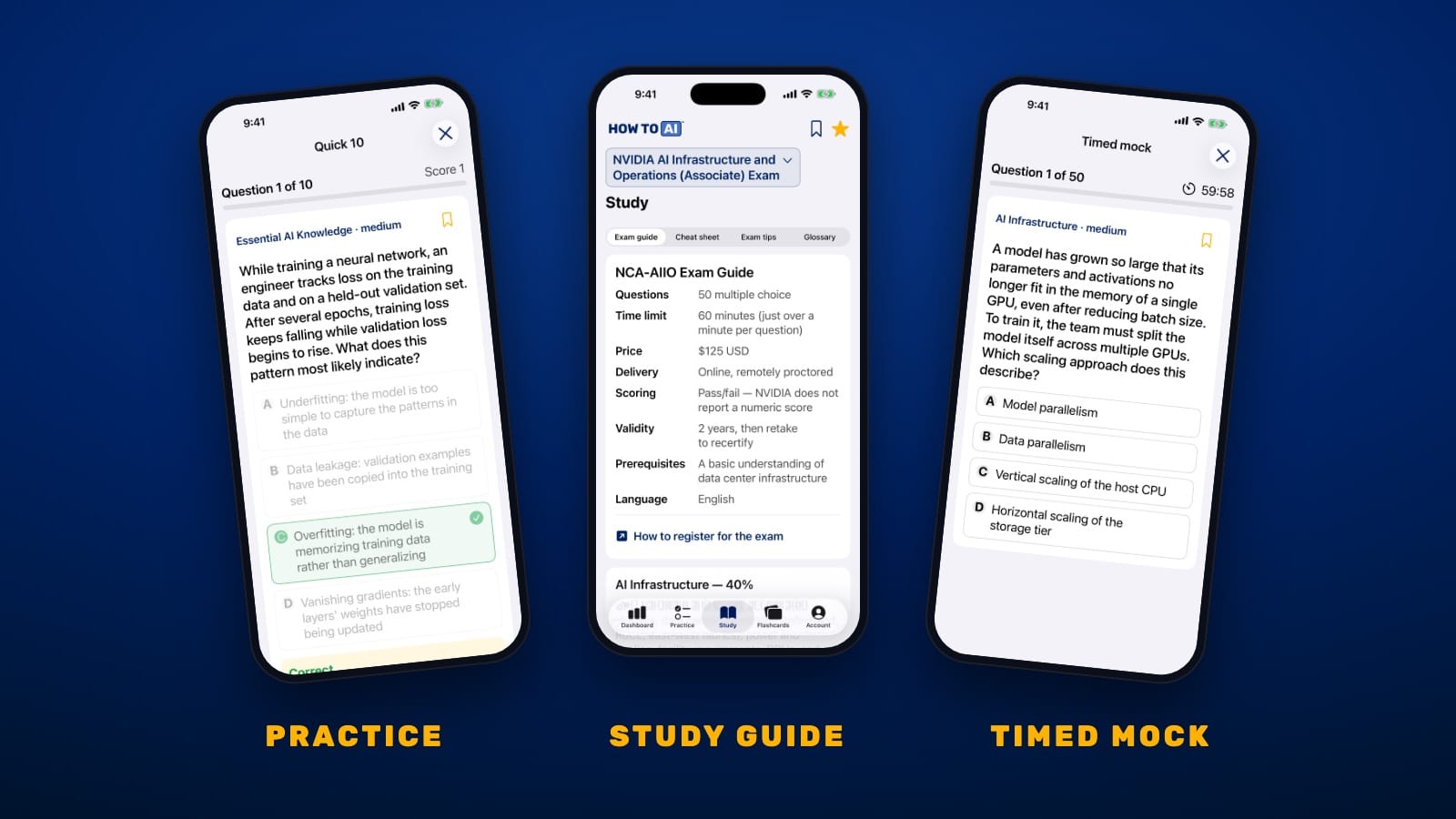
Study this exam on your phone
HOW TO // AI CERT has 6,151 original practice questions across 18 AI and cloud certifications, with plain-English explanations on every answer, full timed mock exams, weak-area drills, and an AI tutor powered by Claude. Free to download, with a free question set for every exam.

How to prepare for the NCA-AIIO
NVIDIA recommends its self-paced AI Infrastructure and Operations Fundamentals course (about 7 hours) and suggests “a basic understanding of data center infrastructure” going in. A study loop that works: read the official exam guide on NVIDIA’s certification page, take a practice set like the one above, then study the domains where you missed questions rather than re-reading everything. If you’re newer to the AI side of the exam, our plain-English AI glossary and explainer on how AI models actually work cover the Essential AI Knowledge concepts in beginner-friendly terms.
Free NCA-AIIO study guide & cheat sheet
No sign-up needed — quick study tips, a topic-by-topic cheat sheet, and a full glossary for the NCA-AIIO exam.
Open the full NCA-AIIO study guide →
HOW TO // AI is not affiliated with or endorsed by NVIDIA. NCA-AIIO is a certification of NVIDIA Corporation; we reference it descriptively. All practice questions on this page are original, written from the publicly published exam objectives — they are not actual exam questions.
Related guides
- AI Terms Explained: A Plain-English Glossary
- How AI Chatbots Really Work
- The 2026 AI Starter Stack
- ChatGPT vs Claude vs Gemini: Which AI Should You Use?
- NCA-GENL exam cost (the other $125 NVIDIA associate exam)
- NCA-AIIO exam cost and retake rules
Practice for every AI & cloud cert
- NVIDIA NCA-GENL practice questions
- AWS AIF-C01 practice questions
- AWS MLA-C02 practice questions
- AWS MLA-C01 practice questions
- Microsoft AI-901 practice questions
- Microsoft AI-103 practice questions
- VMware VCP-VCF Administrator practice questions
- CompTIA AI Fundamentals practice questions
- Google Cloud Generative AI Leader practice questions
- Oracle OCI AI Foundations practice questions
- CertNexus AIP-210 practice questions
- Anthropic CCAO-F practice questions
- Anthropic CCDV-F practice questions
- Anthropic CCAR-F practice questions
- Anthropic CCAR-P practice questions
- Databricks GenAI Engineer Associate practice questions
- Salesforce Agentforce Specialist practice questions
- CompTIA SecAI+ practice questions
- All AI & cloud exam prep →
Frequently asked questions
How many questions are on the NVIDIA NCA-AIIO exam, and what do I need to pass?
The NVIDIA-Certified Associate: AI Infrastructure and Operations exam has 50 multiple-choice questions and gives you 60 minutes. Scoring is pass/fail — NVIDIA does not report a numeric score. It is delivered online, remotely proctored.
How much does the NVIDIA NCA-AIIO exam cost?
NVIDIA's NVIDIA-Certified Associate: AI Infrastructure and Operations exam costs $125 USD. You register through NVIDIA's certification site and take the exam through a Certiverse account. Pricing can vary by region and taxes.
How should I prepare for the NVIDIA NCA-AIIO exam?
It is an associate-level exam, and NVIDIA's stated prerequisite is a basic understanding of data center infrastructure. The most reliable way to prepare is to study the official exam guide and then work through lots of practice questions to find and fix weak spots. Our 300-question bank for NCA-AIIO is blueprint-weighted, so the topic mix mirrors the real exam — practice until your readiness score is consistently high, then book your exam.
Are HOW TO // AI — CERT's NVIDIA NCA-AIIO questions real exam questions?
No. All 300 of our NCA-AIIO practice questions are 100% original, written from the published exam objectives. We never copy, leak, or reproduce real exam content ("brain dumps") — that would violate NVIDIA's policies and would not actually teach you the material. Every question comes with a plain-English explanation so you learn the concept, not just the answer.
Is HOW TO // AI — CERT affiliated with NVIDIA?
No. HOW TO // AI — CERT is an independent study resource and is not affiliated with, authorized by, endorsed by, or sponsored by NVIDIA. All product and exam names are trademarks of their respective owners; we reference them only to describe what our practice questions cover.
Can I try NVIDIA NCA-AIIO practice questions for free?
Yes. You can practice a free set of NCA-AIIO questions with no sign-up required, then unlock more by email. Pro unlocks the full 300-question bank plus timed mock exams, flashcards, spaced-repetition review, a readiness score, and an AI tutor that explains any question — from $12/month, and one subscription covers every certification we offer.