
What this guide covers. The material here follows the current MLA-C01 blueprint. MLA-C02 adds generative AI, agentic AI and foundation model workloads, and its beta runs from September 29, 2026 at $75. AWS’s certification blog dates the standard MLA-C02 to January 14, 2027, though the exam page still lists GA as TBD. See what changes in MLA-C02.
AWS ML Engineer Associate (MLA-C01) Study Guide & Cheat Sheet
A free study guide for the AWS ML Engineer Associate (MLA-C01) exam: exam facts, the domain breakdown, study tips, a topic cheat sheet, and a full glossary. No sign-up needed. For a week-by-week schedule, follow the 6-week AWS ML Engineer study plan.
Ready to practice? Take the free AWS ML Engineer Associate (MLA-C01) practice quiz → · Get the full exam prep →
Check which version you are sitting
Read this before you book, because your language decides your exam. MLA-C01’s last English exam day was September 28, 2026. If you test in English, the only version you can book now is the MLA-C02 beta: you schedule it under the code ME1-C02, it costs $75, and you get 85 questions in 170 minutes with a single attempt. AWS’s certification blog dates the standard MLA-C02 to January 14, 2027 (the exam page still says TBD), and MLA-C01 stays open in Japanese, Korean and Simplified Chinese until MLA-C02 is generally available.
Testing in English? Study from our MLA-C02 study guide and MLA-C02 practice questions instead. The four domains keep the same structure, and our MLA-C02 exam guide covers what is new. The guide below follows the MLA-C01 blueprint.
Either way, this is the job-level AWS exam rather than the survey one. Roughly a quarter of it is building models; the rest is data preparation, pipelines, deployment, monitoring and security. If that is not your week yet, start with the AI Practitioner.
How to use this guide
- Weight your hours by domain, and expect the operations end (deployment, monitoring, security) to need more time than model building.
- Read the tips for how AWS frames scenario questions on this exam, which are longer than the foundational ones.
- Use the cheat sheet as a checklist and mark every service or workflow you have not actually run.
- Practise under time with our free MLA practice questions.
Before you book
See what each version costs, whether it is worth it, and the six-week plan that puts this material on a calendar.
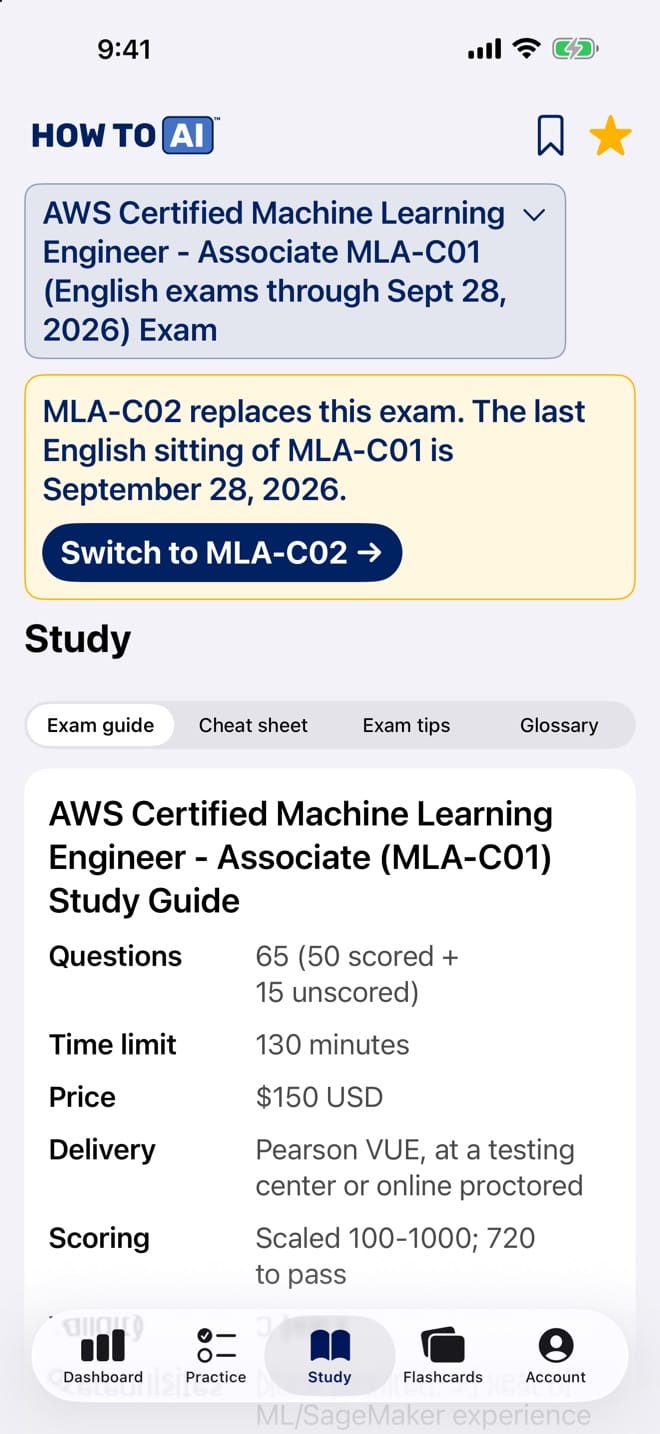
AWS Certified Machine Learning Engineer - Associate (MLA-C01) Study Guide
| Questions | 65 (50 scored + 15 unscored) |
|---|---|
| Time limit | 130 minutes |
| Price | $150 USD |
| Delivery | Pearson VUE, at a testing center or online proctored |
| Scoring | Scaled 100-1000; 720 to pass |
| Validity | 3 years |
| Prerequisites | None required; ~1 year of ML/SageMaker experience recommended |
| Language | English plus other localized languages |
| Exam change | AWS is replacing MLA-C01 with MLA-C02. The last day to take MLA-C01 in English is September 28, 2026. MLA-C02 beta delivery begins September 29, 2026 (85 questions, 170 minutes, $75 beta price, English only), and MLA-C01 stays available in Japanese, Korean and Simplified Chinese until MLA-C02 is generally available in all languages, when MLA-C01 retires. AWS's blog dates that to January 14, 2027; its exam page still says TBD. |
Exam domains
| Domain | Weight | What it covers |
|---|---|---|
| Data Preparation for ML | 28% | Ingest, store, transform, and validate data for ML. Covers S3 storage, Glue/DataBrew and EMR/Spark transforms, Athena queries, streaming ingestion with Kinesis/Firehose/MSK, feature engineering with SageMaker Data Wrangler and Feature Store, labeling with Ground Truth, and governance with Lake Formation, handling issues like class imbalance and data quality. |
| ML Model Development | 26% | Choose, train, and evaluate models. Includes selecting built-in algorithms or JumpStart models, SageMaker training jobs, Automatic Model Tuning and Autopilot, tracking with Experiments, debugging with Debugger and bias/explainability checks with Clarify, and using metrics (accuracy, precision, recall, F1, AUC, RMSE) while managing overfitting and underfitting. |
| Deployment and Orchestration of ML Workflows | 22% | Deploy models and automate pipelines. Covers real-time, serverless, and asynchronous endpoints, Batch Transform, multi-model endpoints and auto scaling, plus orchestration with SageMaker Pipelines, Step Functions, EventBridge, and CI/CD via CodePipeline, infrastructure as code with CloudFormation/CDK, and container images in Amazon ECR. |
| ML Solution Monitoring, Maintenance, and Security | 24% | Monitor, maintain, and secure ML solutions in production. Includes SageMaker Model Monitor for data and model quality drift, observability with CloudWatch and CloudTrail, cost and performance optimization, and security through IAM, KMS, VPC, Secrets Manager, PrivateLink, and Macie for sensitive data. |
Who it’s for: ML engineers and data professionals who build, deploy, and operate machine learning solutions on AWS in a hands-on, associate-level role.
Study & test-day tips
- Map every scenario to the AWS-managed service first: prefer SageMaker built-in tooling (Data Wrangler, Autopilot, Pipelines) over custom code when the question rewards lower operational overhead.
- Know endpoint trade-offs cold: real-time for low-latency steady traffic, serverless for intermittent/spiky traffic, asynchronous for large payloads or long inference, and Batch Transform for offline scoring of whole datasets.
- Match the metric to the problem: precision/recall/F1 and AUC for imbalanced classification, accuracy only for balanced classes, and RMSE/MAE for regression. Watch for questions that penalize false positives vs false negatives.
- For class imbalance, recognize techniques like resampling, SMOTE, class weighting, and stratified splits, and pair them with the right evaluation metric rather than raw accuracy.
- Use SageMaker Clarify for both pre-training bias detection and post-training feature attribution/explainability; use Debugger for training-time issues like vanishing gradients or overfitting.
- For drift, remember Model Monitor compares live traffic against a baseline for data quality, model quality, bias drift, and feature attribution drift, emitting CloudWatch metrics that can trigger retraining.
- Choose ingestion by pattern: Kinesis Data Streams for custom real-time consumers, Data Firehose for near-real-time delivery to S3/Redshift, and MSK for Kafka workloads; use Glue/DataBrew for batch ETL and Athena for serverless SQL on S3.
- For MLOps automation, use SageMaker Pipelines for ML-native DAGs, Step Functions for broader AWS service orchestration, EventBridge for event triggers, and CodePipeline for CI/CD of model build and deploy.
- Default to least privilege and encryption: scope IAM roles tightly, encrypt with KMS, isolate with VPC and PrivateLink, store credentials in Secrets Manager, and detect sensitive data with Macie.
- Save with Feature Store and multi-model endpoints: use the offline store for training and online store for low-latency lookups, and host many models behind one endpoint to cut cost when models are infrequently invoked.
Cheat sheet
Data Preparation and Feature Engineering
- Amazon S3 as the central data lake; Lake Formation for fine-grained access governance.
- AWS Glue and Glue DataBrew for ETL and visual data prep; EMR/Spark for large-scale processing.
- Athena for serverless SQL queries directly on S3 data.
- SageMaker Data Wrangler for visual feature engineering; Feature Store for online/offline feature reuse.
- SageMaker Ground Truth for data labeling and human-in-the-loop annotation.
- Handle class imbalance (resampling, SMOTE, class weights) and split data with stratification.
Streaming and Ingestion
- Kinesis Data Streams: real-time, custom consumers, replayable shards.
- Amazon Data Firehose: near-real-time delivery to S3, Redshift, OpenSearch with transforms.
- Amazon MSK: managed Apache Kafka for high-throughput event streaming.
- Glue/DataBrew for scheduled batch ingestion and transformation into the lake.
Model Development and Training
- SageMaker built-in algorithms (XGBoost, Linear Learner, etc.) and JumpStart pretrained models.
- SageMaker training jobs with managed spot training to reduce cost.
- Automatic Model Tuning (hyperparameter optimization) and Autopilot for AutoML.
- SageMaker Experiments to track runs, parameters, and metrics.
- Debugger for training issues; Clarify for bias detection and explainability.
- Evaluation metrics: accuracy, precision, recall, F1, AUC for classification; RMSE/MAE for regression.
Deployment and Inference
- Real-time endpoints for low-latency, steady traffic with auto scaling.
- Serverless endpoints for intermittent traffic with no idle cost.
- Asynchronous endpoints for large payloads and long-running inference.
- Batch Transform for offline scoring of entire datasets.
- Multi-model endpoints to host many models behind one endpoint and cut cost.
Orchestration and MLOps
- SageMaker Pipelines for ML-native CI/CD workflows and model registry.
- Step Functions for orchestrating across AWS services; EventBridge for event triggers.
- CodePipeline for CI/CD of build, train, and deploy stages.
- CloudFormation and AWS CDK for infrastructure as code.
- Amazon ECR to store and version custom training/inference container images.
Monitoring, Maintenance, and Security
- SageMaker Model Monitor for data quality, model quality, and drift detection against a baseline.
- CloudWatch for metrics, logs, and alarms; CloudTrail for API audit trails.
- IAM least-privilege roles and policies for all ML resources.
- KMS encryption, VPC isolation, and PrivateLink for private connectivity.
- Secrets Manager for credentials; Macie to discover and protect sensitive data (PII).
Glossary
- Amazon S3
- Object storage service that serves as the central data lake for ML datasets, models, and artifacts.
- AWS Glue
- Serverless ETL service for discovering, cataloging, and transforming data at scale.
- AWS Glue DataBrew
- Visual data preparation tool for cleaning and normalizing data without writing code.
- Amazon Athena
- Serverless interactive query service that runs SQL directly against data in S3.
- Amazon EMR
- Managed big data platform running Apache Spark, Hadoop, and related frameworks for large-scale processing.
- Amazon Kinesis Data Streams
- Real-time streaming data service with replayable shards for custom consumer applications.
- Amazon Data Firehose
- Near-real-time streaming delivery service that loads data into S3, Redshift, and other destinations.
- Amazon MSK
- Managed Streaming for Apache Kafka, providing fully managed Kafka clusters for event streaming.
- SageMaker Data Wrangler
- Visual tool for importing, exploring, and engineering features from data for ML.
- SageMaker Feature Store
- Repository for storing, sharing, and serving ML features with online and offline stores.
- SageMaker Ground Truth
- Data labeling service with human and automated workflows to create training datasets. No longer open to new customers; existing customers can continue to use it.
- AWS Lake Formation
- Service for building and governing data lakes with fine-grained access control.
- SageMaker training job
- Managed compute job that trains a model on provided data and outputs model artifacts to S3.
- Built-in algorithms
- Prebuilt, optimized SageMaker algorithms such as XGBoost and Linear Learner for common ML tasks.
- Automatic Model Tuning
- SageMaker hyperparameter optimization that searches parameter combinations to maximize an objective metric.
- SageMaker Autopilot
- AutoML capability that automatically builds, trains, and tunes candidate models with transparency.
- SageMaker JumpStart
- Hub of pretrained models and solution templates for fast fine-tuning and deployment.
- SageMaker Experiments
- Capability to organize, track, and compare training runs, parameters, and metrics.
- SageMaker Debugger
- Tool that captures training tensors to detect issues like overfitting and vanishing gradients.
- SageMaker Clarify
- Service that detects bias in data and models and explains predictions via feature attribution. No longer open to new customers; existing customers can continue to use it.
- Real-time endpoint
- Persistent SageMaker endpoint serving low-latency, synchronous predictions with auto scaling.
- Serverless endpoint
- SageMaker inference option that scales to zero, ideal for intermittent or spiky traffic.
- Asynchronous endpoint
- SageMaker endpoint that queues requests for large payloads and long-running inference.
- Batch Transform
- SageMaker feature for offline, high-throughput inference over an entire dataset.
- Multi-model endpoint
- Single SageMaker endpoint that dynamically loads and hosts many models to reduce cost.
- SageMaker Pipelines
- Purpose-built CI/CD service for building, automating, and managing ML workflows.
- AWS Step Functions
- Serverless orchestration service that coordinates multiple AWS services into workflows.
- Amazon EventBridge
- Event bus service that triggers ML workflows and actions based on events.
- Amazon ECR
- Elastic Container Registry for storing and versioning Docker images for training and inference.
- SageMaker Model Monitor
- Service that monitors deployed models for data quality, model quality, and drift against a baseline. No longer open to new customers; existing customers can continue to use it.
- Model drift
- Degradation in model performance over time as live data diverges from training data distribution.
- Amazon Macie
- Security service that uses ML to discover and protect sensitive data such as PII in S3.
- AWS PrivateLink
- Service that provides private connectivity to AWS services without exposing traffic to the public internet.
- AWS KMS
- Key Management Service for creating and controlling encryption keys protecting data at rest and in transit.
HOW TO // AI is not affiliated with or endorsed by Amazon Web Services. AWS Certified Machine Learning Engineer – Associate and MLA-C01 are certifications of Amazon.com, Inc. or its affiliates; we reference them descriptively. All questions are original.
Take this guide with you
The same study guide, cheat sheet and glossary live in HOW TO // AI CERT on iPhone, next to 6,151 original practice questions, timed mock exams, flashcards and an AI tutor powered by Claude. Free to download, with a free question set for every exam.

Practice for every AI & cloud cert
- NVIDIA NCA-AIIO practice questions
- NVIDIA NCA-GENL practice questions
- AWS AIF-C01 practice questions
- AWS MLA-C02 practice questions
- Microsoft AI-901 practice questions
- Microsoft AI-103 practice questions
- VMware VCP-VCF Administrator practice questions
- CompTIA AI Fundamentals practice questions
- Google Cloud Generative AI Leader practice questions
- Oracle OCI AI Foundations practice questions
- CertNexus AIP-210 practice questions
- Anthropic CCAO-F practice questions
- Anthropic CCDV-F practice questions
- Anthropic CCAR-F practice questions
- Anthropic CCAR-P practice questions
- Databricks GenAI Engineer Associate practice questions
- Salesforce Agentforce Specialist practice questions
- CompTIA SecAI+ practice questions
- All AI & cloud exam prep →
Frequently asked questions
Can I still take MLA-C01 in English?
No. AWS's last day for MLA-C01 in English was September 28, 2026, so English candidates now book the MLA-C02 beta (exam code ME1-C02: $75, 85 questions, 170 minutes, one attempt). MLA-C01 stays available in Japanese, Korean and Simplified Chinese until MLA-C02 is generally available.
How much does the AWS ML Engineer Associate (MLA-C01) exam cost?
MLA-C01 is $150 USD where it is still offered (Japanese, Korean and Simplified Chinese). The English MLA-C02 beta is $75, and AWS has not listed a price for the standard MLA-C02. Both are delivered by Pearson VUE, at a test center or online proctored.
How many questions is MLA-C01 and what score passes?
65 questions (50 scored plus 15 unscored) in 130 minutes, and you need a scaled score of 720 out of 1,000. The MLA-C02 beta has 85 questions in 170 minutes with the same 720 passing score.
What experience should I have before the AWS ML Engineer Associate?
No prerequisites are required, but AWS describes a target candidate with about a year of hands-on experience using SageMaker and other AWS ML services (MLA-C02 adds Amazon Bedrock). It is an associate-level exam, meaningfully deeper than the AI Practitioner, covering data preparation, model development, deployment and MLOps on AWS.
Does the AWS ML Engineer certification expire?
Yes. It is valid for 3 years, including when you earn it through the MLA-C02 beta. To recertify, pass the latest version of the exam or the AWS Certified Generative AI Developer - Professional exam, or maintain it on AWS Skill Builder for one more year with a paid subscription.