
HOW TO // AI CERT · NVIDIA NCA-GENL
NCA-GENL Practice Questions: Free Practice Test With Explanations
384 original practice questions weighted to NVIDIA’s published NCA-GENL domains, with a plain-English explanation on every one.
Start the free quiz, no signup →10 free questions now · 10 more with your email · the full bank from $12 a month
Claude AI Tutor included with Pro: miss a question and it explains exactly why, in plain English, until it clicks.
Yes, you can take an NCA-GENL practice test free. The quiz below gives you 10 original NCA-GENL practice questions with explanations and no sign-up, and 10 more unlock with your email. This page also covers the exam at a glance, NVIDIA’s five domains and weights, how to practice for a pass/fail exam, NVIDIA’s free recommended reading, and why NCA-GENL dumps are a bad bet.
NCA-GENL is NVIDIA’s Generative AI LLM associate exam, for people who help build, test and deploy LLM applications such as RAG apps, chatbots and summarizers, plus the machine learning underneath them. If you work on GPUs, networking and clusters instead, look at NCA-AIIO; our NCA-AIIO vs NCA-GENL comparison helps you choose.
How these questions were made. Every question here is original. HOW TO // AI writes them from NVIDIA’s public NCA-GENL exam guide and maps each one to a domain in its blueprint. They are not real exam questions: real exam content is confidential for every candidate, and we never use exam recall or dumps.
NCA-GENL at a glance
| Exam | NVIDIA Generative AI LLM certification exam (NCA-GENL) |
|---|---|
| Credential | NVIDIA-Certified Associate: Generative AI LLM |
| Level | Associate (entry level) |
| Price | $125 USD (taxes may apply in some countries) |
| Exam time | 60 minutes |
| Questions | 50 to 60 multiple choice |
| Scoring | Pass or fail; NVIDIA doesn’t report a score or publish a cut score |
| Delivery | Online, remotely proctored; you need a Certiverse account |
| Language | English |
| Prerequisites | None required; NVIDIA lists a basic understanding of generative AI and large language models |
| Validity | 2 years; you recertify by retaking the exam |
| Retakes | Buy the exam again after a 14-day wait; no more than five attempts in 12 months |
Checked against NVIDIA’s NCA-GENL exam page and NVIDIA’s certification FAQ on October 8, 2026.
NCA-GENL exam domains
Our question set is weighted to NVIDIA’s published domains:
| Domain | Weight | What it covers |
|---|---|---|
| Core Machine Learning and AI Knowledge | 30% | The largest domain: machine learning fundamentals (feature engineering, model comparison, cross-validation), prompt engineering, creating text embeddings, curating and embedding datasets for retrieval-augmented generation (RAG), building LLM use cases such as RAG apps, chatbots and summarizers, and Python packages such as spaCy, NumPy and Keras. At 30%, that is roughly 15 to 18 of your 50 to 60 questions. |
| Software Development | 24% | Building LLM applications with Python natural language packages and vector databases, identifying the data, hardware and software a solution needs, monitoring data collection and experiments, writing software components and scripts, and supporting deployment and scalability, performance and reliability testing. |
| Experimentation | 22% | Helping with model training and optimization, preparing large datasets (scraping, tokenization) for pretraining, fine-tuning and RLHF, designing hardware and software tests for LLM applications, benchmarking and refining models, and weighing emerging technologies on cost, portability and compatibility. |
| Data Analysis | 14% | Extracting insights from large datasets with data mining and visualization, comparing models with statistical performance metrics such as loss functions or explained variance, spotting relationships, trends and factors that could affect results, and presenting results in charts and graphs. |
| Trustworthy AI | 10% | The ethical principles of trustworthy AI, balancing data privacy with data consent, using NVIDIA and other technologies to make AI more trustworthy, and minimizing bias. |
Domain names and weights are NVIDIA’s; the descriptions are our summaries of the objectives on NVIDIA’s exam page.
Take the free practice quiz
Start with 10 free questions and read the explanation after each, then unlock 10 more with your email. No account needed to begin.
FREE PRACTICE QUIZ
Try 10 free NCA-GENL practice questions
Answer at your own pace. Every question shows the correct answer and a plain-English explanation, and that's where the learning happens. Unlock 10 more questions free at the end.
Read the 10 free NCA-GENL questions as text, with answers and explanations
A data scientist is explaining why a deep neural network uses nonlinear activation functions (such as ReLU) between its layers. Which statement best describes the primary reason they are necessary?
- A. They guarantee that the loss function becomes convex, ensuring a single global minimum.
- B. They normalize the input data so that every feature has zero mean and unit variance.
- C. They reduce the total number of parameters the network must store in GPU memory.
- D. They let the network learn nonlinear relationships between inputs.
Answer: D. Activation functions introduce nonlinearity, which lets a deep network approximate complex nonlinear functions; without them, any number of stacked linear layers reduces to one linear layer. They do not reduce parameter count, do not make the loss convex (deep nets are highly non-convex), and input normalization is a separate preprocessing step, not the role of activations.
During training of a feedforward network, an engineer observes that gradients in the earliest layers shrink toward zero as they propagate backward, slowing learning in those layers. What is this phenomenon commonly called, and which choice is a typical mitigation?
- A. Overfitting; mitigate by increasing the number of training epochs.
- B. Data leakage; mitigate by shuffling the validation set.
- C. Catastrophic forgetting; mitigate by lowering the batch size.
- D. The vanishing gradient problem; use ReLU and residual connections.
Answer: D. When gradients shrink as they flow backward through many layers, early-layer weights barely update; this is the vanishing gradient problem. ReLU-style activations and residual/skip connections (as in ResNets and Transformers) help gradients flow. Overfitting, catastrophic forgetting, and data leakage are unrelated phenomena with different causes.
In the self-attention mechanism of a Transformer, each token's representation is computed using three learned projections of the input. What are these three components called?
- A. Filter, Stride, and Padding
- B. Gate, Cell, and Hidden state
- C. Encoder, Decoder, and Bottleneck
- D. Query, Key, and Value
Answer: D. Self-attention projects each token into Query, Key, and Value vectors; attention scores come from Query-Key dot products and are used to weight the Values. Encoder/decoder describe overall architecture blocks, gate/cell/hidden belong to LSTMs, and filter/stride/padding are convolution concepts.
Why do Transformer models add positional encodings (or positional embeddings) to their input token embeddings?
- A. To apply dropout selectively only to rare tokens.
- B. To compress the vocabulary so fewer embedding rows are needed.
- C. To convert floating-point embeddings into integer token IDs for faster lookup.
- D. Because self-attention is order-agnostic and needs position information.
Answer: D. Self-attention treats input as an unordered set, so without positional signals the model cannot distinguish word order; positional encodings inject that order information. They do not compress vocabulary, do not convert embeddings to IDs (the reverse of how lookup works), and are unrelated to selective dropout.
A developer notices that the string "unbelievable" is split into the sub-pieces "un", "believ", and "able" before being fed to an LLM. Which step of the LLM input pipeline is producing these sub-pieces?
- A. Subword tokenization
- B. Attention computation
- C. Positional encoding
- D. Embedding lookup
Answer: A. Modern LLMs use subword tokenization (e.g., Byte-Pair Encoding or WordPiece) that breaks rare or compound words into smaller, reusable sub-pieces so the vocabulary stays manageable while still covering unseen words. Embedding lookup happens after tokenization (it converts each token ID into a vector), positional encoding adds order information, and attention is part of the transformer layers, none of which split text into sub-pieces.
A team feeds an LLM a 20,000-token document, but the model is configured with an 8,192-token context window. What is the most likely consequence?
- A. The model automatically increases its context window to fit the document.
- B. The model raises the temperature to compensate for the longer input.
- C. Tokens beyond the context window limit are not attended to, so content past the limit is truncated or dropped.
- D. The document is converted to a single embedding vector that preserves all information losslessly.
Answer: C. The context window is a hard upper bound on how many tokens the model can process at once; input exceeding it is truncated (or must be chunked), so content past the limit is effectively ignored. A model cannot grow its own context window at runtime, a single embedding cannot losslessly hold 20,000 tokens, and temperature controls sampling randomness, not input length.
In a semantic search system, why are the words "automobile" and "car" expected to have embedding vectors that are close together in vector space?
- A. Because they contain a similar number of characters
- B. Because they were assigned consecutive token IDs in the vocabulary
- C. Because embeddings encode meaning, so similar contexts map nearby
- D. Because the tokenizer merged them into the same token
Answer: C. Embeddings are learned representations that place semantically similar items near one another, so synonyms used in similar contexts end up close in vector space, which is what enables semantic (meaning-based) search. Character count, token-ID ordering, and tokenizer merges are surface-level or unrelated artifacts that do not capture meaning.
A prompt instructs an LLM to "Classify the sentiment of this review as positive or negative" and provides three labeled example reviews before the new review to classify. Which prompting technique is being used?
- A. Zero-shot prompting
- B. Chain-of-thought prompting
- C. Retrieval-augmented generation
- D. Few-shot prompting
Answer: D. Providing several in-context labeled examples before the target input is few-shot prompting, which helps the model infer the desired format and behavior. Zero-shot gives no examples, chain-of-thought asks the model to reason step by step, and RAG injects retrieved external documents rather than demonstration examples.
A team is assembling a large web-scraped text corpus to use for continuous pre-training of an LLM. During an initial scan they find that many documents appear multiple times verbatim. Which preprocessing step most directly addresses this issue and why is it important?
- A. Deduplication, since repeats cause memorization and waste compute
- B. Tokenization, because duplicate text must be converted to token IDs before training
- C. Stop-word removal, because duplicate documents are usually filler text
- D. Normalization, because duplicates indicate inconsistent character encodings
Answer: A. Deduplication removes exact or near-duplicate documents, which reduces memorization, improves generalization, and avoids spending compute repeatedly on the same content. Tokenization converts text to IDs but does not detect duplicates; normalization handles encoding/casing; stop-word removal is rarely used for modern LLM corpora and does not address repetition.
While cleaning a multilingual text dataset, you notice the same character (for example, an accented letter) is represented with different byte sequences across documents. Which preprocessing operation best resolves this inconsistency before tokenization?
- A. Lemmatization of every word form
- B. Unicode normalization (NFC/NFKC)
- C. Random shuffling of all records
- D. One-hot encoding of each token
Answer: B. Unicode normalization (such as NFC or NFKC) maps visually identical characters with different byte representations to a canonical form, ensuring consistent tokenization. Lemmatization reduces words to base forms (a different concern), shuffling changes order not encoding, and one-hot encoding is for categorical features, not text encoding consistency.
Want more? Finish the quiz above to unlock 10 more free questions, or open the full NCA-GENL practice app.
After the free 20
Practice the full NCA-GENL bank, timed like exam day
HOW TO // AI CERT has 384 original NCA-GENL practice questions written from NVIDIA’s public exam guide. You also get timed mock exams, an AI tutor powered by Claude that explains every miss, and a readiness score that tells you when to book. Pro is $12 a month, or $39 for the whole year, and covers every exam we offer. Start with a free account. 14-day refund.
These are original practice questions, not real exam questions. No brain dumps, nothing copied from real exams.
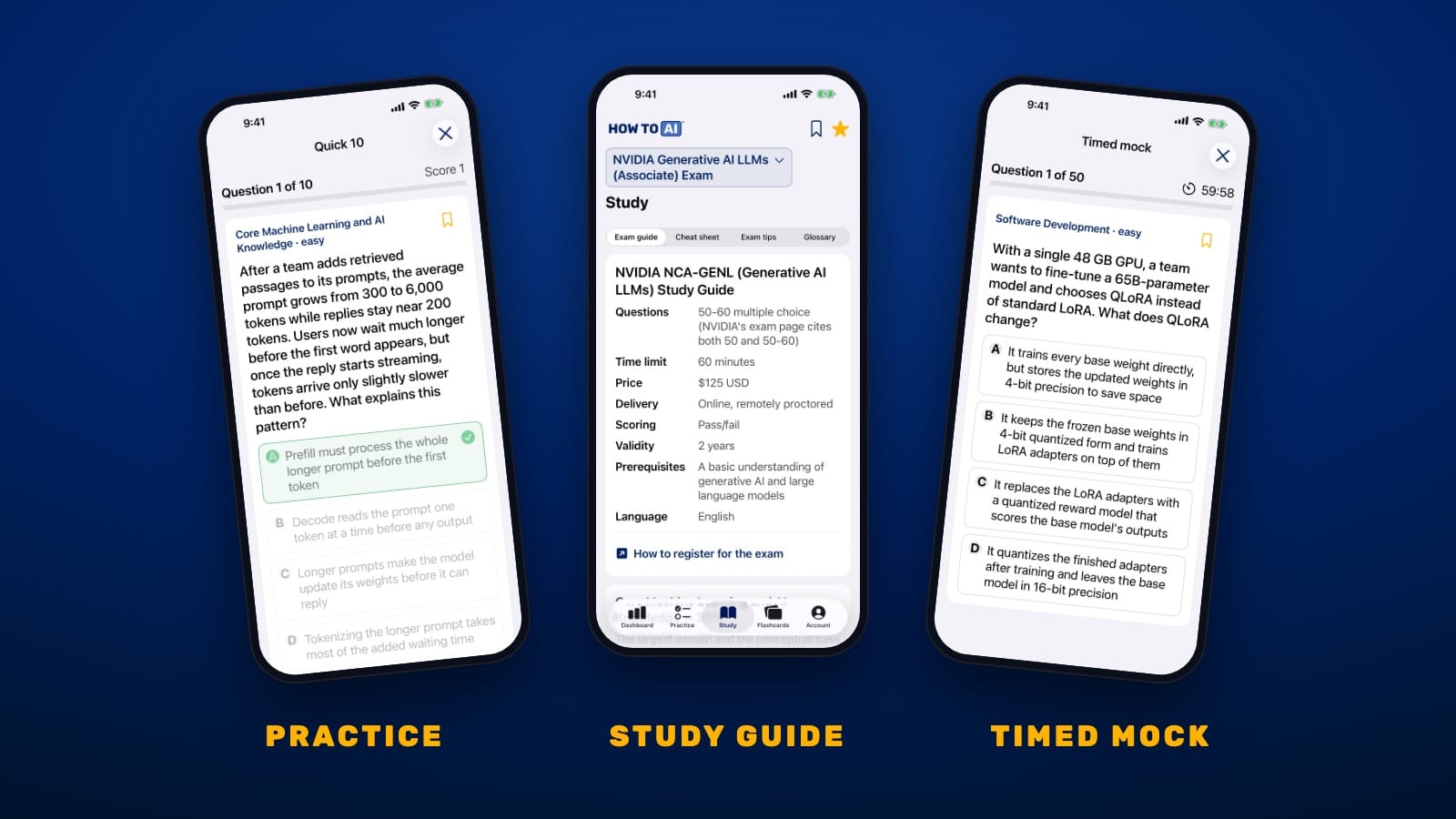
Study this exam on your phone
HOW TO // AI CERT has 6,151 original practice questions across 18 AI and cloud certifications, with plain-English explanations on every answer, full timed mock exams, weak-area drills, and an AI tutor powered by Claude. Free to download, with a free question set for every exam.

How to use NCA-GENL practice questions
- Take a cold set first. Do a round before you study to find your weak domains, not to get a score.
- Read every explanation, including on questions you got right. A lucky guess is still a gap.
- Weight your time like the exam. Core Machine Learning and AI Knowledge (30%) plus Software Development (24%) make up more than half of it.
- Aim well past a bare pass. NVIDIA reports pass or fail only, with no score and no published cut score, so there is no number to coast toward. Get consistent across every domain instead.
- Practice against the clock. 60 minutes for 50 to 60 questions is about a minute per question.
- Build something small. A basic RAG app with embeddings and a vector database turns many Core and Software Development objectives from definitions into things you’ve done.
NVIDIA’s free NCA-GENL prep resources
We didn’t find an official NVIDIA practice test on the NCA-GENL exam page, but it does list recommended reading for every domain, much of it free: the Prompt Engineering Guide, the “Attention Is All You Need” paper, the scikit-learn user guide, the Hugging Face LLM Course, the NIST AI Risk Management Framework, and NVIDIA’s own NeMo, Triton and TensorRT documentation, among others. It also recommends two NVIDIA courses: Fundamentals of Deep Learning (published as open-source course materials) and Rapid Application Development With Large Language Models (the page doesn’t state a price).
Why not NCA-GENL dumps?
“Dumps” claim to be real exam questions. NVIDIA says it runs periodic data forensics to detect cheating and content theft, and it reserves the right to invalidate an exam for misconduct. Dumps are also often wrong, and because the result is only pass or fail, you won’t even learn which memorized answers let you down. Original questions with explanations teach the reasoning the exam tests. More in our NCA-GENL dumps guide.
Free NCA-GENL study guide and cheat sheet
Prefer to study first? The free NVIDIA NCA-GENL study guide has the exam breakdown, a topic cheat sheet and a full glossary, with no sign-up.
How to prepare
Read the official exam objectives on the NVIDIA NCA-GENL page, take a practice set above, then focus your studying on the domains where you missed questions rather than re-reading everything. Pair it with the study guide for the concepts. Before you book, check what NCA-GENL costs (including retakes) and whether it is worth it for your role.
HOW TO // AI is not affiliated with or endorsed by NVIDIA. NCA-GENL is a certification of NVIDIA Corporation; we reference it descriptively. All questions are original.
Practice for every AI & cloud cert
- NVIDIA NCA-AIIO practice questions
- AWS AIF-C01 practice questions
- AWS MLA-C02 practice questions
- AWS MLA-C01 practice questions
- Microsoft AI-901 practice questions
- Microsoft AI-103 practice questions
- VMware VCP-VCF Administrator practice questions
- CompTIA AI Fundamentals practice questions
- Google Cloud Generative AI Leader practice questions
- Oracle OCI AI Foundations practice questions
- CertNexus AIP-210 practice questions
- Anthropic CCAO-F practice questions
- Anthropic CCDV-F practice questions
- Anthropic CCAR-F practice questions
- Anthropic CCAR-P practice questions
- Databricks GenAI Engineer Associate practice questions
- Salesforce Agentforce Specialist practice questions
- CompTIA SecAI+ practice questions
- All AI & cloud exam prep →
Frequently asked questions
Is there a free NCA-GENL practice test?
Yes. The quiz on this page gives you 10 original NCA-GENL practice questions with explanations and no sign-up, and 10 more unlock with your email. Pro unlocks the full bank, timed mock exams and an AI tutor, from $12 a month.
Are these real NCA-GENL exam questions?
No. Every question is original, written from NVIDIA's published exam objectives. We never copy or reproduce real exam content, and every question has a plain-English explanation so you learn the concept, not just the answer.
Should I use NCA-GENL dumps?
No. NVIDIA says it runs data forensics to detect cheating and content theft and can invalidate an exam for misconduct. Dumps are often wrong anyway, and with a pass/fail result you won't learn which memorized answers failed.
How many questions are on the NVIDIA NCA-GENL exam, and what do I need to pass?
50 to 60 multiple-choice questions in 60 minutes. Scoring is pass or fail: NVIDIA doesn't report a score or publish a passing score. It is delivered online with remote proctoring.
How much does the NVIDIA NCA-GENL exam cost?
$125 USD, and taxes may apply in some countries. You register through NVIDIA's certification site and take the exam through a Certiverse account. A retake means buying the exam again.
Does NVIDIA have an official NCA-GENL practice exam?
We didn't find one on NVIDIA's exam page. NVIDIA does list recommended reading for each domain, much of it free, and two recommended courses: Fundamentals of Deep Learning and Rapid Application Development With Large Language Models.
What happens if I fail NCA-GENL?
You buy the exam again and wait 14 days before retaking it. NVIDIA allows no more than five attempts at the same exam in 12 months, counted from your first purchase.
How should I prepare for the NVIDIA NCA-GENL exam?
Study NVIDIA's published objectives and recommended reading, build a small RAG app, then work through practice questions to find and fix weak domains. Because NVIDIA reports only pass or fail, aim for consistent results across all five domains before you book.