
Azure AI Fundamentals Study Guide & Cheat Sheet
A free study guide for the Azure AI Fundamentals exam (AI-901) — exam facts, the domain breakdown, study tips, a topic cheat sheet, and a full glossary. No sign-up needed.
Ready to practice? Take the free Azure AI Fundamentals practice quiz → · Get the full exam prep →
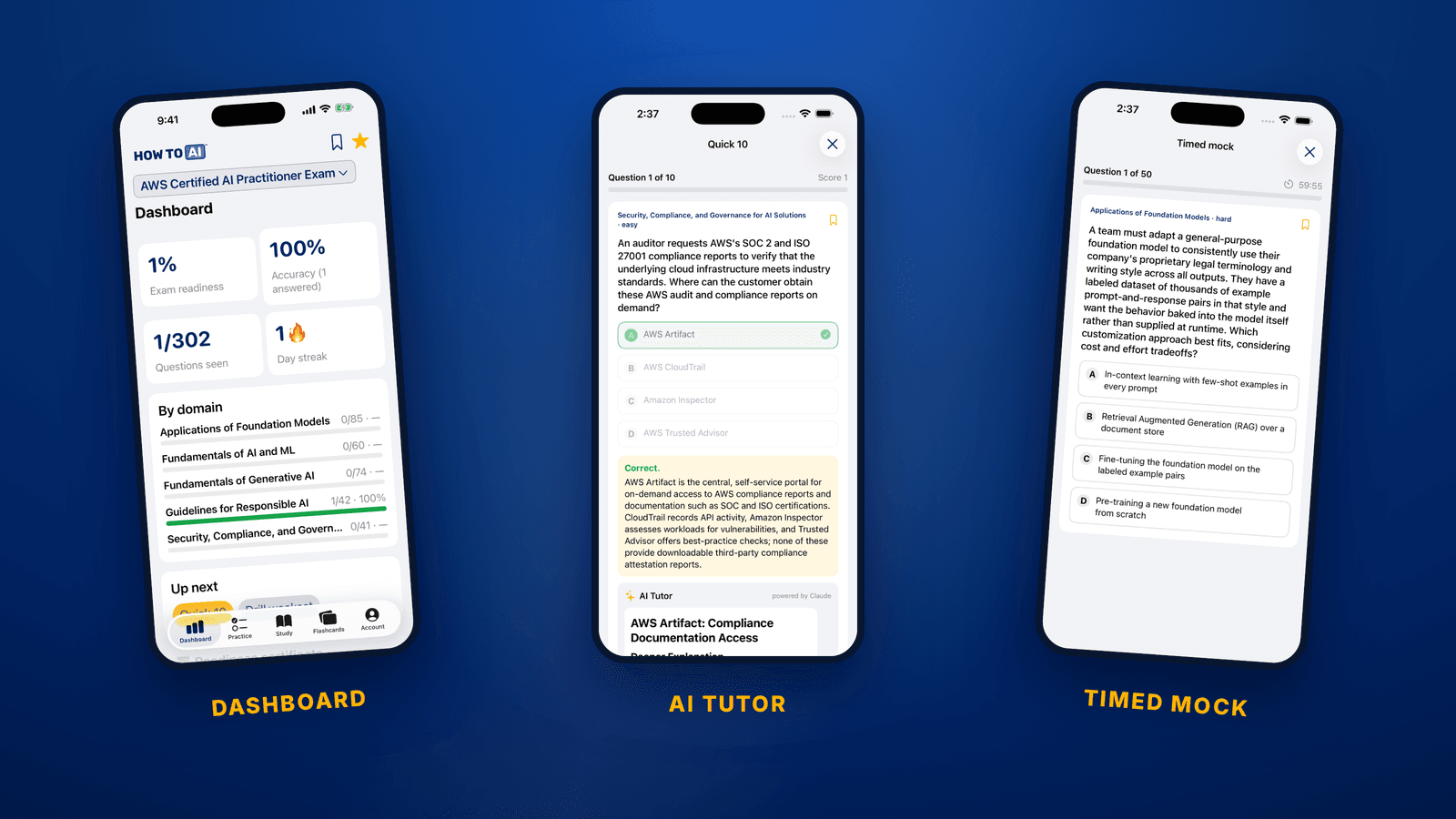
Study this exam on your phone
HOW TO AI — CERT has 4,675 original practice questions across 15 AI and cloud certifications — including all four Anthropic Claude exams — plain-English explanations on every answer, full timed mock exams, weak-area drills, and an AI tutor powered by Claude. Free to download, with a free question set for every exam.
Microsoft Azure AI Fundamentals (AI-901) Exam Guide
| Questions | Typically 40-60 items. Microsoft doesn't publish a fixed count or the question types in advance; its free exam sandbox shows the formats you may see. |
|---|---|
| Time limit | 45 minutes of exam time within a 65-minute seat time, which is Microsoft's timing for Fundamentals exams. Budget a little under a minute per question and leave time to review flagged items. |
| Price | $99 USD (regional pricing and taxes may apply). |
| Delivery | Pearson VUE. Take it online proctored from home or at a physical test center. |
| Scoring | Scaled score of 700 out of 1000 required to pass. You do not need to answer every question correctly. |
| Validity | Does not expire. Microsoft Fundamentals certifications have no expiration and require no renewal. |
| Prerequisites | None formally, but Microsoft's audience profile expects knowledge of Python coding syntax and familiarity with Azure resources, REST APIs, SDKs, and CLIs. |
| Replaces | AI-901 replaced AI-900, which retired June 30, 2026. AI-901 is not a refresh: it is 55-60% hands-on implementation in Microsoft Foundry. Both earn the same certification. |
Exam domains
| Domain | Weight | What it covers |
|---|---|---|
| Identify AI concepts and capabilities | 42% | Officially 40-45%. Responsible AI's six principles (fairness, reliability and safety, privacy and security, inclusiveness, transparency, accountability). How generative AI models work, choosing a model by capability, and deployment options and configuration parameters such as temperature, top_p, max tokens, and context window. Identifying workloads across generative and agentic AI, text analysis (keyword extraction, entity detection, sentiment analysis, summarization), speech recognition and synthesis, computer vision and image generation, and information extraction from text, images, audio, and video. |
| Implement AI solutions by using Microsoft Foundry | 58% | Officially 55-60%, and this is what most AI-900 study material misses entirely. Writing effective system and user prompts. Deploying a model and interacting with it in the Foundry portal. Building a lightweight chat client with the Foundry SDK, which means reading Python. Creating and testing a single-agent solution in the portal and a client app for an agent. Text and speech apps using Azure Speech in Foundry Tools. Multimodal models for interpreting images in prompts and generating images. Azure Content Understanding for extracting information from documents, forms, images, audio, and video. |
Who it’s for: You are at the beginning of a career in AI solution development. Microsoft expects conceptual knowledge of AI solutions in Azure plus the foundational technical skills to build them: Python coding syntax, Azure resources, and familiarity with REST APIs, SDKs, and CLIs. If you studied for AI-900, note that regression, clustering, and Azure Machine Learning designer are no longer the focus. Microsoft Foundry is.
Study & test-day tips
- AI-901 replaced AI-900 on June 30, 2026. If your study material talks about regression, clustering, and Azure Machine Learning designer as major topics, it was written for the retired exam.
- Over half the exam is Microsoft Foundry implementation. Open the Foundry portal, deploy a model, and chat with it before exam day. Reading about it is not enough.
- You do not have to write Python from scratch, but you must read it. Expect snippets using the Foundry SDK where you pick the correct line, argument, or client call.
- Know the Foundry vocabulary cold: Foundry resource, project, model catalog, deployment, endpoint, playground, and Foundry Tools.
- Agents come up repeatedly. Understand what an agent adds over a bare model: instructions, tools, and the ability to take actions in a loop.
- Azure Content Understanding is its own sub-domain. It extracts structured information from documents, forms, images, audio, and video. Do not confuse it with the older Document Intelligence branding.
- Multimodal means one model handling text plus images or audio. Expect questions where the right answer is 'use a multimodal model' instead of chaining separate vision and language services.
- The six responsible AI principles are still worth easy points. Memorize them and one concrete example each.
- Temperature, top_p, and max tokens are configuration parameters you will be asked to reason about. Higher temperature means more random output, lower means more deterministic.
- Read the scenario for the deciding constraint: cost, latency, privacy, or accuracy. Microsoft writes distractors that are technically real services but wrong for the stated constraint.
Cheat sheet
The two domains (and their real weights)
- Identify AI concepts and capabilities: 40-45%
- Implement AI solutions by using Microsoft Foundry: 55-60%
- If your prep is mostly concepts, you are studying under half the exam.
Microsoft Foundry building blocks
- Portal: deploy models, use the playground, build and test agents
- Model catalog: browse and compare models before deploying
- Deployment: a hosted instance of a model with its own endpoint
- Foundry SDK: the Python client you use to call the deployment from an app
- Foundry Tools: includes Azure Speech and Azure Content Understanding
Model configuration parameters
- temperature: randomness. Low for factual and deterministic, high for creative
- top_p: nucleus sampling. Tune this or temperature, not both at once
- max tokens: caps the response length and therefore cost
- context window: how much input plus output the model can hold at once
- system prompt: sets persistent behavior. User prompt: the immediate request
Which service for which job
- Chat, summarize, generate: a deployed generative model via Foundry
- Take actions with tools in a loop: an agent
- Speech to text or text to speech: Azure Speech in Foundry Tools
- Pull fields from invoices, forms, images, audio, video: Content Understanding
- Describe or classify an image in a prompt: a multimodal model
Responsible AI, six principles
- Fairness: avoid bias across groups
- Reliability and safety: perform consistently, fail safely
- Privacy and security: protect data at rest, in transit, and in prompts
- Inclusiveness: work for people of all abilities
- Transparency: users understand what the system does and its limits
- Accountability: humans remain responsible for outcomes
Retired with AI-900 (deprioritize)
- Regression, classification, and clustering as major topics
- Azure Machine Learning designer and automated ML workflows
- Individual Cognitive Services branding as the primary framing
- These may still appear as background concepts, but they are no longer the focus
Glossary
- Agent
- A model plus instructions, tools, and the ability to act in a loop. Use an agent when the task needs steps or tool calls; use a bare model when a single response is enough.
- Artificial intelligence (AI)
- Software that performs tasks normally requiring human intelligence, such as recognizing images, understanding language, or making predictions.
- Azure AI Face
- Service that detects, analyzes, and recognizes human faces and facial attributes in images.
- Azure AI Foundry
- Former name of Microsoft Foundry. Study material and exam items may use either name; they refer to the same platform.
- Azure Language in Foundry Tools
- Formerly Azure AI Language. Service (formerly Text Analytics/LUIS) for sentiment analysis, entity recognition, key phrase extraction, and language understanding.
- Foundry Tools
- The name the AI-901 outline uses for prebuilt AI capabilities you call from Microsoft Foundry, such as Azure Speech in Foundry Tools and Azure Content Understanding in Foundry Tools. Older material calls these Azure AI services, and before that Cognitive Services.
- Azure Speech in Foundry Tools
- Formerly Azure AI Speech. Service for speech-to-text, text-to-speech, speech translation, and speaker recognition.
- Azure Translator in Foundry Tools
- Formerly Azure AI Translator. Service that performs real-time text translation across many languages.
- Azure Vision in Foundry Tools
- Formerly Azure AI Vision. Service (formerly Computer Vision) for image classification, object detection, captioning, and OCR.
- Azure Content Understanding
- The Foundry Tools service that extracts structured information from documents, forms, images, audio, and video. Its own sub-domain on AI-901.
- Azure Machine Learning
- Azure's cloud platform for building, training, deploying, and managing ML models at scale.
- Azure OpenAI Service
- Azure service providing access to OpenAI models including GPT (text/chat), embeddings, and DALL-E (image generation).
- Classification
- A supervised ML task that predicts which category or class an item belongs to.
- Context window
- The total tokens a model can consider at once, covering the prompt plus the response. Long documents may need chunking to fit.
- Deep learning
- Machine learning that uses multi-layered neural networks to model complex patterns, powering vision and language tasks.
- Deployment
- A hosted instance of a chosen model with its own endpoint and capacity. Your app talks to the deployment, not to the catalog entry.
- Embedding
- A numeric vector representation of text that captures meaning, used for search, similarity, and grounding.
- Endpoint
- A deployed model exposed as a callable service so applications can request predictions in real time or batch.
- Foundry portal
- The web interface for Microsoft Foundry where you deploy models, use the playground, and create and test agents without writing code.
- Foundry project
- The workspace that holds your deployments, agents, connected data, and tools. You create a project before deploying anything.
- Foundry SDK
- The client library (commonly Python) used to call a deployed model or agent from an application. AI-901 shows you snippets and asks which call or argument is correct.
- Generative AI
- AI that creates new content - text, images, code, or audio - in response to a prompt.
- Grounding
- Supplying a model with authoritative source data at request time so its answers reflect your content instead of only its training data.
- Large language model (LLM)
- A generative model trained on vast text data to understand and produce human-like language.
- Machine learning (ML)
- A subset of AI in which models learn patterns from data rather than being explicitly programmed with rules.
- Max tokens
- The cap on how many tokens a response may contain, which bounds both length and cost.
- Microsoft Foundry
- The unified platform (formerly Azure AI Foundry / Azure AI Studio) for building AI solutions: browse the model catalog, deploy models, test in the playground, build agents, and call everything from the Foundry SDK. AI-901 is built around it.
- Model catalog
- The browsable library of models in Foundry from Microsoft, OpenAI, and open-source providers, used to compare and pick a model before deploying it.
- Multimodal model
- A single model that accepts more than one input type, such as text plus images or audio, removing the need to chain separate vision and language services.
- Named entity recognition
- An NLP task that identifies entities such as people, places, organizations, and dates within text.
- Natural language processing (NLP)
- AI that interprets, analyzes, and generates human language in text or speech.
- Object detection
- A vision task that identifies objects in an image and locates each with a bounding box.
- Optical character recognition (OCR)
- Technology that reads printed or handwritten text from images and documents into machine-readable text.
- Playground
- The interactive chat surface in the Foundry portal for testing prompts and configuration against a deployment before writing code.
- Prompt and completion
- The prompt is the input you give a generative model; the completion is the output it generates in response.
- Responsible AI
- Microsoft's framework of six principles - fairness, reliability and safety, privacy and security, inclusiveness, transparency, and accountability - for building trustworthy AI.
- Retrieval Augmented Generation (RAG)
- A pattern that retrieves relevant documents and includes them in the prompt so the model answers from your data with citations.
- Sentiment analysis
- An NLP task that classifies text as positive, negative, or neutral in tone.
- System prompt
- Instructions that set a model's persistent behavior and role for the whole conversation, as opposed to the user prompt, which is the immediate request.
- Temperature
- A configuration parameter controlling randomness. Lower values give focused, deterministic output; higher values give more varied, creative output.
- Token
- A chunk of text (word or sub-word) that a language model processes; usage and limits are measured in tokens.
- top_p
- Nucleus sampling: the model considers only the most probable tokens whose cumulative probability reaches p. Tune temperature or top_p, not both at once.
- Transformer
- A neural network architecture using attention mechanisms; the foundation of modern large language models.
Put it into practice
Studying is step one — practice questions are where it sticks. Start with free Azure AI Fundamentals practice questions, then go Pro for the full ~300-question bank, timed mocks, and an AI tutor.
Keep reading: How to pass AI-901: a 2-week study plan · Is Azure AI Fundamentals worth it? · AI-900 vs AI-901: what changed · Microsoft’s new AI certification path · Ready for the next step? The new AI-103 agents exam · AWS AI Practitioner vs Azure AI Fundamentals: which first?
HOW TO // AI is not affiliated with or endorsed by Microsoft. Azure AI Fundamentals, AI-901, and AI-900 are certifications and trademarks of Microsoft Corporation; we reference them descriptively. All content is original.
Practice for every AI & cloud cert
- NVIDIA NCA-AIIO practice questions
- NVIDIA NCA-GENL practice questions
- AWS AIF-C01 practice questions
- AWS MLA-C01 practice questions
- AWS MLA-C02 practice questions
- Microsoft AI-103 practice questions
- VMware VCP-VCF Administrator practice questions
- CompTIA AI Fundamentals practice questions
- Google Cloud Generative AI Leader practice questions
- Oracle OCI AI Foundations practice questions
- CertNexus AIP-210 practice questions
- Anthropic CCAO-F practice questions
- Anthropic CCDV-F practice questions
- Anthropic CCAR-F practice questions
- Anthropic CCAR-P practice questions
- All AI & cloud exam prep →
Frequently asked questions
How much does the Azure AI Fundamentals (AI-901) exam cost?
$99 USD, delivered through Pearson VUE — online proctored from home or at a test center. Regional pricing and taxes may apply.
What score do I need to pass AI-901?
A scaled score of 700 out of 1000. Expect roughly 40–60 questions in 45 minutes; Microsoft doesn't disclose question types in advance.
Does the Azure AI Fundamentals certification expire?
No. Microsoft Fundamentals certifications never expire and require no renewal. That also means a previously earned AI-900 remains valid even though that exam retired on June 30, 2026.
How hard is AI-901, and do I need to code?
It is a beginner-level exam for people starting out in AI solution development, but it is not code-free: Microsoft expects knowledge of Python coding syntax and programming techniques plus familiarity with Azure resources, though there are no formal prerequisites. Implementing AI solutions by using Microsoft Foundry is the heaviest domain at 55–60%, so budget hands-on time in the Foundry portal and with the Foundry SDK. Most motivated beginners are exam-ready within a few weeks.