
HOW TO // AI CERT · ANTHROPIC CCAO-F
CCAO-F Practice Questions for the Claude Certified Associate: Foundations Exam
315 original practice questions written from Anthropic’s published CCAO-F exam guide and weighted to its blueprint, with a plain-English explanation on every one.
Start the free quiz, no signup →5 questions free right now · 15 more with your email · full bank from $12/mo
Claude AI Tutor included with Pro. Miss a question and it explains exactly why, in plain English, until it clicks.
CCAO-F is Anthropic’s Claude Certified Associate: Foundations exam: 60 multiple-choice and multiple-response items in 120 minutes, a scaled passing score of 720, and a $99 fee. The free CCAO-F practice questions on this page are original, written by HOW TO // AI from Anthropic’s published exam guide in the item formats it describes, and every answer comes with a plain-English explanation.
CCAO-F is the entry-level Claude certification and the only one that needs no coding. Anthropic built it for people who use Claude as a productivity tool in operations, marketing, project management, education and communications, and its Partner Academy describes the Associate role as one for consultants, sellers and delivery leads.
How these questions were made. Every question here is original. HOW TO // AI writes them from Anthropic’s published CCAO-F exam guide, which is free and public, and maps each one to a domain in its blueprint. They are not real exam questions: live exam content is confidential under Anthropic’s exam NDA, and we never use exam recall or dumps.
CCAO-F exam at a glance
| Exam | Claude Certified Associate: Foundations (CCAO-F) |
|---|---|
| Questions | 60 items, multiple choice and multiple response (each item says how many answers to pick) |
| Time | 120 minutes (plan for about 135 minutes of seat time) |
| Passing score | Scaled 720 on a range of 100–1,000 |
| Price | $99 USD, 50% off for Select, Preferred and Global Premier partners, free for Global Premier through December 31, 2026 |
| Delivery | Pearson VUE, online proctored (OnVUE) or at a Pearson test center |
| Who can register | Claude Partner Network employees only, with a recognized company email (details) |
| Language | English only |
| Prerequisites | None, and no coding or API experience needed |
| Validity | 12 months, then a free on-time renewal |
| Partner tier credit | No. It is the only Claude certification that doesn’t count toward Partner Network tier standing |
| Official practice exam | Retired on June 30, 2026. The exam guide includes 3 sample questions |
Checked against Anthropic’s Partner Academy CCAO-F exam guide and certification FAQ on October 8, 2026.
CCAO-F exam domains and weights
This is the published exam outline from Anthropic’s CCAO-F exam guide (Version 1.0, effective July 2026). Our practice questions follow the same weights.
| Domain | Weight | What the guide lists |
|---|---|---|
| 1. Prompting and Task Execution | 14% | Effective prompts for business and technical tasks, task decomposition, iterating for quality, adapting strategy for analysis, research, drafting and brainstorming. |
| 2. Output Evaluation and Validation | 21% | Accuracy and completeness, spotting hallucinations, inconsistencies and bias, fact-checking, deciding when human review is needed, editing for the audience, choosing output formats. |
| 3. Product and Model Selection | 12% | Projects, research mode, chat and artifacts. Telling Haiku, Sonnet and Opus apart. Matching the model to cost, speed and quality. Context limits and memory. |
| 4. Workflow Integration and Solution Design | 16% | Analyzing requirements and use cases, research and planning, supporting solution design, integrating Claude into existing workflows, explaining value and limits to stakeholders. |
| 5. Configuration and Knowledge Management | 12% | Configuring Projects with instructions and knowledge sources, managing uploads and connectors, system-level instructions, keeping configurations current. |
| 6. Governance, Risk, and Responsible Use | 15% | Appropriate and inappropriate use cases, data sensitivity, regulation and privacy, organizational AI policy, ethical implications. |
| 7. Troubleshooting and Optimization | 10% | Diagnosing weak prompts and poor outputs, adjusting based on feedback, optimizing workflows. |
Worth knowing. The heaviest domain is not prompting. It is evaluating and validating what Claude produced, at 21%, so more than one question in five is about catching a problem in the output. If you only practice writing prompts, you are preparing for 14% of the exam.
What CCAO-F exam questions look like
Here is what Anthropic’s published exam guide and FAQ say about the format. Every item is multiple choice or multiple response, and each one tells you how many answers to select. Anthropic describes the multiple-response items as scenario-based: a short workplace situation, then the best action.
The guide’s 3 official sample questions, which Anthropic says are not drawn from the live item bank, show the pattern. One asks what to do before sending a confident Claude summary that cites a specific regulation subsection to a compliance team. One asks which model fits a high volume of short, simple drafts where speed and cost matter most. One asks how to analyze a spreadsheet containing customer identifiers when policy restricts personal data.
The answers reward the same habits: verify specific claims against the source, match the model to the task, and follow data policy without abandoning the work. The published blueprint pairs that judgment with product knowledge, such as Projects, artifacts and choosing between Haiku, Sonnet and Opus. Our questions are written to train both across all seven domains.
How to use these practice questions
- Take the 5 free questions cold, before you study, to get a baseline.
- Read every explanation, including the ones you got right. The reasoning is what transfers to new questions.
- Note the domain of each miss and study that part of the outline above.
- Unlock 15 more with your email and take them after a few days of study to see what moved.
- Finish with Anthropic’s own sample questions in the official exam guide, which show the real item style.
About the official sample questions: Anthropic retired its CCAO-F practice exam when delivery moved to Pearson VUE on June 30, 2026. The exam guide on Partner Academy now carries 3 sample questions with answers and rationales, and Anthropic notes they are not drawn from the live item bank. Our questions are a separate, original set written from the same published guide.
Want a full CCAO-F mock exam? The free quiz below is the place to start. Timed CCAO-F mock exams, the complete question bank and weak-area drills are in the HOW TO // AI CERT app.
Take the free CCAO-F practice quiz
Start with 5 free questions, read the explanation after each, then unlock 15 more with your email. No account needed to begin.
FREE PRACTICE QUIZ
Try 5 free CCAO-F practice questions
Answer at your own pace. Every question shows the correct answer and a plain-English explanation — that's where the learning happens. Unlock 15 more questions free at the end.
Read the 5 free CCAO-F questions as text, with answers and explanations
You need a repeatable way to check whether a Claude-generated report is complete. Which approach gives the most reliable signal?
- A. Ask Claude whether its own report covered everything you asked for.
- B. Check that the report is longer than the previous version produced by the team.
- C. Compare the report against the list of required elements in your request.
- D. Read the opening and closing paragraphs, since gaps usually appear there.
Answer: C. Completeness is measured against the requirement list you defined, so an explicit element-by-element check is the reliable method. A fails because the model is judging itself with the same context that produced the gap, which adds no independent evidence. B confuses length with coverage. D is a sampling shortcut that misses omissions buried in the body, which is where they typically occur.
In reviewing Claude output, what distinguishes an accuracy problem from a completeness problem?
- A. Accuracy problems appear in numbers; completeness problems appear in prose.
- B. Accuracy problems occur in long outputs; completeness problems occur in short outputs.
- C. An accuracy problem means something stated is wrong; a completeness problem means something required is absent.
- D. Accuracy problems require human review; completeness problems can always be fixed by re-prompting.
Answer: C. The distinction is between what is present and false versus what is required and missing, and a review process should test for both. A ties the categories to content type, which is arbitrary; a prose claim can be inaccurate and a table can be incomplete. B ties them to length, which is unrelated. D is wrong on both halves: completeness gaps can be as serious as accuracy errors, and re-prompting does not guarantee the gap is closed.
You have a Claude-drafted brief and the source document it was built from. What is the most effective first step in validating the brief?
- A. Ask Claude to rate its own confidence in each paragraph of the brief.
- B. Identify every specific claim in the brief, then locate each one in the source document.
- C. Ask Claude to regenerate the brief and compare the two versions for differences.
- D. Run the brief past a colleague who has not read the source, to check readability.
Answer: B. Claim-by-claim tracing to the source is the core fact-checking technique and produces evidence you can point to. A relies on the model to audit itself, and self-reported confidence is not independent verification. C detects instability between generations but two consistent outputs can be consistently wrong. D checks whether the brief reads well, which is a different quality dimension entirely.
You asked Claude to 'write something about our Q3 results' and received a generic, high-level paragraph that could describe almost any company.What is the most likely cause?
- A. The model tier is too low for business writing.
- B. The request lacked the data, audience, purpose, and length that shape output.
- C. Claude is not able to write about financial topics without special configuration.
- D. The conversation has too much prior context, which diluted the request.
Answer: B. A generic request produces generic output because nothing in it constrains the result to your company or your reader; supplying the results, audience, purpose, and length is the direct fix. A reaches for a model change before the prompt has been given anything to work with. C invents a restriction that does not exist. D blames context, but this failure appears even at the start of a fresh conversation.
A long Claude response stops in the middle of a sentence partway through a list you requested.What is the most reasonable first response?
- A. Conclude that the request violated a content restriction.
- B. Ask Claude to continue from where it stopped, or rerun the request in smaller parts.
- C. Report the account as malfunctioning before trying again.
- D. Accept the partial list, since the remaining items are likely minor.
Answer: B. A response cut off mid-sentence usually means the output ran up against a length limit, and asking for a continuation or splitting the request into smaller units addresses it directly. A misreads a length cutoff as a refusal, which typically presents as an explanation rather than a truncated sentence. C escalates before the simplest remedy has been attempted. D silently accepts an incomplete deliverable.
Want more? Finish the quiz above to unlock 15 more free questions, or open the full CCAO-F practice app.
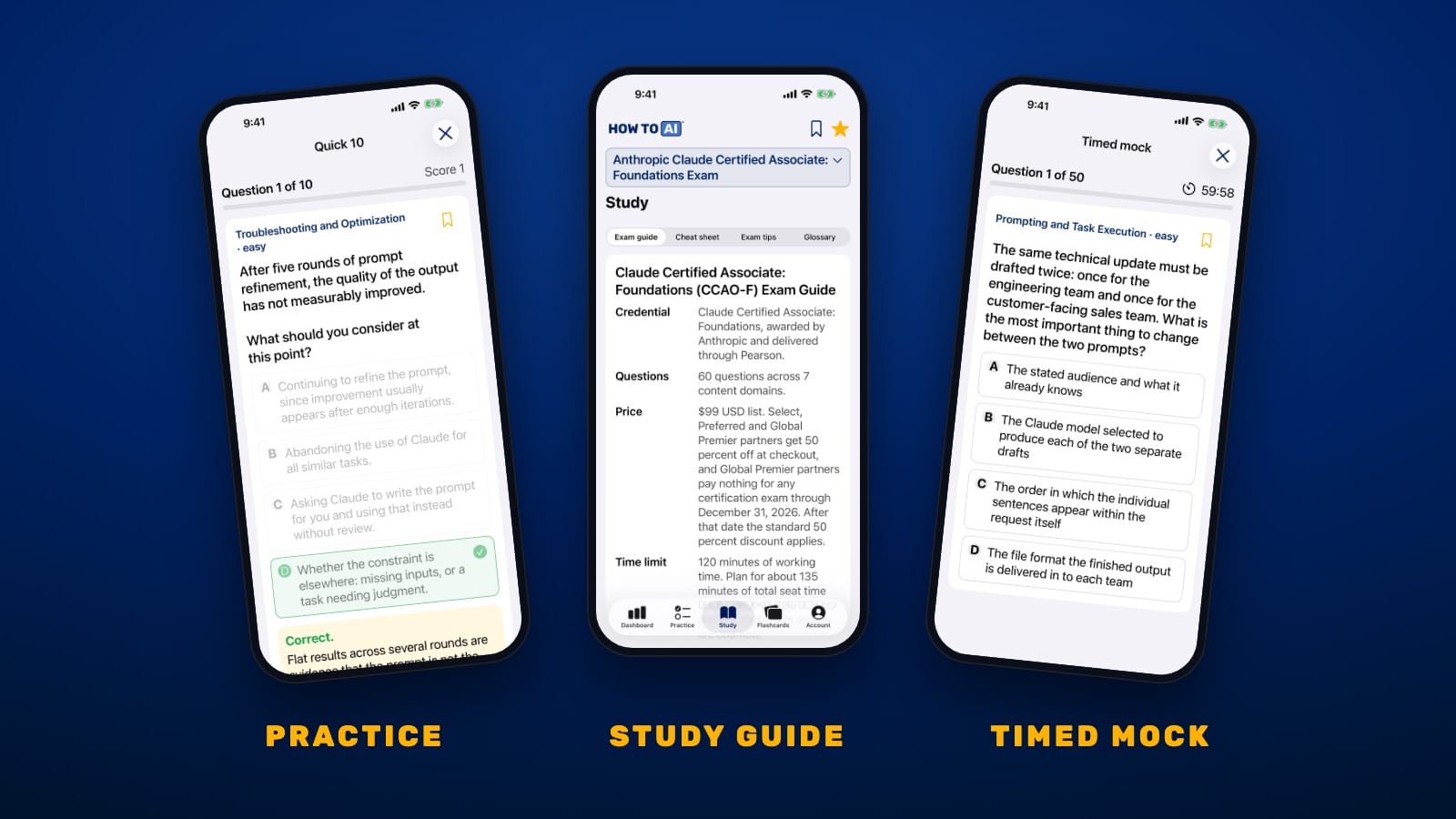
Study this exam on your phone
HOW TO // AI CERT has 5,245 original practice questions across 15 AI and cloud certifications, with plain-English explanations on every answer, full timed mock exams, weak-area drills, and an AI tutor powered by Claude. Free to download, with a free question set for every exam.

🤖 An AI Tutor on every question, powered by Claude
Stuck? Ask the AI Tutor. It explains the concept, shows why your pick was tempting but wrong, and answers follow-ups. Included with Pro.
🎓 Want the full question bank?
HOW TO // AI CERT unlocks the complete CCAO-F bank, timed mock exams, flashcards, spaced-repetition review, and the AI tutor. Free to start, Pro from $12/month, and one subscription covers every cert.
Free CCAO-F study guide & cheat sheet
Prefer to study first? The free CCAO-F study guide has the full exam breakdown, every domain with its official weight, and a topic cheat sheet. No sign-up.
How to prepare for CCAO-F
Start with Anthropic’s official CCAO-F exam guide on Partner Academy. It is the authoritative source for what the exam covers. The guide recommends hands-on practice: configure a Claude Project with instructions and knowledge sources, decompose and iterate on prompts, check outputs for accuracy and bias, and review Anthropic’s documentation for Projects, Artifacts, Memory, Skills and Code Execution.
Partner Academy also has a free Associate prep course made up of 8 courses. Anyone can use the free courses at Claude Academy, such as Claude 101, AI Fluency: Framework and foundations, and AI capabilities and limitations. For a day-by-day schedule, follow our 3-week CCAO-F study plan.
Before you book: registration is open only to people at Claude Partner Network organizations, so check who can take the Claude certification and what each Claude exam costs with partner discounts.
Searching for CCAO-F dumps? Skip them. Anthropic’s exam policy treats using leaked exam questions as misconduct that can get your result invalidated or your certification revoked. Here is why you don’t need dumps to pass.
Not sure this is the right exam for you? Compare all four: Claude certification explained, or read whether the Claude Certified Associate is worth it. Weighing the two architect exams? CCAR-F vs CCAR-P.
HOW TO // AI is not affiliated with or endorsed by Anthropic. CCAO-F, Claude Certified Associate: Foundations, Claude and Claude Code are trademarks of Anthropic PBC; we reference them descriptively. All questions are original and written from Anthropic’s published exam guide.
Practice for every AI & cloud cert
- NVIDIA NCA-AIIO practice questions
- NVIDIA NCA-GENL practice questions
- AWS AIF-C01 practice questions
- AWS MLA-C02 practice questions
- AWS MLA-C01 practice questions
- Microsoft AI-901 practice questions
- Microsoft AI-103 practice questions
- VMware VCP-VCF Administrator practice questions
- CompTIA AI Fundamentals practice questions
- Google Cloud Generative AI Leader practice questions
- Oracle OCI AI Foundations practice questions
- CertNexus AIP-210 practice questions
- Anthropic CCDV-F practice questions
- Anthropic CCAR-F practice questions
- Anthropic CCAR-P practice questions
- All AI & cloud exam prep →
Frequently asked questions
What is the CCAO-F exam?
CCAO-F is the exam code for Claude Certified Associate: Foundations, Anthropic's entry-level Claude certification for professionals who use Claude as a productivity tool. It needs no coding or API experience.
How many questions are on the CCAO-F exam, and what is the passing score?
The CCAO-F exam has 60 multiple-choice and multiple-response items with a 120-minute time limit. You need a scaled score of 720 on a range of 100 to 1,000 to pass.
How much does the CCAO-F exam cost?
CCAO-F costs $99 USD. Select, Preferred and Global Premier partners get 50% off, and Global Premier partners get 100% off through December 31, 2026.
Who can take the CCAO-F exam?
Only people at Claude Partner Network organizations can register, using a company email on a recognized domain. Anyone can still use these practice questions to learn the material.
Is there an official CCAO-F practice test?
Not anymore. Anthropic retired its practice exam when delivery moved to Pearson VUE on June 30, 2026, and the official exam guide now includes 3 sample questions with answers and rationales.
What do CCAO-F exam questions look like?
Every item is multiple choice or multiple response and says how many answers to pick, and many describe a short workplace scenario. Anthropic's 3 published sample questions cover checking a cited source before sharing, picking a fast, low-cost model for simple high-volume work, and anonymizing personal data before upload.
Are these real CCAO-F exam questions?
No. They are original questions written by HOW TO // AI from Anthropic's published exam guide, each with a plain-English explanation. Real exam content is confidential, and we never use exam recall or dumps.
Should I use CCAO-F dumps?
No. Anthropic's exam policy treats using leaked exam questions as misconduct, and the penalties include invalidating your result or revoking your certification. Practice questions written from the published guide prepare you without that risk.
Can I try CCAO-F practice questions for free?
Yes. The quiz on this page gives you 5 free CCAO-F questions with explanations, no sign-up needed, and you can unlock 15 more free with your email. The full question bank, timed mock exams and an AI tutor are in the HOW TO // AI CERT app.