
HOW TO // AI — CERT · CERTNEXUS AIP-210
Pass the CertNexus CAIP — the First Time
300 original practice questions weighted to the official AIP-210 blueprint, with a plain-English explanation on every single one.
Start the free quiz — no signup →5 questions free right now · 15 more with your email · full bank from $12/mo
Claude AI Tutor included with Pro — miss a question and it explains exactly why, in plain English, until it clicks.
Searching for “CompTIA AIP-210”? You’re in the right place: the AIP-210 exam is the CertNexus Certified Artificial Intelligence Practitioner (CAIP) — CertNexus is a separate company (a division of Logical Operations, not CompTIA), so the “CompTIA” label is a common mix-up. The exam is registered through CertNexus and Pearson VUE. Practice questions are the fastest way to get ready for it: they show how concepts are tested, surface your gaps, and make exam day feel familiar. Every question below comes with an explanation of why the answer is right.
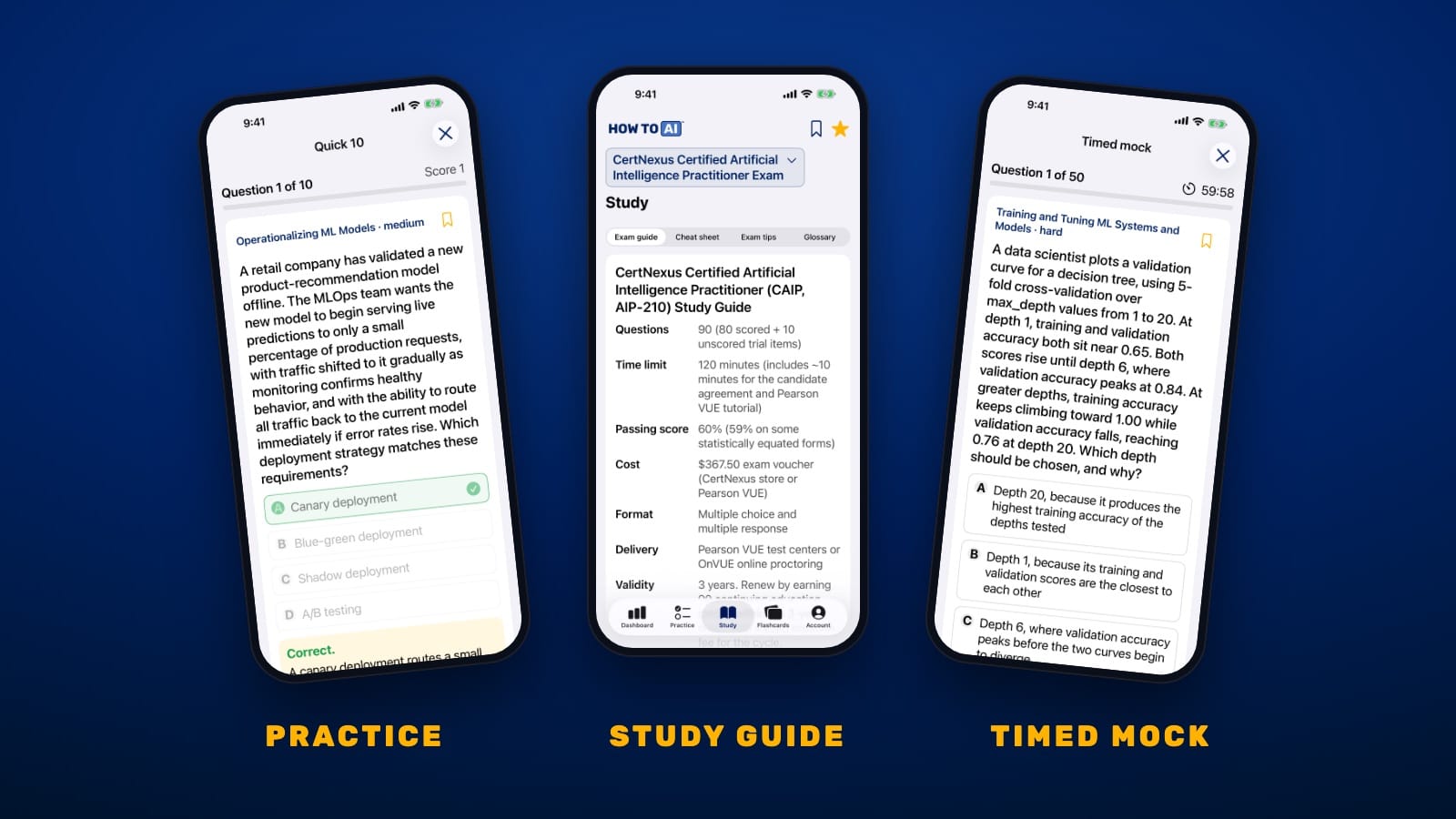
Study this exam on your phone
HOW TO // AI CERT has 5,245 original practice questions across 15 AI and cloud certifications, with plain-English explanations on every answer, full timed mock exams, weak-area drills, and an AI tutor powered by Claude. Free to download, with a free question set for every exam.

What’s on the CAIP (AIP-210) exam
| Questions | 90 (80 scored + 10 unscored trial items) |
|---|---|
| Time limit | 120 minutes (includes ~10 minutes for the agreement and tutorial) |
| Passing score | 60% (59% on some statistically equated forms) |
| Price | $367.50 exam voucher (CertNexus store or Pearson VUE) |
| Format | Multiple choice and multiple response |
| Delivery | Pearson VUE test centers or OnVUE online proctoring |
| Validity | 3 years — renew by retake, or earn 90 continuing education credits within 3 years ($150 CE program fee) |
| Prerequisites | None required; 1–3 years of ML/data exposure recommended (Python or R, statistics, SQL) |
Our question set is weighted to the blueprint:
| Domain | Weight | What it covers |
|---|---|---|
| Understanding the AI Problem | 26% | Framing business problems as AI/ML problems: matching algorithm families to use cases, supervised vs unsupervised vs reinforcement learning, communicating goals and KPIs with stakeholders, and spotting ethical concerns before a project starts. |
| Engineering Features for ML | 20% | Preparing data so models can learn: ETL and transformations, encoding categorical data, imputation, outliers, class imbalance and SMOTE, dimensionality reduction with PCA, avoiding data leakage, and the ethics of feature choices. |
| Training and Tuning ML Models | 24% | Building and refining models: classic ML algorithms (regression, trees, ensembles, SVM, k-NN, clustering) and deep learning architectures (ANN, CNN, RNN/LSTM, GAN), hyperparameter tuning, regularization, and cross-validation. |
| Operationalizing ML Models | 30% | The heaviest domain: taking models to production — deployment, monitoring, retraining, and the MLOps practices that keep a solution working after launch. |
Take the free practice quiz
Start with 5 free questions — read the explanation after each — then unlock 15 more with your email. No account needed to begin.
FREE PRACTICE QUIZ
Try 5 free AIP-210 practice questions
Answer at your own pace. Every question shows the correct answer and a plain-English explanation — that's where the learning happens. Unlock 15 more questions free at the end.
Read the 5 free AIP-210 questions as text, with answers and explanations
An insurance company processes about 40,000 auto claims per month. Experienced adjusters spend most of their day approving routine, low-value claims that follow highly predictable patterns. Leadership sponsors an ML project that will automatically approve routine claims and route only unusual or high-value claims to human adjusters. Which business value case does this project primarily represent?
- A. Replacing the entire claims department with a fully autonomous system
- B. Increasing the total number of claims the company receives each month
- C. Automating repetitive decisions so staff focus on complex work
- D. Eliminating the need for any human oversight of claim decisions
Answer: C. The classic ML value case here is automation of high-volume, repetitive decisions, which frees expert adjusters to work on the complex cases where their judgment adds the most value. Options A and D overstate what the project does: unusual claims are explicitly routed to humans, so people remain in the loop. Option B confuses operational efficiency with demand generation; ML does not change how many claims arrive.
A government transportation agency can fund only one machine learning project this year and asks a consultant to rank four candidate initiatives by their probability of success as ML projects. Which initiative should be ranked highest?
- A. Calculating toll charges, which are fully determined by a published rate table
- B. Prioritizing which of 12,000 bridges to inspect first, using 20 years of historical inspection reports and sensor readings
- C. Replacing paper permit applications with a standard online web form
- D. Enforcing a new statute that requires exact, rule-defined compliance checks with no tolerance for error
Answer: B. Bridge inspection prioritization has the shape of a strong ML use case: a large decision space, abundant historical data, and patterns too complex to encode as fixed rules. Options A and D are deterministic problems where the logic is fully specified: simple rules are more accurate, cheaper, and auditable, so ML adds risk without value. Option C is process digitization, not a prediction problem at all.
An electronics manufacturer wants to automatically detect surface defects such as scratches and solder faults on circuit boards as they move down the assembly line, using cameras mounted above the conveyor. Which type of learning system best fits this business case?
- A. Natural language processing (NLP)
- B. Speech recognition of spoken audio
- C. A recommendation system for users
- D. Image recognition (computer vision)
Answer: D. Detecting visual defects in camera images is a textbook computer vision / image recognition use case, typically implemented with convolutional neural networks. NLP and speech recognition operate on text and audio, not images, and recommendation systems suggest items to users rather than inspect products. Matching the data modality (images) to the learning system is the key skill tested here.
A telecom operator's call center wants to automatically route incoming customer phone calls. The planned system will first convert each caller's spoken words into text, then determine the caller's intent from that text in order to select the correct department. Which combination of learning systems does this solution require?
- A. Image recognition followed by natural language processing
- B. Speech recognition followed by natural language processing
- C. Speech recognition followed by a recommendation system
- D. Robotics followed by speech recognition
Answer: B. The pipeline has two distinct stages: speech recognition transcribes audio into text, and natural language processing (specifically natural language understanding) extracts the caller's intent from that text. Option C fails because recommenders suggest items based on user preferences, not classify intent from language. Options A and D involve modalities (images, physical actuation) that do not appear anywhere in this workflow.
A video streaming service has three years of subscriber records, each labeled with whether the subscriber canceled within 90 days of that record. The company wants to predict which current subscribers are likely to cancel in the next 90 days so retention offers can be targeted. How should this problem be framed?
- A. Reinforcement learning, with cancellations as negative rewards
- B. Supervised learning, as a regression problem predicting a continuous value
- C. Unsupervised learning, as a clustering problem
- D. Supervised learning, as a binary classification problem
Answer: D. Historical labels (canceled or not) plus a categorical yes/no prediction target make this supervised binary classification: the standard framing for churn. Clustering is unsupervised and would ignore the valuable labels the company already has. Regression predicts continuous quantities, and reinforcement learning applies to sequential decision-making with an agent acting in an environment, not to one-shot prediction from historical records.
Want more? Finish the quiz above to unlock 15 more free questions, or open the full AIP-210 practice app.
🤖 An AI Tutor on every question — powered by Claude
Stuck? Ask the AI Tutor — it explains the concept, shows why your pick was tempting but wrong, and answers follow-ups. Included with Pro.
🎓 Want the full question bank?
HOW TO // AI — CERT unlocks the complete CAIP (AIP-210) bank, timed mock exams, flashcards, spaced-repetition review, and the AI tutor — free to start, Pro from $12/month (one subscription covers every cert).
Free AIP-210 study guide & cheat sheet
Prefer to study first? The free AIP-210 study guide has the exam breakdown, a topic cheat sheet, and a full glossary — no sign-up.
How to prepare
Read the official exam page at CertNexus, take a practice set above, then focus your studying on the domains where you missed questions rather than re-reading everything. Pair it with the study guide for the concepts — and note the heaviest domain is Operationalizing ML Models (30%), so make sure deployment and MLOps get real study time. Weighing your options at this level? Microsoft’s brand-new AI-103 (Azure AI Apps & Agents Developer) is the other hands-on AI exam of the moment.
HOW TO // AI is not affiliated with or endorsed by CertNexus or CompTIA. Certified Artificial Intelligence Practitioner (CAIP) and AIP-210 are credentials of CertNexus; we reference them descriptively. All questions are original.
Practice for every AI & cloud cert
- NVIDIA NCA-AIIO practice questions
- NVIDIA NCA-GENL practice questions
- AWS AIF-C01 practice questions
- AWS MLA-C02 practice questions
- AWS MLA-C01 practice questions
- Microsoft AI-901 practice questions
- Microsoft AI-103 practice questions
- VMware VCP-VCF Administrator practice questions
- CompTIA AI Fundamentals practice questions
- Google Cloud Generative AI Leader practice questions
- Oracle OCI AI Foundations practice questions
- Anthropic CCAO-F practice questions
- Anthropic CCDV-F practice questions
- Anthropic CCAR-F practice questions
- Anthropic CCAR-P practice questions
- All AI & cloud exam prep →
Frequently asked questions
How much does the AIP-210 (CAIP) exam cost?
The exam voucher is $367.50, purchased through the CertNexus store or Pearson VUE. It is delivered at Pearson VUE test centers or via OnVUE online proctoring.
Is AIP-210 a CompTIA exam?
No. AIP-210 is the CertNexus Certified Artificial Intelligence Practitioner (CAIP). CertNexus is a separate company (a division of Logical Operations), not part of CompTIA — "CompTIA AIP-210" is a common search mix-up. You register through CertNexus and Pearson VUE, and the credential carries the CertNexus name.
How many questions is AIP-210 and what score passes?
90 questions — 80 scored plus 10 unscored trial items — in 120 minutes (including about 10 minutes of agreement and tutorial). The passing score is 60%, or 59% on some statistically equated forms. Formats are multiple choice and multiple response.
What experience do I need for the CAIP exam?
There are no formal prerequisites, but CertNexus recommends 1–3 years of professional machine-learning or data exposure — Python or R, statistics, and SQL. It is a practitioner-level exam, not an AI-literacy credential.
How long is the CAIP certification valid?
3 years. You can renew by retaking the exam or by earning 90 continuing education credits within the 3 years, with a $150 CE program fee.
Can I try AIP-210 practice questions for free?
Yes. The quiz on this page gives you 5 free AIP-210 questions with explanations, no sign-up needed, and you can unlock 15 more free by adding your email at the end. The full question bank, timed mock exams and an AI tutor are in the HOW TO // AI — CERT app.