
VCP-VCF Administrator Study Guide & Cheat Sheet
A free study guide for the VCP-VCF Administrator exam (2V0-17.25) — exam facts, the domain breakdown, study tips, a topic cheat sheet, and a full glossary. No sign-up needed. For a week-by-week schedule, follow the 4-week VCP-VCF Administrator study plan.
Ready to practice? Take the free VCP-VCF Administrator practice quiz → · Get the full exam prep →
Make sure this is the right exam
Start here, because more people waste study time on this than on any other VMware certification. The current VCP-VCF Administrator requirement is exam code 2V0-17.25, built on VMware Cloud Foundation 9.0. The 2V0-13.x codes belong to the Architect track, and 2V0-11.25 was the older VCF 5.2 administrator exam that Broadcom has retired. Prep material written for those is not prep material for this.
The exam is for people who run VMware Cloud Foundation day to day: deploying and operating the stack, not designing it on a whiteboard. Broadcom does not publish percentage weights per section, which changes how you study. (Any percentages you see in the breakdown below are our own estimates, not Broadcom figures.) There is no heavy domain to lean into, so breadth plus lab time beats trying to guess where the questions are.
How to use this guide
- Read the sections as a coverage map. Without weights, the goal is no blank spots rather than a favourite topic.
- Take the tips seriously. They cover how the questions are framed and what “operate it” means in practice.
- Turn the cheat sheet into lab tasks. For each line, ask whether you have actually done it in a VCF 9.0 lab. Reading about a workflow is not the same as running it.
- Then test under time with the practice questions linked above.
Before you book
This is one of the pricier exams we cover, so it is worth reading what it costs, including retakes, and whether it pays off for your role first. Our four-week plan is mostly lab hours, for the reason above.
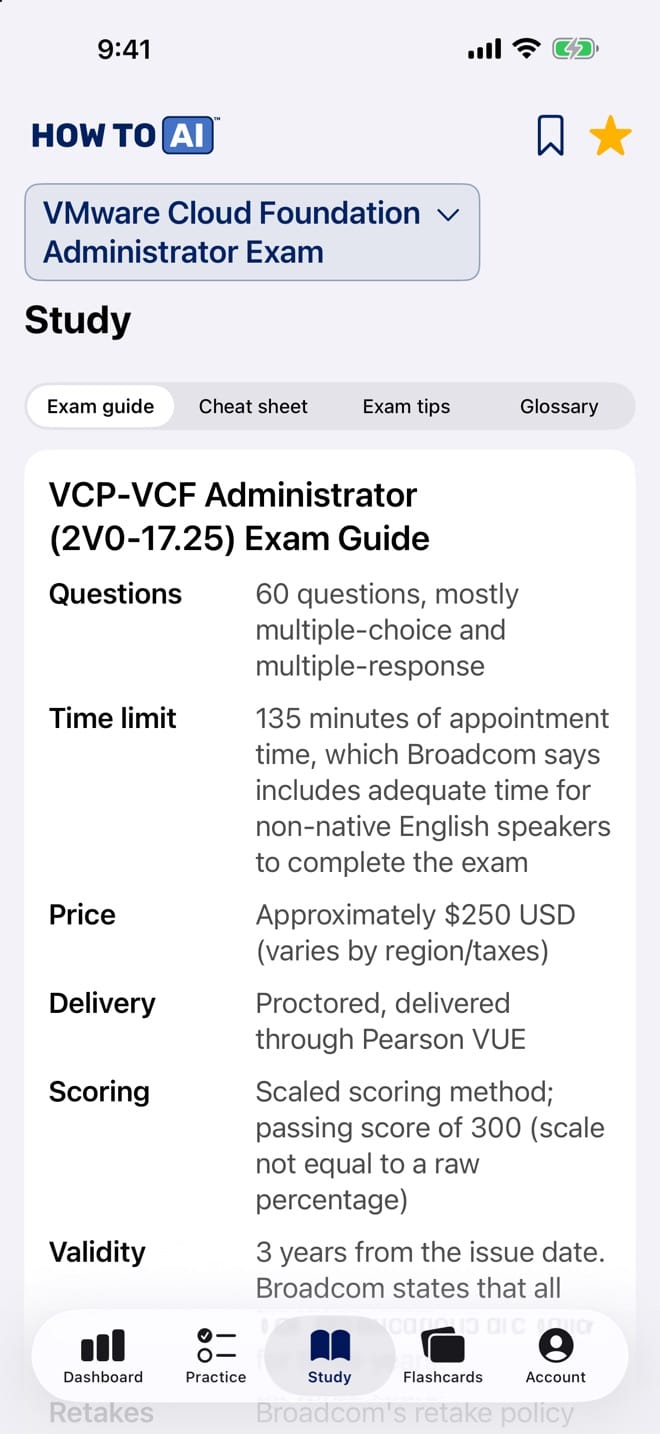
VCP-VCF Administrator (2V0-17.25) Exam Guide
| Questions | 60 questions, mostly multiple-choice and multiple-response |
|---|---|
| Time limit | 135 minutes of appointment time, which Broadcom says includes adequate time for non-native English speakers to complete the exam |
| Price | Approximately $250 USD (varies by region/taxes) |
| Delivery | Proctored, delivered through Pearson VUE |
| Scoring | Scaled scoring method; passing score of 300 (scale not equal to a raw percentage) |
| Validity | 3 years from the issue date. Broadcom states that all VCF certifications are valid for three years. |
| Retakes | Broadcom's retake policy requires a seven-day wait between attempts. |
| Prerequisites | No formal prerequisite; recommended ~1 year of IT experience plus ~6 months working with VCF or its components |
| Language | Primarily English. Broadcom says Japanese is available for some VCF exams, so confirm the language list when you schedule. |
| Domain weights | Broadcom publishes exam sections and objectives for 2V0-17.25 but no percentage weights. The percentages shown in this guide are HOW TO // AI estimates of relative emphasis, not official figures. |
Exam domains
| Domain | Weight | What it covers |
|---|---|---|
| Private Cloud Vision | 6% | The business and architectural rationale for a private cloud built on VMware Cloud Foundation 9.0 — the unified full-stack model (compute, storage, networking, automation, operations) and how VCF delivers cloud agility on-premises with consistent operations and a single SDDC lifecycle. |
| Compute Fundamentals | 12% | Core vSphere compute concepts in VCF 9.0: the ESX hypervisor, vCenter, vSphere clusters, and features such as HA, DRS, vMotion, and resource pools that underpin every management and workload domain. |
| Storage Fundamentals | 14% | vSAN as the principal VCF storage: ESA versus OSA architectures, Storage Policy-Based Management (SPBM), Failures To Tolerate (FTT), deduplication/compression, plus supplemental and external storage options for workload domains. |
| Network Fundamentals | 12% | NSX networking and the underlying vSphere Distributed Switch (vDS): overlay/Geneve segments, Tier-0/Tier-1 gateways, static and dynamic routing, NAT, load balancing, and the Distributed Firewall (DFW) for micro-segmentation. |
| VCF Deploy & Configure | 15% | Standing up VCF 9.0 with the VCF Installer (bring-up): deploying the management domain, creating VI/workload domains and vSphere clusters, host commissioning, and establishing the foundational SDDC configuration. |
| VCF Manage | 11% | Day-2 administration of the VCF fleet: certificate, license, and password management, identity/RBAC via VCF Identity Broker, lifecycle and upgrades, host add/remove, and importing existing vCenters into VCF. |
| VCF Operations | 16% | Monitoring, troubleshooting, and optimizing the environment with VCF Operations, VCF Operations for Logs, VCF Operations for Networks, VCF Fleet Management, and VCF Health and Diagnostics — capacity, performance, alerting, and log/network analytics. |
| VCF Consume & Automate | 14% | Self-service consumption with VCF Automation: Regions, multi-org tenancy, provider/org networking, content libraries, governance policies, extensibility, and provisioning Kubernetes via vSphere Supervisor. |
Who it’s for: VMware administrators and cloud-infrastructure engineers who install, configure, manage, and troubleshoot a VMware Cloud Foundation 9.0 private cloud.
Study & test-day tips
- Learn VCF 9.0 product names cold — the exam uses current branding (ESX not ESXi, VCF Operations not Aria Operations, VCF Operations for Logs not Log Insight, VCF Automation not vRealize/Aria Automation). Legacy 5.x/Aria/vRealize names in answer options are common distractors.
- Memorize the vSAN ESA vs OSA distinction: ESA is single-tier, all-NVMe, no separate cache/capacity disk groups, with compression-per-object and better default RAID-5/6 efficiency; OSA uses disk groups with a dedicated cache tier. Know which features require ESA.
- Master SPBM and FTT math: FTT=1 with RAID-1 mirroring needs 2 copies + witness; RAID-5 needs 4 hosts (FTT=1), RAID-6 needs 6 hosts (FTT=2). Expect questions tying host count to a chosen storage policy.
- Know the VCF domain model precisely — exactly one management domain runs the SDDC managers/operations stack, while VI/workload domains run tenant workloads. Be clear on what bring-up via the VCF Installer creates versus what you add later.
- Drill NSX gateway hierarchy: Tier-0 gateways handle north-south/upstream routing (BGP/static), Tier-1 gateways handle tenant/segment routing and connect down to overlay segments; the DFW enforces micro-segmentation independent of network topology.
- Understand which VCF Operations component answers a given question: Operations for capacity/performance/health, Operations for Logs for log analytics, Operations for Networks for flow/path visibility, Fleet Management for multi-instance lifecycle. Scenario questions hinge on picking the right tool.
- Study VCF Automation tenancy: the difference between provider and org (tenant) constructs, Regions, provider vs org networking, content libraries, and governance/extensibility — expect scenarios about isolating tenants and applying policy.
- Know lifecycle and upgrade ordering and that VCF coordinates fleet-wide LCM; understand certificate, license, and password rotation workflows and where VCF Identity Broker fits for identity federation and RBAC.
- Because scoring is scaled to 300 (not a raw percentage), don't try to back-calculate how many you can miss — answer every question (no penalty for guessing) and flag-and-review uncertain ones within the 135-minute window.
- Practice reading multi-response questions carefully — note exactly how many answers are required, eliminate legacy-named and version-mismatched options first, and watch for VCF 9.0-specific behaviors (e.g., importing existing vCenters, vSphere Supervisor for Kubernetes) that differ from older releases.
Cheat sheet
Compute (vCenter / ESX / clusters)
- ESX is the VCF 9.0 hypervisor (renamed from ESXi); vCenter provides centralized management of clusters and hosts.
- vSphere clusters enable HA (restart VMs on host failure), DRS (load balancing via vMotion), and EVC for CPU compatibility.
- vMotion = live VM migration; Storage vMotion = live datastore migration; both are zero-downtime.
- Each VCF domain (management or workload) has its own vCenter; the management domain is deployed first during bring-up.
- Hosts are commissioned into the VCF inventory before being assigned to a cluster/workload domain.
Storage (vSAN)
- vSAN ESA: single-tier all-NVMe, no disk groups, per-object compression, efficient RAID-5/6 — the modern default in VCF 9.0.
- vSAN OSA: legacy disk-group model with separate cache + capacity tiers.
- SPBM (Storage Policy-Based Management) assigns availability/performance rules per VM or object.
- FTT defines failures tolerated: RAID-1 mirror (FTT=1) needs ~2 hosts + witness; RAID-5 needs 4; RAID-6 (FTT=2) needs 6.
- Space efficiency: deduplication and compression reduce capacity usage (ESA does compression by default).
- vSAN is the principal VCF storage; external/supplemental storage can be added to workload domains.
Networking (NSX)
- NSX overlays run on a vSphere Distributed Switch (vDS); Geneve encapsulation carries overlay segment traffic.
- Tier-0 gateway = north-south / upstream routing (BGP or static) to the physical fabric.
- Tier-1 gateway = tenant/segment routing, connects overlay segments and links up to a Tier-0.
- Distributed Firewall (DFW) enforces micro-segmentation at the vNIC, independent of topology.
- NSX also provides NAT and load balancing for north-south and east-west services.
- Edge nodes/clusters host centralized services (T0 routing, NAT, LB).
Deploy & bring-up
- VCF Installer performs bring-up, deploying the management domain (SDDC managers + operations stack) first.
- After bring-up, create VI/workload domains and additional vSphere clusters for tenant workloads.
- Hosts must be commissioned (validated, added to inventory) before cluster assignment.
- Existing vCenters can be imported into VCF 9.0 rather than only greenfield deployment.
- vSphere Supervisor enables Kubernetes (Tanzu/Supervisor) on a cluster for modern apps.
Manage & lifecycle
- VCF coordinates fleet-wide lifecycle management (LCM) — upgrades/patches across the SDDC stack in a supported order.
- Certificate management: issue/replace certs across components from a central workflow.
- License and password management are handled centrally for the fleet.
- VCF Identity Broker provides identity federation and RBAC for the platform.
- Add/remove hosts and expand clusters as day-2 operations through SDDC management.
Operations & automation
- VCF Operations (was Aria Operations): capacity, performance, health, alerting, optimization.
- VCF Operations for Logs (was Log Insight): centralized log aggregation and analytics.
- VCF Operations for Networks (was vRealize Network Insight): flow analysis, path/topology, security planning.
- VCF Fleet Management + VCF Health and Diagnostics: multi-instance oversight and proactive health checks.
- VCF Automation (was Aria/vRealize Automation): self-service catalog, Regions, multi-org tenancy, governance, extensibility.
- Tenancy: provider constructs vs org (tenant) constructs, with provider/org networking and content libraries.
Glossary
- VMware Cloud Foundation (VCF)
- VMware's integrated full-stack private-cloud platform that bundles compute, storage, networking, automation, and operations with unified lifecycle management. Version 9.0 is the basis for the 2V0-17.25 exam.
- ESX
- VMware's bare-metal hypervisor in VCF 9.0 (formerly named ESXi) that runs virtual machines on physical hosts.
- vCenter
- The centralized management server for ESX hosts and clusters, providing features like HA, DRS, and vMotion. Each VCF domain has its own vCenter.
- Management domain
- The first VCF domain deployed during bring-up; it runs the SDDC management and operations components that control the entire environment.
- VI / workload domain
- A logically isolated VCF domain (with its own vCenter and clusters) created to run tenant or production workloads separately from management.
- vSphere cluster
- A group of ESX hosts managed as a single pool of compute and storage, enabling HA, DRS, and shared vSAN datastores.
- vSphere HA
- High Availability — automatically restarts virtual machines on surviving hosts when a host or VM fails.
- vSphere DRS
- Distributed Resource Scheduler — balances VM workloads across cluster hosts using vMotion based on resource demand.
- vMotion
- Live migration of a running VM from one host to another with no downtime; Storage vMotion does the same for the VM's datastore.
- vSAN
- VMware's software-defined storage that pools local host disks into a shared datastore; the principal storage layer for VCF.
- vSAN ESA
- Express Storage Architecture — a single-tier, all-NVMe vSAN design without disk groups, offering efficient RAID-5/6 and default per-object compression.
- vSAN OSA
- Original Storage Architecture — the legacy vSAN design using disk groups with a separate cache tier and capacity tier.
- SPBM
- Storage Policy-Based Management — assigns availability and performance requirements (such as FTT and RAID type) to VMs or objects through policies.
- FTT
- Failures To Tolerate — the number of host/device failures a vSAN object can survive, which together with the RAID type drives the minimum host count.
- Deduplication & compression
- vSAN space-efficiency features that remove duplicate blocks and compress data to reduce capacity consumption; ESA performs compression by default.
- NSX
- VMware's software-defined networking and security platform providing overlay segments, gateways, routing, NAT, load balancing, and firewalling in VCF.
- vSphere Distributed Switch (vDS)
- A cluster-wide virtual switch that provides consistent networking across hosts and serves as the foundation for NSX overlay traffic.
- Geneve
- The encapsulation protocol NSX uses to tunnel overlay (logical) network traffic across the physical underlay.
- Tier-0 gateway
- An NSX gateway that handles north-south routing between the virtual environment and the physical network, typically using BGP or static routes.
- Tier-1 gateway
- An NSX gateway for tenant/segment-level routing that connects overlay segments and links upward to a Tier-0 gateway.
- Distributed Firewall (DFW)
- NSX's hypervisor-level firewall that enforces micro-segmentation policy at each VM's virtual NIC, independent of network topology.
- vSphere Supervisor
- The Kubernetes control plane embedded in vSphere that turns a cluster into a platform for running containers and Kubernetes workloads.
- VCF Installer
- The tool that performs VCF bring-up — validating inputs and deploying the management domain and initial SDDC components.
- VCF Operations
- The monitoring and optimization product (formerly Aria Operations) for capacity, performance, health, and alerting across the VCF fleet.
- VCF Operations for Logs
- Centralized log aggregation and analytics (formerly vRealize/Aria Log Insight) for troubleshooting across the environment.
- VCF Operations for Networks
- Network flow, path, and topology analytics (formerly vRealize Network Insight) used for visibility and micro-segmentation planning.
- VCF Fleet Management
- The capability for managing multiple VCF instances/components together, including coordinated lifecycle and oversight at fleet scale.
- VCF Health and Diagnostics
- Proactive health-check and diagnostic tooling that surfaces issues and remediation guidance across the VCF stack.
- VCF Automation
- The self-service provisioning and governance product (formerly vRealize/Aria Automation) offering catalogs, tenancy, policies, and extensibility.
- Region
- A VCF Automation construct grouping infrastructure resources to scope where and how workloads are provisioned.
- Multi-org tenancy
- VCF Automation's model of separating provider and tenant (org) constructs so multiple organizations share the platform with isolation and governance.
- VCF Identity Broker
- The platform component that provides identity federation and role-based access control (RBAC) across VCF services.
- Lifecycle management (LCM)
- VCF's coordinated upgrade and patch process that updates the full SDDC stack in a supported sequence to keep the fleet on compatible versions.
Put it into practice
Studying is step one — practice questions are where it sticks. Start with free VCP-VCF Administrator practice questions, then go Pro for the full 301-question bank, timed mocks, and an AI tutor. Before you book, check the VCP-VCF Administrator exam cost and retake rules.
HOW TO // AI is not affiliated with or endorsed by VMware or Broadcom. VMware Cloud Foundation, VCP-VCF Administrator, and exam 2V0-17.25 are trademarks or certifications of Broadcom Inc.; we reference them descriptively. All content is original.
Take this guide with you
The same study guide, cheat sheet and glossary live in HOW TO // AI CERT on iPhone, next to 6,151 original practice questions, timed mock exams, flashcards and an AI tutor powered by Claude. Free to download, with a free question set for every exam.

Practice for every AI & cloud cert
- NVIDIA NCA-AIIO practice questions
- NVIDIA NCA-GENL practice questions
- AWS AIF-C01 practice questions
- AWS MLA-C02 practice questions
- AWS MLA-C01 practice questions
- Microsoft AI-901 practice questions
- Microsoft AI-103 practice questions
- CompTIA AI Fundamentals practice questions
- Google Cloud Generative AI Leader practice questions
- Oracle OCI AI Foundations practice questions
- CertNexus AIP-210 practice questions
- Anthropic CCAO-F practice questions
- Anthropic CCDV-F practice questions
- Anthropic CCAR-F practice questions
- Anthropic CCAR-P practice questions
- Databricks GenAI Engineer Associate practice questions
- Salesforce Agentforce Specialist practice questions
- CompTIA SecAI+ practice questions
- All AI & cloud exam prep →
Frequently asked questions
How much does the VCP-VCF Administrator (2V0-17.25) exam cost?
$250 USD, as a proctored exam delivered through Pearson VUE.
How many questions is the VCP-VCF Administrator exam?
60 questions — mostly multiple-choice and multiple-response — in a 135-minute appointment, which includes time for non-native English speakers.
What is the passing score for 2V0-17.25?
300 on Broadcom's scaled scoring method — the scale does not translate directly to a raw percentage, so use consistent practice-exam performance as your readiness signal.
What experience do I need before taking the VCP-VCF Administrator exam?
There is no formal prerequisite, but Broadcom recommends about a year of IT experience plus roughly 6 months working with VMware Cloud Foundation or its components (vSphere, vSAN, NSX).