
HOW TO // AI — CERT · GOOGLE CLOUD
Pass the Google Generative AI Leader — the First Time
300 original practice questions weighted to the official exam blueprint, with a plain-English explanation on every single one.
Start the free quiz — no signup →10 free questions now · 10 more with your email · the full bank from $12 a month
Claude AI Tutor included with Pro — miss a question and it explains exactly why, in plain English, until it clicks.
Practice questions are the fastest way to get ready for the Google Cloud Generative AI Leader exam: they show how concepts are tested, surface your gaps, and make exam day feel familiar. Every question below comes with an explanation of why the answer is right.
How these questions were made. Every question here is original. HOW TO // AI writes them from Google Cloud’s public Generative AI Leader exam guide and maps each one to a domain in its blueprint. They are not real exam questions: real exam content is confidential for every candidate, and we never use exam recall or dumps.
What Google Cloud’s public exam guide covers
Everything in this section comes from Google Cloud’s public exam guide, not from the exam itself.
| Questions | 50-60 multiple choice |
|---|---|
| Time limit | 90 minutes |
| Price | $99 USD |
| Delivery | Online-proctored or onsite-proctored |
| Scoring | Pass/fail |
| Validity | 3 years; renewable within Google’s renewal eligibility period |
| Prerequisites | None; no hands-on Google Cloud experience required |
| Language | English, Japanese, Spanish, Portuguese |
Our question set is weighted to the blueprint:
| Domain | Weight | What it covers |
|---|---|---|
| Fundamentals of Generative AI | 30% | Covers the core concepts a leader needs: what generative AI and foundation models are, how large language models work, and the role of tokens, embeddings, and multimodal inputs and outputs. Focuses on understanding capabilities and limitations – including hallucinations, bias, and the difference between traditional AI and generative AI – rather than building models. |
| Google Cloud's Generative AI Offerings | 35% | The largest domain. Know Google's portfolio at a high level: the Gemini family of models and the Gemini app, Gemini for Google Workspace, Gemini Enterprise Agent Platform (Agent Platform) and its components (Model Garden, Agent Studio, Agent Search, custom agents, vector search), and media models such as Imagen and Veo plus tools like Gemini Notebook (formerly NotebookLM) and Gemini Code Assist. Emphasis is on matching a business need to the right Google product, not on configuration. |
| Techniques to Improve Generative AI Output | 20% | Explains how organizations make model output more accurate, relevant, and trustworthy. Grounding and retrieval-augmented generation (RAG) are the most heavily tested, alongside prompt engineering and fine-tuning, and when each technique is the right choice for a given business problem. |
| Business Strategies for Generative AI Solutions | 15% | Focuses on adopting generative AI responsibly and profitably: Google's responsible-AI principles, security and data governance, change management, and measuring return on investment and business value. Covers how leaders evaluate use cases, manage risk, and build organizational readiness. |
Take the free practice quiz
Start with 10 free questions — read the explanation after each — then unlock 10 more with your email. No account needed to begin.
FREE PRACTICE QUIZ
Try 10 free Google Cloud Generative AI Leader practice questions
Answer at your own pace. Every question shows the correct answer and a plain-English explanation, and that's where the learning happens. Unlock 10 more questions free at the end.
Read the 10 free Google Cloud Generative AI Leader questions as text, with answers and explanations
A retail company's chief digital officer is briefing the board on the technology behind their new customer-service assistant. She explains that it runs on a very large model that was pre-trained on a broad, diverse dataset and can be adapted to many different downstream tasks such as summarization, classification, and chat. Which term best describes this type of model?
- A. A relational database engine
- B. A rules-based expert system
- C. A traditional regression model trained for a single task
- D. A foundation model
Answer: D. A foundation model is a large model pre-trained on broad data that can be adapted (via prompting, fine-tuning, or grounding) to many downstream tasks. A rules-based expert system and a single-task regression model are narrow and not adaptable across many tasks, and a relational database engine stores and queries data rather than generating content.
When a leader is estimating the cost of using a large language model through Agent Platform, they are told that pricing is often based on the number of "tokens" processed in both the input and the output. What is a token in this context?
- A. A security credential that authenticates the API call
- B. A reward point a user earns for giving the model feedback
- C. A unit of text, such as a word or part of a word
- D. A single pixel in an image the model generates
Answer: C. In LLMs, a token is a chunk of text (a whole word or a fragment of one) that the model reads or produces, and most usage-based pricing counts input and output tokens. The other options confuse the term with authentication credentials, loyalty points, or image pixels, none of which is how text token pricing works.
A media company wants to build a search experience where employees can type a plain-language question and retrieve conceptually similar documents even when the documents use different wording than the query. Their data team proposes converting both the documents and the queries into numerical vectors that capture semantic meaning, then matching them by similarity. What is being described?
- A. Manual tagging of every document with metadata labels
- B. Diffusion-based image generation
- C. Keyword indexing with exact-match lookup
- D. Embeddings used with vector search
Answer: D. Embeddings represent text (or other data) as vectors that capture semantic meaning, so similar concepts land near each other and can be matched with vector search even when wording differs. Exact-match keyword indexing would miss synonyms and paraphrases, diffusion generates images, and manual tagging does not produce the semantic vector matching described.
A product leader wants a single Google model that can accept a photo of a damaged product, read an attached text complaint, and produce a written summary of the issue for the support team. Which characteristic of the model makes this possible?
- A. It is deterministic, returning identical output for any input
- B. It is a narrow model fine-tuned only for image classification
- C. It is an embedding-only model that outputs vectors rather than text
- D. It is multimodal, combining inputs such as images and text
Answer: D. Multimodal models (such as Gemini) can take multiple input types like images and text together and produce a combined response. Determinism is unrelated to handling multiple input types, a narrow image classifier cannot read the text complaint and write a summary, and an embedding-only model outputs vectors rather than the written summary required.
During a pilot, a company's legal team notices that the generative AI assistant confidently cited a court case that does not actually exist. What is this failure mode called?
- A. Overfitting to the validation set
- B. Latency
- C. Hallucination
- D. Rate limiting
Answer: C. A hallucination is when a generative model produces content that is plausible-sounding but factually false or fabricated, such as a nonexistent legal citation. Latency refers to response speed, rate limiting caps request volume, and overfitting describes a training problem, none of which describes inventing false facts.
A retail company wants to give employees a single, conversational AI assistant they can access directly through a web interface or mobile app to brainstorm ideas, draft text, and analyze uploaded images, without setting up any cloud project. Which Google offering is designed for this consumer- and employee-facing chat experience?
- A. Cloud Run
- B. Model Garden on Agent Platform
- C. The Gemini app
- D. Agent Platform
Answer: C. The Gemini app is Google's ready-to-use, end-user chat interface (web and mobile) powered by Gemini models, requiring no cloud project or development. Model Garden and the broader Agent Platform are aimed at builders and developers, and Cloud Run is a compute service for deploying containers, not a chat assistant.
A marketing director wants AI assistance embedded directly inside Gmail, Google Docs, Google Sheets, and Google Slides so staff can draft emails, summarize threads, and generate slide content without leaving those apps. Which offering provides this?
- A. Gemini Notebook
- B. Imagen for image generation
- C. Gemini for Google Workspace
- D. Agent Search
Answer: C. Gemini for Google Workspace integrates Gemini's generative capabilities directly into Workspace apps like Gmail, Docs, Sheets, and Slides. Gemini Notebook (formerly NotebookLM) is a separate research and note-grounding tool, Imagen is an image-generation model that Google has discontinued in favor of Gemini image models, and Agent Search builds search experiences over enterprise data.
A bank's AI team wants a single place within Agent Platform to discover, compare, and select from Google first-party models (like Gemini and Veo), partner models, and open-source models before building. Which component meets this need?
- A. Model Garden
- B. Agent Search
- C. Gemini Code Assist
- D. Vector Search
Answer: A. Model Garden is the Agent Platform catalog where teams browse, evaluate, and deploy a wide range of foundation models, including Google first-party (Gemini, Veo), partner, and open models. Agent Search builds search apps, Gemini Code Assist helps developers write code, and Vector Search is the similarity-search service, not a model catalog.
A leader is concerned that a customer-facing chatbot built on a foundation model invents plausible-sounding but false answers about the company's own products. The team wants responses anchored to the company's current, approved product documentation. Which technique most directly addresses this?
- A. Switching to a smaller, cheaper model
- B. Increasing the model's temperature setting
- C. Adding more example conversations to the system instructions only
- D. Grounding the model with retrieval over the company's product documents
Answer: D. Grounding (often via Retrieval-Augmented Generation) connects the model to authoritative external or enterprise data so answers are based on real, current sources rather than the model's parametric memory, directly reducing hallucination. Raising temperature increases randomness, a smaller model does not fix factual grounding, and a few examples alone cannot supply the up-to-date product facts.
A product leader wants a low-code environment on Google Cloud's Agent Platform where business and technical staff can quickly test prompts, tune parameters, and compare model responses before committing to a production build. Which component is intended for this rapid experimentation?
- A. Vector Search, for similarity lookup
- B. Agent Studio, the visual AI workspace
- C. BigQuery, the analytics data warehouse
- D. Cloud Storage, for object file storage
Answer: B. Agent Studio (formerly Vertex AI Studio) provides an interactive environment for prompt design, testing, parameter tuning, and comparing model outputs, ideal for rapid experimentation. Vector Search handles similarity search, Cloud Storage stores files, and BigQuery is a data warehouse, none of which is a prompt-experimentation interface.
Want more? Finish the quiz above to unlock 10 more free questions, or open the full Google Cloud Generative AI Leader practice app.
After the free 20
Practice the full Generative AI Leader bank, timed like exam day
HOW TO // AI CERT has 300 original Generative AI Leader practice questions written from Google Cloud’s public exam guide. You also get timed mock exams, an AI tutor powered by Claude that explains every miss, and a readiness score that tells you when to book. Pro is $12 a month, or $39 for the whole year, and covers every exam we offer. Start with a free account. 14-day refund.
These are original practice questions, not real exam questions. No brain dumps, nothing copied from real exams.
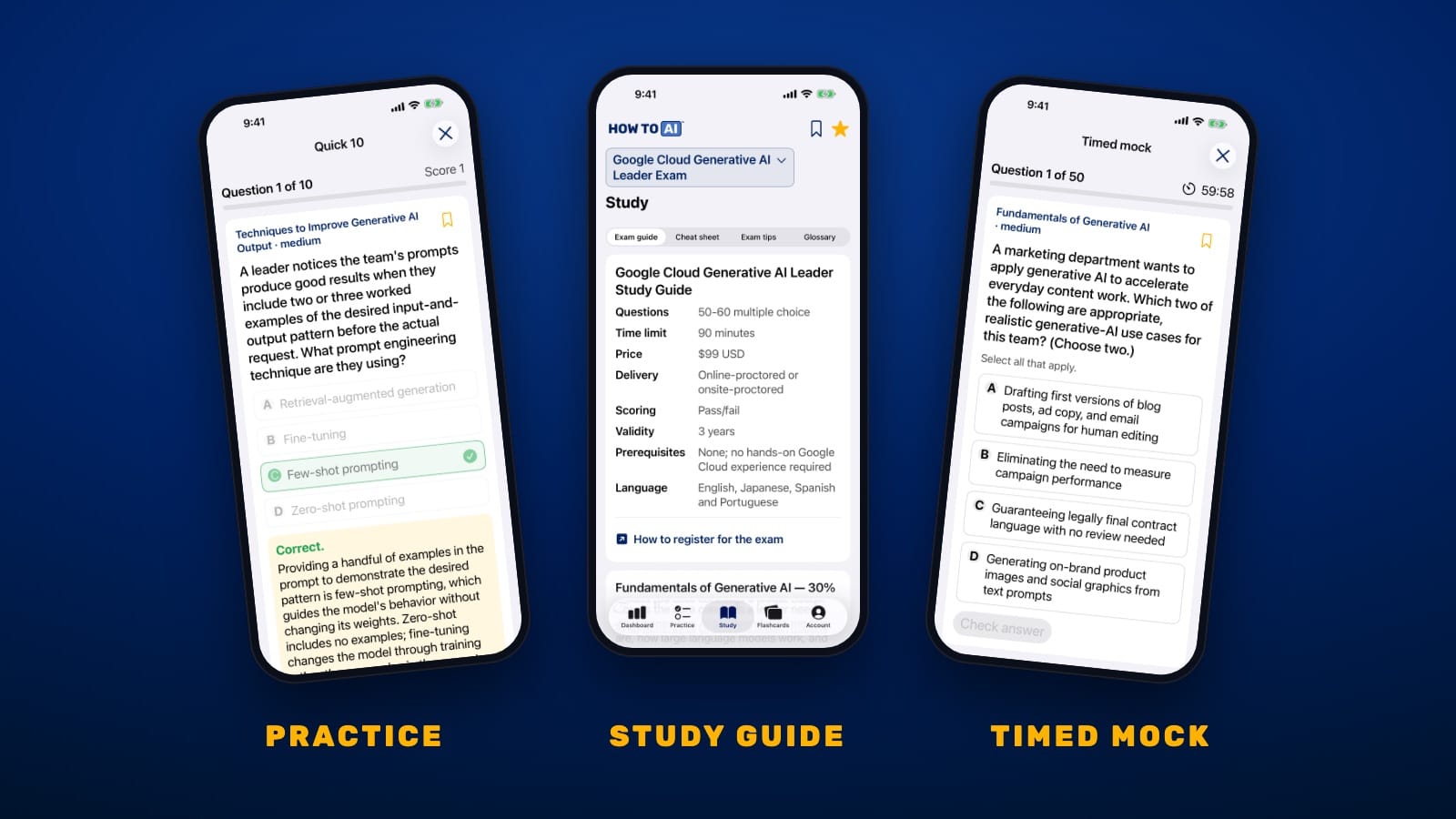
Study this exam on your phone
HOW TO // AI CERT has 6,151 original practice questions across 18 AI and cloud certifications, with plain-English explanations on every answer, full timed mock exams, weak-area drills, and an AI tutor powered by Claude. Free to download, with a free question set for every exam.

Free Google Cloud Generative AI Leader study guide & cheat sheet
Prefer to study first? The free Google Cloud Generative AI Leader study guide has the exam breakdown, a topic cheat sheet, and a full glossary — no sign-up.
How to prepare
Read the official exam objectives on the Google Cloud Generative AI Leader page, take a practice set above, then focus your studying on the domains where you missed questions rather than re-reading everything. Pair it with the study guide for the concepts.
HOW TO // AI is not affiliated with or endorsed by Google. Google Cloud Generative AI Leader is a certification of Google LLC; we reference it descriptively. All questions are original.
Practice for every AI & cloud cert
- NVIDIA NCA-AIIO practice questions
- NVIDIA NCA-GENL practice questions
- AWS AIF-C01 practice questions
- AWS MLA-C02 practice questions
- AWS MLA-C01 practice questions
- Microsoft AI-901 practice questions
- Microsoft AI-103 practice questions
- VMware VCP-VCF Administrator practice questions
- CompTIA AI Fundamentals practice questions
- Oracle OCI AI Foundations practice questions
- CertNexus AIP-210 practice questions
- Anthropic CCAO-F practice questions
- Anthropic CCDV-F practice questions
- Anthropic CCAR-F practice questions
- Anthropic CCAR-P practice questions
- Databricks GenAI Engineer Associate practice questions
- Salesforce Agentforce Specialist practice questions
- CompTIA SecAI+ practice questions
- All AI & cloud exam prep →
Frequently asked questions
How many questions are on the Google Generative AI Leader exam, and what do I need to pass?
The Google Cloud Generative AI Leader exam has 50–60 multiple-choice questions and gives you 90 minutes. Google does not publish a passing score; results are pass/fail. It is delivered online-proctored or onsite-proctored.
How much does the Google Generative AI Leader exam cost?
Google's Google Cloud Generative AI Leader exam costs $99 USD. You register through the official Google certification site. Pricing can vary by region and taxes.
How should I prepare for the Google Generative AI Leader exam?
It is a leadership-focused exam; no hands-on Google Cloud experience is required. The most reliable way to prepare is to study the official exam guide and then work through lots of practice questions to find and fix weak spots. Our 300-question bank for Generative AI Leader is blueprint-weighted, so the topic mix mirrors the real exam — practice until your readiness score is consistently high, then book your exam.
Are HOW TO // AI — CERT's Google Generative AI Leader questions real exam questions?
No. All 300 of our Generative AI Leader practice questions are 100% original, written from the published exam objectives. We never copy, leak, or reproduce real exam content ("brain dumps") — that would violate Google's policies and would not actually teach you the material. Every question comes with a plain-English explanation so you learn the concept, not just the answer.
Is HOW TO // AI — CERT affiliated with Google?
No. HOW TO // AI — CERT is an independent study resource and is not affiliated with, authorized by, endorsed by, or sponsored by Google. All product and exam names are trademarks of their respective owners; we reference them only to describe what our practice questions cover.
Can I try Google Generative AI Leader practice questions for free?
Yes. You can practice a free set of Generative AI Leader questions with no sign-up required, then unlock more by email. Pro unlocks the full 300-question bank plus timed mock exams, flashcards, spaced-repetition review, a readiness score, and an AI tutor that explains any question — from $12/month, and one subscription covers every certification we offer.