
HOW TO // AI CERT · ANTHROPIC CCAO-F
CCAO-F Practice Questions for the Claude Certified Associate: Foundations Exam
315 original practice questions written from Anthropic’s published CCAO-F exam guide and weighted to its blueprint, with a plain-English explanation on every one.
Start the free quiz, no signup →10 free questions now · 10 more with your email · the full bank from $12 a month
Claude AI Tutor included with Pro. Miss a question and it explains exactly why, in plain English, until it clicks.
CCAO-F is Anthropic’s Claude Certified Associate: Foundations exam: 60 multiple-choice and multiple-response items in 120 minutes, a scaled passing score of 720, and a $99 fee. The free CCAO-F practice questions on this page are original, written by HOW TO // AI from Anthropic’s published exam guide in the item formats it describes, and every answer comes with a plain-English explanation.
CCAO-F is the entry-level Claude certification and the only one that needs no coding. Anthropic built it for people who use Claude as a productivity tool in operations, marketing, project management, education and communications, and its Partner Academy describes the Associate role as one for consultants, sellers and delivery leads.
How these questions were made. Every question here is original. HOW TO // AI writes them from Anthropic’s published CCAO-F exam guide, which is free and public, and maps each one to a domain in its blueprint. They are not real exam questions: live exam content is confidential under Anthropic’s exam NDA, and we never use exam recall or dumps.
CCAO-F exam at a glance
| Exam | Claude Certified Associate: Foundations (CCAO-F) |
|---|---|
| Questions | 60 items until December 6, 2026; 70 items (60 scored) from December 7. Multiple choice and multiple response (each item says how many answers to pick) |
| Time | 120 minutes (plan for about 135 minutes of seat time) |
| Passing score | Scaled 720 on a range of 100–1,000 |
| Price | $99 USD, 50% off for Select, Preferred and Global Premier partners, free for Global Premier through December 31, 2026 |
| Delivery | Pearson VUE, online proctored (OnVUE) or at a Pearson test center |
| Who can register | Claude Partner Network employees only, with a recognized company email (details) |
| Language | English only |
| Prerequisites | None, and no coding or API experience needed |
| Validity | 12 months, then a free on-time renewal |
| Partner tier credit | No. It is the only Claude certification that doesn’t count toward Partner Network tier standing |
| Official practice exam | Retired on June 30, 2026. The exam guide includes 3 sample questions |
Checked against Anthropic’s Partner Academy CCAO-F exam guide and certification FAQ on October 8, 2026.
CCAO-F exam domains and weights
This is the published exam outline from Anthropic’s CCAO-F exam guide (Version 1.0, effective July 2026). Our practice questions follow the same weights.
| Domain | Weight | What the guide lists |
|---|---|---|
| 1. Prompting and Task Execution | 14% | Effective prompts for business and technical tasks, task decomposition, iterating for quality, adapting strategy for analysis, research, drafting and brainstorming. |
| 2. Output Evaluation and Validation | 21% | Accuracy and completeness, spotting hallucinations, inconsistencies and bias, fact-checking, deciding when human review is needed, editing for the audience, choosing output formats. |
| 3. Product and Model Selection | 12% | Projects, research mode, chat and artifacts. Telling Haiku, Sonnet and Opus apart. Matching the model to cost, speed and quality. Context limits and memory. |
| 4. Workflow Integration and Solution Design | 16% | Analyzing requirements and use cases, research and planning, supporting solution design, integrating Claude into existing workflows, explaining value and limits to stakeholders. |
| 5. Configuration and Knowledge Management | 12% | Configuring Projects with instructions and knowledge sources, managing uploads and connectors, system-level instructions, keeping configurations current. |
| 6. Governance, Risk, and Responsible Use | 15% | Appropriate and inappropriate use cases, data sensitivity, regulation and privacy, organizational AI policy, ethical implications. |
| 7. Troubleshooting and Optimization | 10% | Diagnosing weak prompts and poor outputs, adjusting based on feedback, optimizing workflows. |
Worth knowing. The heaviest domain is not prompting. It is evaluating and validating what Claude produced, at 21%, so more than one question in five is about catching a problem in the output. If you only practice writing prompts, you are preparing for 14% of the exam.
What CCAO-F exam questions look like
Here is what Anthropic’s published exam guide and FAQ say about the format. Every item is multiple choice or multiple response, and each one tells you how many answers to select. Anthropic describes the multiple-response items as scenario-based: a short workplace situation, then the best action.
The guide’s 3 official sample questions, which Anthropic says are not drawn from the live item bank, show the pattern. One asks what to do before sending a confident Claude summary that cites a specific regulation subsection to a compliance team. One asks which model fits a high volume of short, simple drafts where speed and cost matter most. One asks how to analyze a spreadsheet containing customer identifiers when policy restricts personal data.
The answers reward the same habits: verify specific claims against the source, match the model to the task, and follow data policy without abandoning the work. The published blueprint pairs that judgment with product knowledge, such as Projects, artifacts and choosing between Haiku, Sonnet and Opus. Our questions are written to train both across all seven domains.
How to use these practice questions
- Take the 10 free questions cold, before you study, to get a baseline.
- Read every explanation, including the ones you got right. The reasoning is what transfers to new questions.
- Note the domain of each miss and study that part of the outline above.
- Unlock 10 more with your email and take them after a few days of study to see what moved.
- Finish with Anthropic’s own sample questions in the official exam guide, which show the real item style.
About the official sample questions: Anthropic retired its CCAO-F practice exam when delivery moved to Pearson VUE on June 30, 2026. The exam guide on Partner Academy now carries 3 sample questions with answers and rationales, and Anthropic notes they are not drawn from the live item bank. Our questions are a separate, original set written from the same published guide.
Want a full CCAO-F mock exam? The free quiz below is the place to start. Timed CCAO-F mock exams, the complete question bank and weak-area drills are in the HOW TO // AI CERT app.
Take the free CCAO-F practice quiz
Start with 10 free questions, read the explanation after each, then unlock 10 more with your email. No account needed to begin.
FREE PRACTICE QUIZ
Try 10 free CCAO-F practice questions
Answer at your own pace. Every question shows the correct answer and a plain-English explanation, and that's where the learning happens. Unlock 10 more questions free at the end.
Read the 10 free CCAO-F questions as text, with answers and explanations
You need a repeatable way to check whether a Claude-generated report is complete. Which approach gives the most reliable signal?
- A. Ask Claude whether its own report covered everything you asked for.
- B. Check that the report is longer than the previous version produced by the team.
- C. Compare the report against the list of required elements in your request.
- D. Read the opening and closing paragraphs, since gaps usually appear there.
Answer: C. Completeness is measured against the requirement list you defined, so an explicit element-by-element check is the reliable method. A fails because the model is judging itself with the same context that produced the gap, which adds no independent evidence. B confuses length with coverage. D is a sampling shortcut that misses omissions buried in the body, which is where they typically occur.
In reviewing Claude output, what distinguishes an accuracy problem from a completeness problem?
- A. Accuracy problems appear in numbers; completeness problems appear in prose.
- B. Accuracy problems occur in long outputs; completeness problems occur in short outputs.
- C. An accuracy problem means something stated is wrong; a completeness problem means something required is absent.
- D. Accuracy problems require human review; completeness problems can always be fixed by re-prompting.
Answer: C. The distinction is between what is present and false versus what is required and missing, and a review process should test for both. A ties the categories to content type, which is arbitrary; a prose claim can be inaccurate and a table can be incomplete. B ties them to length, which is unrelated. D is wrong on both halves: completeness gaps can be as serious as accuracy errors, and re-prompting does not guarantee the gap is closed.
You have a Claude-drafted brief and the source document it was built from. What is the most effective first step in validating the brief?
- A. Ask Claude to rate its own confidence in each paragraph of the brief.
- B. Identify every specific claim in the brief, then locate each one in the source document.
- C. Ask Claude to regenerate the brief and compare the two versions for differences.
- D. Run the brief past a colleague who has not read the source, to check readability.
Answer: B. Claim-by-claim tracing to the source is the core fact-checking technique and produces evidence you can point to. A relies on the model to audit itself, and self-reported confidence is not independent verification. C detects instability between generations but two consistent outputs can be consistently wrong. D checks whether the brief reads well, which is a different quality dimension entirely.
You asked Claude to 'write something about our Q3 results' and received a generic, high-level paragraph that could describe almost any company.What is the most likely cause?
- A. The model tier is too low for business writing.
- B. The request lacked the data, audience, purpose, and length that shape output.
- C. Claude is not able to write about financial topics without special configuration.
- D. The conversation has too much prior context, which diluted the request.
Answer: B. A generic request produces generic output because nothing in it constrains the result to your company or your reader; supplying the results, audience, purpose, and length is the direct fix. A reaches for a model change before the prompt has been given anything to work with. C invents a restriction that does not exist. D blames context, but this failure appears even at the start of a fresh conversation.
A long Claude response stops in the middle of a sentence partway through a list you requested.What is the most reasonable first response?
- A. Conclude that the request violated a content restriction.
- B. Ask Claude to continue from where it stopped, or rerun the request in smaller parts.
- C. Report the account as malfunctioning before trying again.
- D. Accept the partial list, since the remaining items are likely minor.
Answer: B. A response cut off mid-sentence usually means the output ran up against a length limit, and asking for a continuation or splitting the request into smaller units addresses it directly. A misreads a length cutoff as a refusal, which typically presents as an explanation rather than a truncated sentence. C escalates before the simplest remedy has been attempted. D silently accepts an incomplete deliverable.
An output is not what you wanted and you are deciding what to try first.What is the most sensible first diagnostic step?
- A. Re-read your request and check whether it stated what you expected.
- B. Switch to a different Claude model and compare.
- C. Start a fresh conversation to clear any accumulated confusion.
- D. Add several examples of the output you want so the model can match them.
Answer: A. Most disappointing outputs trace back to an expectation that was held but never stated, so comparing the request against the expectation is the cheapest and most often decisive check. B, C, and D are all legitimate later moves, but each changes the setup before you know what went wrong, which risks fixing the wrong thing and hides the actual cause.
A marketing lead asks Claude to 'write something about our new product' and receives a generic paragraph that could describe almost any product. What is the most effective single improvement to the request?
- A. Ask Claude to be more creative and generate a longer, more distinctive paragraph
- B. Name the audience, the purpose, the length and tone, and supply the facts
- C. Send the same request several times and keep whichever version happens to read best
- D. Switch to a more capable model before changing anything about the request itself
Answer: B. B is correct because a generic output is almost always the symptom of a generic input: audience, purpose, format constraints, and the actual product facts are the information Claude cannot invent and does not have. A fails because 'be more creative' adds no information about what the text is for, so the result will vary in style but not in usefulness. C fails because resampling the same underspecified prompt only surveys the range of generic answers. D fails because model capability does not supply facts about a product Claude has never seen; the bottleneck is context, not intelligence.
An HR coordinator wants Claude to answer employee questions about the company's parental leave policy. Why should she paste the policy document into the request rather than simply asking the question?
- A. Pasting the document makes Claude respond faster
- B. Pasting the document reduces the cost of the request
- C. Pasting the document guarantees the answer will be formatted as a numbered list of steps
- D. Claude cannot see internal policies and would answer from general knowledge instead
Answer: D. D is correct because an internal policy is private information that is not in the model's training data or reachable without a supplied document or a connected source; without it, Claude produces a plausible generic answer that may contradict the real policy. A fails because adding input text does not make a response faster and typically makes it slower. B fails because more input tokens cost more, not less. C fails because formatting comes from the formatting instruction, not from the presence of an attachment.
A business analyst wants a one-page briefing that an executive will use to approve or reject a budget request. Which addition to the prompt most improves the odds of a usable first draft?
- A. State the required sections, the length limit, and the decision it supports
- B. Tell Claude the briefing is very important and that it must be excellent work
- C. Ask Claude to write the briefing in a suitably crisp and executive tone throughout
- D. Request several alternative versions of the briefing so that one can be chosen later
Answer: A. A is correct because naming the structure, the length limit, and the decision the document supports converts a vague request into checkable success criteria that Claude can aim at. B fails because urgency is not a specification and does not tell Claude what to include. C fails because tone alone leaves the content, structure, and scope unresolved. D fails because generating several equally underspecified drafts multiplies review work without improving any one of them.
A compliance team runs the same weekly review, always working from the same policy manual, style guide, and reporting template, and always wanting Claude to behave the same way. Which Claude feature best fits?
- A. A new standalone chat each week with all three documents re-attached from scratch
- B. A project, with the documents as knowledge and the directions as instructions
- C. An artifact that contains the three documents for the team to consult each week
- D. Web search enabled on every chat so that the manual is always the current version
Answer: B. B is correct because projects exist for exactly this shape of work: a persistent knowledge base plus instructions that apply to every chat inside the project, so the setup is done once rather than weekly. A fails because it repeats the setup cost every week and invites drift as people attach slightly different versions. C fails because an artifact is a piece of standalone content Claude produces, not a mechanism for supplying persistent context. D fails because the sources here are internal documents that a web search cannot reach.
Want more? Finish the quiz above to unlock 10 more free questions, or open the full CCAO-F practice app.
After the free 20
Practice the full CCAO-F bank, timed like exam day
HOW TO // AI CERT has 315 original CCAO-F practice questions written from Anthropic’s public exam guide. You also get timed mock exams, an AI tutor powered by Claude that explains every miss, and a readiness score that tells you when to book. Pro is $12 a month, or $39 for the whole year, and covers every exam we offer. Start with a free account. 14-day refund.
These are original practice questions, not real exam questions. No brain dumps, nothing copied from real exams.
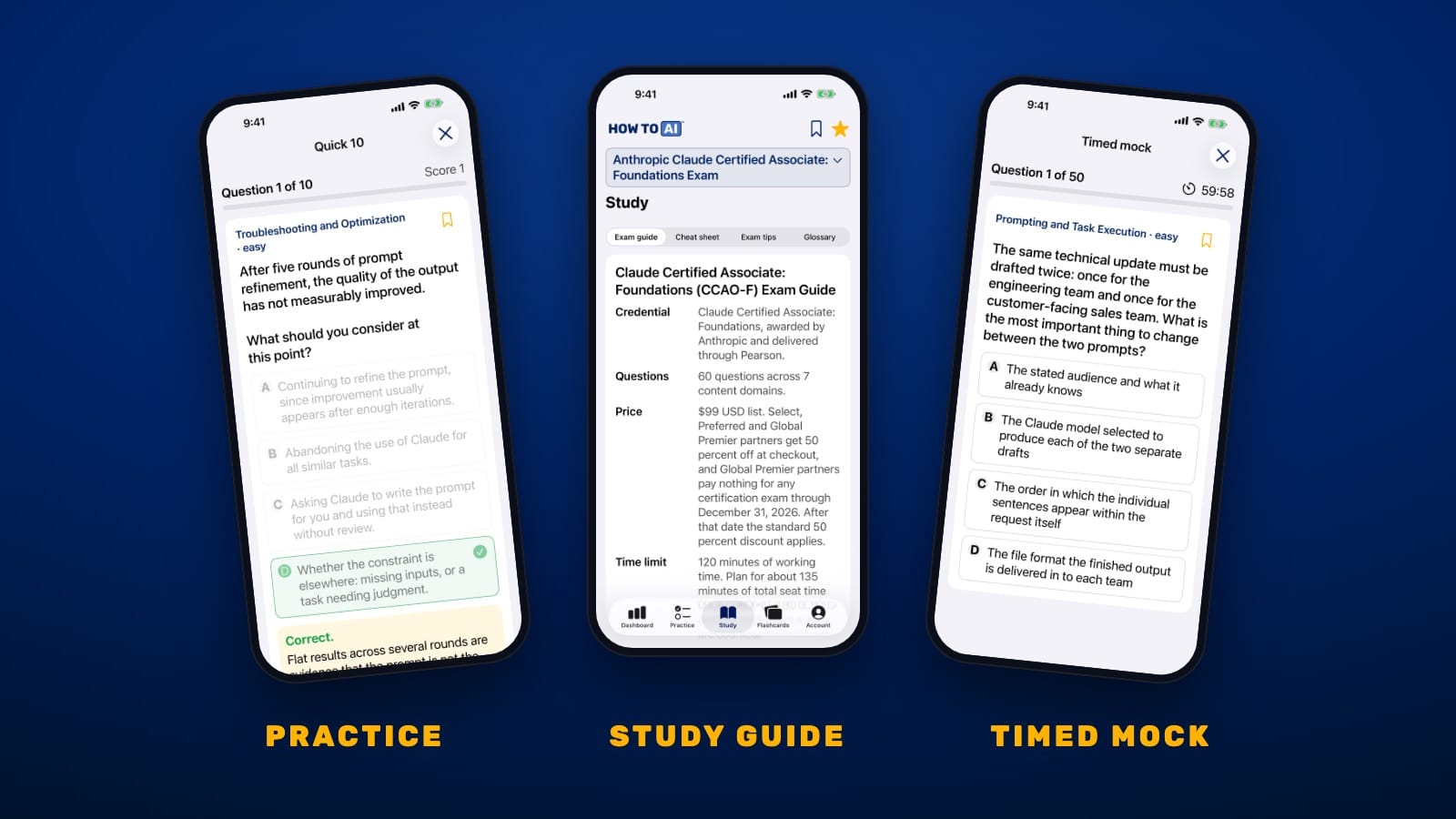
Study this exam on your phone
HOW TO // AI CERT has 6,151 original practice questions across 18 AI and cloud certifications, with plain-English explanations on every answer, full timed mock exams, weak-area drills, and an AI tutor powered by Claude. Free to download, with a free question set for every exam.

Free CCAO-F study guide & cheat sheet
Prefer to study first? The free CCAO-F study guide has the full exam breakdown, every domain with its official weight, and a topic cheat sheet. No sign-up.
How to prepare for CCAO-F
Start with Anthropic’s official CCAO-F exam guide on Partner Academy. It is the authoritative source for what the exam covers. The guide recommends hands-on practice: configure a Claude Project with instructions and knowledge sources, decompose and iterate on prompts, check outputs for accuracy and bias, and review Anthropic’s documentation for Projects, Artifacts, Memory, Skills and Code Execution.
Partner Academy also has a free Associate prep course made up of 8 courses. Anyone can use the free courses at Claude Academy, such as Claude 101, AI Fluency: Framework and foundations, and AI capabilities and limitations. For a day-by-day schedule, follow our 3-week CCAO-F study plan.
Before you book: registration is open only to people at Claude Partner Network organizations, so check who can take the Claude certification and what each Claude exam costs with partner discounts.
Searching for CCAO-F dumps? Skip them. Anthropic’s exam policy treats using leaked exam questions as misconduct that can get your result invalidated or your certification revoked. Here is why you don’t need dumps to pass.
Not sure this is the right exam for you? Compare all four: Claude certification explained, or read whether the Claude Certified Associate is worth it. Weighing the two architect exams? CCAR-F vs CCAR-P.
HOW TO // AI is not affiliated with or endorsed by Anthropic. CCAO-F, Claude Certified Associate: Foundations, Claude and Claude Code are trademarks of Anthropic PBC; we reference them descriptively. All questions are original and written from Anthropic’s published exam guide.
Practice for every AI & cloud cert
- NVIDIA NCA-AIIO practice questions
- NVIDIA NCA-GENL practice questions
- AWS AIF-C01 practice questions
- AWS MLA-C02 practice questions
- AWS MLA-C01 practice questions
- Microsoft AI-901 practice questions
- Microsoft AI-103 practice questions
- VMware VCP-VCF Administrator practice questions
- CompTIA AI Fundamentals practice questions
- Google Cloud Generative AI Leader practice questions
- Oracle OCI AI Foundations practice questions
- CertNexus AIP-210 practice questions
- Anthropic CCDV-F practice questions
- Anthropic CCAR-F practice questions
- Anthropic CCAR-P practice questions
- Databricks GenAI Engineer Associate practice questions
- Salesforce Agentforce Specialist practice questions
- CompTIA SecAI+ practice questions
- All AI & cloud exam prep →
Frequently asked questions
What is the CCAO-F exam?
CCAO-F is the exam code for Claude Certified Associate: Foundations, Anthropic's entry-level Claude certification for professionals who use Claude as a productivity tool. It needs no coding or API experience.
How many questions are on the CCAO-F exam, and what is the passing score?
The CCAO-F exam has 60 multiple-choice and multiple-response items with a 120-minute time limit. You need a scaled score of 720 on a range of 100 to 1,000 to pass.
How much does the CCAO-F exam cost?
CCAO-F costs $99 USD. Select, Preferred and Global Premier partners get 50% off, and Global Premier partners get 100% off through December 31, 2026.
Who can take the CCAO-F exam?
Only people at Claude Partner Network organizations can register, using a company email on a recognized domain. Anyone can still use these practice questions to learn the material.
Is there an official CCAO-F practice test?
Not anymore. Anthropic retired its practice exam when delivery moved to Pearson VUE on June 30, 2026, and the official exam guide now includes 3 sample questions with answers and rationales.
What do CCAO-F exam questions look like?
Every item is multiple choice or multiple response and says how many answers to pick, and many describe a short workplace scenario. Anthropic's 3 published sample questions cover checking a cited source before sharing, picking a fast, low-cost model for simple high-volume work, and anonymizing personal data before upload.
Are these real CCAO-F exam questions?
No. They are original questions written by HOW TO // AI from Anthropic's published exam guide, each with a plain-English explanation. Real exam content is confidential, and we never use exam recall or dumps.
Should I use CCAO-F dumps?
No. Anthropic's exam policy treats using leaked exam questions as misconduct, and the penalties include invalidating your result or revoking your certification. Practice questions written from the published guide prepare you without that risk.
Can I try CCAO-F practice questions for free?
Yes. The quiz on this page gives you 10 free CCAO-F questions with explanations, no sign-up needed, and you can unlock 10 more free with your email. The full question bank, timed mock exams and an AI tutor are in the HOW TO // AI CERT app.