
Advanced Claude Architect Study Guide & Cheat Sheet (CCAR-P)
A free study guide for Anthropic’s most advanced Claude exam. Exam facts, all seven domains with official weights, and the surprising thing a verified passer says about its difficulty. No sign-up needed.
Ready to practice? Take the free CCAR-P practice quiz →
How this guide was made. I have never seen the CCAR-P exam. I can’t, because Anthropic restricts registration to employees of partner companies with 10 or more staff, and I don’t qualify. Everything below comes from Anthropic’s published exam guide, which is free and public, and from named first-hand accounts. No exam recall. No dumps. Ever.
Exam facts
| Exam code | CCAR-P |
|---|---|
| Full name | Claude Certified Architect: Professional |
| Price | $175 USD, the most expensive of the four |
| Questions | 63 |
| Time | 120 minutes |
| Passing score | 720 on a scaled range of 100 to 1,000 |
| Prerequisites | None. You do not need Foundations first |
| Validity | 12 months, then a free non-proctored renewal |
| Guide version | v1.0, July 2026 |
The counterintuitive part: it may be the easier architect exam
The naming suggests Professional is a step up from Foundations. The best available first-hand account says otherwise.
A candidate with four to five years of AI systems experience, who uses Claude Code in production daily, published a detailed write-up after passing. His assessment: moderately easy, and noticeably easier than the Architect Foundations exam. His advice was that if you have already cleared Foundations, go straight for Professional without overthinking it.
That is one account, from someone experienced, so calibrate against your own background. But it is consistent with the blueprints. Foundations is a deep implementation exam. Professional is broader and shallower, and it trades technical depth for architecture judgment. Full comparison here.
Who it is for
Mid to senior technical professionals who design, build and deliver production-grade AI solutions. Anthropic’s guide explicitly excludes entry-level developers and anyone without end-to-end system design experience.
Recommended background is three or more years in systems architecture or platform engineering, plus six or more months with Claude or comparable LLM systems in production.
The domain breakdown
Notice how flat this is compared to the other exams. No domain dominates, so you cannot skip one and pass comfortably.
| Domain | Weight | Roughly |
|---|---|---|
| Integration | 19% | ~12 questions |
| Solution Design & Architecture | 17% | ~11 questions |
| Evaluation, Testing & Optimization | 16% | ~10 questions |
| Governance, Safety & Risk Management | 14% | ~9 questions |
| Stakeholder Communication & Lifecycle Management | 14% | ~9 questions |
| Claude Models, Prompting & Context Engineering | 13% | ~8 questions |
| Developer Productivity & Operational Enablement | 7% | ~4 questions |
Integration (19%)
- Evaluating tool and agent configuration for capability bloat
- Analyzing authentication and authorization requirements to find security gaps
- Weighing accuracy against latency and justifying the call
- Observability and monitoring strategies at scale
- Designing a RAG pipeline with appropriate chunking and indexing
- Matching retrieval strategy to data shape and query pattern
- Choosing between connection protocols and integration mechanisms
- Progressive discovery versus monolithic context
RAG shows up here and barely appears in Foundations. That is one of the clearest content deltas between the two architect exams.
Solution Design & Architecture (17%)
- Translating business problems into Claude-based solutions
- End-to-end architectures covering input, processing, output and feedback loops
- Selecting patterns: workflow, agentic, or augmented LLM
- Multi-agent systems and orchestration strategy
- Decomposition techniques for complex problems
- Aligning to business value pillars: efficiency, transformation, productivity, cost, performance SLAs
Evaluation, Testing & Optimization (16%)
- Defining metrics across accuracy, latency, cost, safety and security
- Designing evaluation datasets and mixed-methodology test frameworks
- A/B testing and iterative improvement
- Diagnosing prompt failure, hallucination, and model mismatch
- Optimizing token usage, latency and cost-performance trade-offs
- Monitoring with logging and observability tooling
Counterintuitive fact worth memorizing. Anthropic’s documented eval guidance says to prioritize volume over quality: more questions with slightly lower-signal automated grading beats fewer hand-graded ones. Grading preference runs code-based first, then human, then LLM-based, and the docs say to avoid human grading if possible.
Governance, Safety & Risk Management (14%)
- Implementing guardrails and safety controls
- Identifying risks, limitations and failure modes
- Human-in-the-loop validation strategies
- Compliance with GDPR, HIPAA and FedRAMP
- Ethical considerations: bias, fairness, transparency
A trap to know. If you handle PHI you need HIPAA readiness, which is a signed BAA plus a HIPAA-enabled organization. You do not also need Zero Data Retention. The instinct is to stack both, and the documentation is explicit that you should not.
Stakeholder Communication & Lifecycle Management (14%)
- Structured discovery and requirement gathering
- Communicating architectural decisions and trade-offs
- Managing feedback loops and expectations, including SLAs
- Documenting architectures and providing implementation guidance
- Supporting discovery, design, handoff, monitoring and iteration
This is where engineers lose the exam. Fourteen percent of a technical architecture exam is about talking to people who fund the work. Combined with Governance that is 28% of your score sitting outside the code. A verified passer said the technical tooling questions were the intuitive ones and that the governance and security trade-off scenarios were what actually needed studying.
Claude Models, Prompting & Context Engineering (13%)
- Model selection based on trade-offs
- System prompts, templates and guardrails
- Zero-shot, few-shot and chain-of-thought technique
- Context window optimization and token management
- Prompt reuse through caching, modular prompts and Skills
Cache ordering matters as much as caching. One of the guide’s own sample answers is to place the static system prompt and policy before the dynamic content, then enable prompt caching. Both halves. Cache reads cost roughly a tenth of base input, a five-minute write costs 1.25 times, and a one-hour write costs double.
Developer Productivity & Operational Enablement (7%)
Configuring Claude tools and environments for teams, improving developer workflows, and supporting debugging and operational resolution. The smallest domain. Do not over-invest here.
The pattern in the answers
Across the sample questions, when something goes wrong the correct answer is a systems answer. Remove a capability. Fix the index. Reorder for cache. Add a gate. It is rarely improve the prompt and almost never use a bigger model.
Three examples from Anthropic’s own guide. A support agent exposing refund and delete tools nobody uses: remove them entirely, which is least privilege applied to tool design. An 8,000-token static system prompt sent every request: reorder and cache. A RAG system returning confident wrong answers after a document refresh: the retrieval and indexing step is serving stale chunks, and the model is not the problem.
Question structure to watch for
A passer flagged one specific trap. Some questions ask what you would do at a given step, then follow up asking what you would do before that process. The process under discussion is named in the first line of the question and is not repeated in the follow-up, so it is easy to answer against the wrong one.
Read the setup line twice before committing. He also estimated the split at roughly 40% of questions answerable immediately and 60% needing you to read the full scenario and weigh trade-offs.
How to prepare
Anthropic’s own directive is to build and operate at least one end-to-end Claude solution including RAG, evaluation and observability. Then study the blueprint and self-assess against every objective, and work the sample questions.
Weight your effort toward governance and stakeholder work rather than tooling. That is where the marginal point is. For a week-by-week schedule, follow the 6-week CCAR-P study plan.
Free official reading: the model overview, prompt caching, developing tests, and the Responsible Scaling Policy. Check the RSP version before you rely on any summary of it, because most third-party guides still cite a 2023 edition.
Put it into practice
Free CCAR-P practice questions, weighted to the official blueprint, with a plain-English explanation on every one.
Keep reading: CCAR-F vs CCAR-P · The CCAR-F guide · All four Claude exams explained
HOW TO // AI is not affiliated with or endorsed by Anthropic. CCAR-P, Claude Certified Architect and Claude are trademarks of Anthropic PBC; we reference them descriptively. All content is original and built from Anthropic’s published exam blueprint.
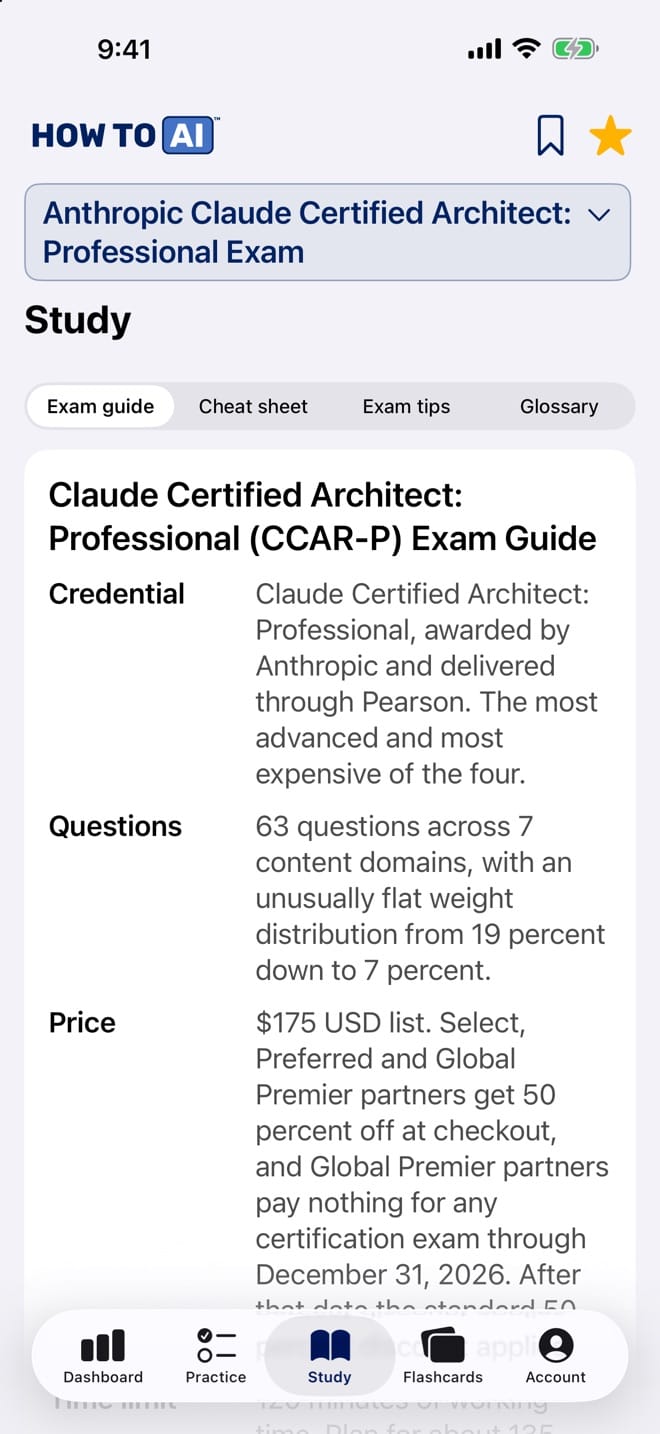
Take this guide with you
The same study guide, cheat sheet and glossary live in HOW TO // AI CERT on iPhone, next to 5,245 original practice questions, timed mock exams, flashcards and an AI tutor powered by Claude. Free to download, with a free question set for every exam.

Practice for every AI & cloud cert
- NVIDIA NCA-AIIO practice questions
- NVIDIA NCA-GENL practice questions
- AWS AIF-C01 practice questions
- AWS MLA-C02 practice questions
- AWS MLA-C01 practice questions
- Microsoft AI-901 practice questions
- Microsoft AI-103 practice questions
- VMware VCP-VCF Administrator practice questions
- CompTIA AI Fundamentals practice questions
- Google Cloud Generative AI Leader practice questions
- Oracle OCI AI Foundations practice questions
- CertNexus AIP-210 practice questions
- Anthropic CCAO-F practice questions
- Anthropic CCDV-F practice questions
- Anthropic CCAR-F practice questions
- All AI & cloud exam prep →