
HOW TO // AI — CERT · ORACLE 1Z0-1122-26
Pass Oracle OCI AI Foundations — the First Time
464 original practice questions mapped to Oracle’s exam topics, with a plain-English explanation on every single one.
Start the free quiz — no signup →10 free questions now · 10 more with your email · the full bank from $12 a month
Claude AI Tutor included with Pro — miss a question and it explains exactly why, in plain English, until it clicks.
Practice questions are the fastest way to get ready for the Oracle OCI AI Foundations exam: they show how concepts are tested, surface your gaps, and make exam day feel familiar. Every question below comes with an explanation of why the answer is right.
How these questions were made. Every question here is original. HOW TO // AI writes them from Oracle’s public OCI AI Foundations exam guide and maps each one to one of its exam topics. They are not real exam questions: real exam content is confidential for every candidate, and we never use exam recall or dumps.
What Oracle’s public exam guide covers
Everything in this section comes from Oracle’s public exam guide, not from the exam itself.
| Questions | Multiple choice; Oracle’s public exam page doesn’t list the count |
|---|---|
| Time limit | 60 minutes |
| Price | Free (exam and training at no cost) |
| Delivery | Online in Oracle MyLearn, no registration required, with automated proctoring (webcam, proctoring browser extension and a government ID that matches your profile) |
| Scoring | Passing score not shown on Oracle’s public exam page; check the Exam Topics module in MyLearn |
| Validity | 24 months from the date the credential is earned |
| Prerequisites | None; Oracle says no AI/ML background or coding experience is needed |
Checked against Oracle MyLearn’s exam and learning path pages and Oracle’s certification guidelines on October 6, 2026.
The exam topics and weights our question set follows. Oracle keeps the current 1Z0-1122-26 topic list in the Exam Topics module of its free MyLearn learning path (sign-in required), so confirm the weights there before you plan your study time:
| Exam topic | Weight | What it covers |
|---|---|---|
| Intro to AI Foundations | 10% | AI basics, AI applications and the types of data AI works with, and how AI, machine learning, and deep learning differ. |
| Intro to ML Foundations | 15% | Machine learning basics: supervised learning (regression and classification), unsupervised learning, and reinforcement learning. |
| Intro to DL Foundations | 15% | Deep learning fundamentals, convolutional neural networks (CNNs), and sequence models (RNNs and LSTMs). |
| Intro to Generative AI & LLMs | 15% | Generative AI and large language model fundamentals, transformers, prompt engineering and instruction tuning, and LLM fine-tuning. |
| Get started with OCI AI Portfolio | 15% | An overview of Oracle’s AI services, machine learning services, and AI infrastructure, plus responsible AI. |
| OCI Generative AI and Oracle 23ai Oracle now calls the database Oracle AI Database 26ai; the exam topic keeps the 23ai name. | 10% | OCI Generative AI services, Autonomous Database Select AI, and Oracle Vector Search. |
| Intro to OCI AI Services | 20% | The heaviest topic: OCI AI services and their APIs for Language, Vision, Document Understanding, and Speech. |
Take the free practice quiz
Start with 10 free questions — read the explanation after each — then unlock 10 more with your email. No account needed to begin.
FREE PRACTICE QUIZ
Try 10 free 1Z0-1122-26 practice questions
Answer at your own pace. Every question shows the correct answer and a plain-English explanation, and that's where the learning happens. Unlock 10 more questions free at the end.
Read the 10 free 1Z0-1122-26 questions as text, with answers and explanations
A retail analytics team stores customer records in a relational database with clearly defined columns such as customer ID, purchase amount, and transaction date. Which category of data best describes this dataset?
- A. Unstructured data
- B. Streaming-only data
- C. Semi-structured data
- D. Structured data
Answer: D. Data organized into fixed rows and columns within a relational database, with a predefined schema, is structured data. Unstructured data (images, free-text, audio) has no predefined model, and semi-structured data (JSON, XML) carries tags but no rigid table schema. 'Streaming-only' describes how data arrives, not its structure.
Which statement correctly describes the relationship among Artificial Intelligence (AI), Machine Learning (ML), and Deep Learning (DL)?
- A. Deep Learning is a broad field that contains Machine Learning, which in turn contains AI
- B. AI, ML, and DL are three completely separate and unrelated fields
- C. Machine Learning is a subset of AI, and Deep Learning is a subset of Machine Learning
- D. Deep Learning and AI are the same thing, while Machine Learning is unrelated
Answer: C. AI is the broadest field; ML is a subset of AI that learns patterns from data; DL is a subset of ML that uses multi-layered neural networks. Option A reverses the hierarchy, and the other options misstate the nested relationship.
A bank wants to predict the exact dollar amount a customer is likely to spend next month based on historical spending. Which type of machine learning task does this represent?
- A. Classification
- B. Dimensionality reduction
- C. Clustering
- D. Regression
Answer: D. Predicting a continuous numeric value (a dollar amount) is a regression task. Classification predicts discrete categories, clustering groups unlabeled data, and dimensionality reduction compresses features rather than predicting a target value.
A data science team has a dataset of 50,000 historical loan applications, each tagged with whether the borrower ultimately defaulted or repaid. They want to train a model that predicts default for new applicants. Which category of machine learning does this scenario describe?
- A. Reinforcement learning, because the model learns from reward signals
- B. Unsupervised learning, because the model discovers structure on its own
- C. Semi-structured learning, because the data has both numbers and text
- D. Supervised learning, because the training data includes known output labels
Answer: D. Supervised learning trains on data where each example carries a known label (here, defaulted vs. repaid), and the model learns to map inputs to those labels. Unsupervised learning has no labels, and reinforcement learning learns from rewards through trial-and-error interaction. 'Semi-structured learning' is not a real ML category.
An autonomous warehouse robot improves its navigation policy over time by receiving positive feedback when it reaches a target shelf quickly and negative feedback when it collides with obstacles. Which type of machine learning is the robot using?
- A. Transfer learning
- B. Supervised learning
- C. Reinforcement learning
- D. Unsupervised learning
Answer: C. Reinforcement learning is defined by an agent that learns a policy through trial and error using reward and penalty signals from its environment, exactly as described. Supervised learning requires labeled examples, and unsupervised learning finds patterns in unlabeled data. Transfer learning is a technique for reusing a pretrained model, not a feedback-driven paradigm.
A retailer has millions of customer transaction records but NO predefined customer categories. They want to automatically discover natural groupings of customers based on purchasing behavior so the marketing team can design targeted campaigns. Which learning approach is most appropriate?
- A. Supervised learning with a classification model
- B. Supervised learning with a regression model
- C. Unsupervised learning with a clustering model
- D. Reinforcement learning with a reward function
Answer: C. Because there are no predefined labels and the goal is to discover natural groupings, this is unsupervised learning, and clustering is the technique that groups similar data points together. Classification and regression are supervised methods that require labeled training data. Reinforcement learning addresses sequential decision-making with rewards, not grouping of static records.
In a feedforward artificial neural network, what is the primary purpose of an activation function applied at each neuron?
- A. To introduce non-linearity for modelling complex relations
- B. To permanently store the training data inside the neuron
- C. To convert all inputs into a fixed-size image format
- D. To compress the model so it requires no GPU for training
Answer: A. Activation functions (such as ReLU, sigmoid, or tanh) introduce non-linearity, allowing a network of stacked layers to approximate complex, non-linear functions; without them, any number of layers would collapse into a single linear transformation. They do not store data, reformat inputs into images, or eliminate hardware needs.
A retail team wants to automatically classify uploaded product photos by category. Which type of neural network architecture is specifically designed to excel at this kind of image-based task?
- A. A recurrent neural network (RNN)
- B. A k-means clustering model
- C. A linear regression model
- D. A convolutional neural network (CNN)
Answer: D. CNNs use convolutional layers to detect spatial features (edges, textures, shapes) in grid-like data such as images, making them the standard choice for image classification. RNNs are designed for sequential data, linear regression predicts continuous values, and k-means is an unsupervised clustering algorithm; none are purpose-built for image recognition.
Within a CNN, what is the main role of a pooling layer (for example, max pooling) placed after a convolutional layer?
- A. It assigns class probabilities as the final output of the network
- B. It converts the image into a textual caption
- C. It reduces the feature maps' spatial dimensions, cutting compute
- D. It increases the resolution of the input image to capture more detail
Answer: C. Pooling downsamples feature maps, shrinking their width and height to reduce the number of parameters and computation while making detected features more robust to small shifts in position. It does not upscale images, generate captions, or produce final class probabilities (that is typically the job of a softmax output layer).
A large language model (LLM) produces text one token at a time, where each new token is predicted based on all the tokens that came before it. What is this generation behavior called?
- A. Autoregressive generation
- B. Recurrent backpropagation
- C. Convolutional decoding
- D. Reinforcement sampling
Answer: A. LLMs based on decoder transformers generate text autoregressively, predicting the next token conditioned on the preceding sequence. 'Convolutional decoding' refers to CNN-style operations not used for token generation; 'reinforcement sampling' and 'recurrent backpropagation' are not standard terms for this process.
Want more? Finish the quiz above to unlock 10 more free questions, or open the full 1Z0-1122-26 practice app.
After the free 20
Practice the full OCI AI Foundations bank, timed like exam day
HOW TO // AI CERT has 464 original OCI AI Foundations practice questions written from Oracle’s public exam guide. You also get timed mock exams, an AI tutor powered by Claude that explains every miss, and a readiness score that tells you when to book. Pro is $12 a month, or $39 for the whole year, and covers every exam we offer. Start with a free account. 14-day refund.
These are original practice questions, not real exam questions. No brain dumps, nothing copied from real exams.
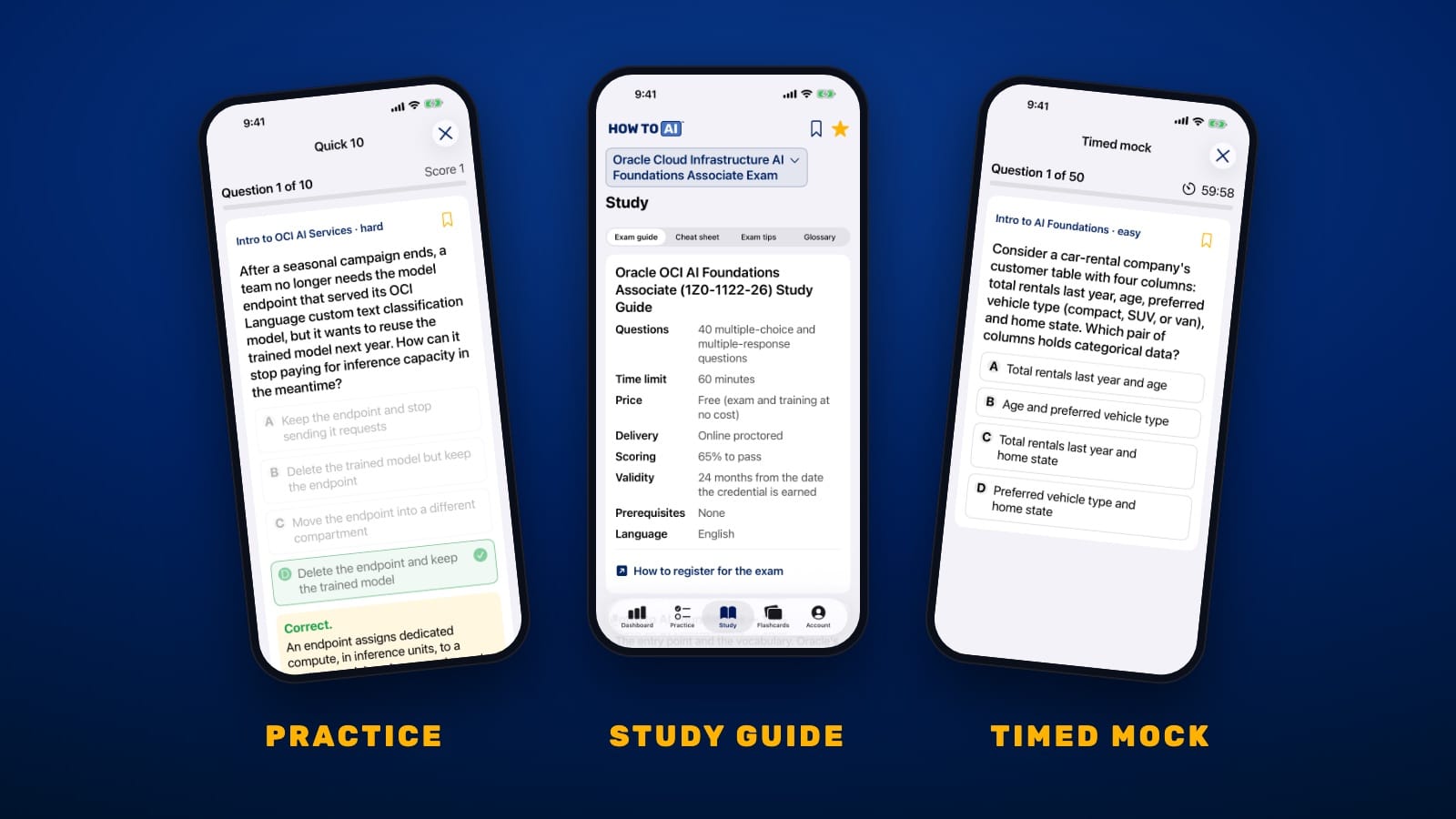
Study this exam on your phone
HOW TO // AI CERT has 6,151 original practice questions across 18 AI and cloud certifications, with plain-English explanations on every answer, full timed mock exams, weak-area drills, and an AI tutor powered by Claude. Free to download, with a free question set for every exam.

Free Oracle OCI AI Foundations study guide & cheat sheet
Prefer to study first? The free Oracle OCI AI Foundations study guide has the exam breakdown, a topic cheat sheet, and a full glossary — no sign-up.
How to prepare
Read the official exam topics in Oracle’s free Become an OCI AI Foundations Associate learning path, take a practice set above, then focus your studying on the domains where you missed questions rather than re-reading everything. Pair it with the study guide for the concepts.
HOW TO // AI is not affiliated with or endorsed by Oracle. Oracle Cloud Infrastructure AI Foundations Associate and 1Z0-1122-26 are certifications/trademarks of Oracle Corporation; we reference them descriptively. All questions are original.
Practice for every AI & cloud cert
- NVIDIA NCA-AIIO practice questions
- NVIDIA NCA-GENL practice questions
- AWS AIF-C01 practice questions
- AWS MLA-C02 practice questions
- AWS MLA-C01 practice questions
- Microsoft AI-901 practice questions
- Microsoft AI-103 practice questions
- VMware VCP-VCF Administrator practice questions
- CompTIA AI Fundamentals practice questions
- Google Cloud Generative AI Leader practice questions
- CertNexus AIP-210 practice questions
- Anthropic CCAO-F practice questions
- Anthropic CCDV-F practice questions
- Anthropic CCAR-F practice questions
- Anthropic CCAR-P practice questions
- Databricks GenAI Engineer Associate practice questions
- Salesforce Agentforce Specialist practice questions
- CompTIA SecAI+ practice questions
- All AI & cloud exam prep →
Frequently asked questions
How many questions are on the Oracle OCI AI Foundations (1Z0-1122-26) exam, and what do I need to pass?
Oracle's exam page lists a 60-minute, multiple-choice exam but doesn't show the question count or passing score for the 2026 version, so check the Exam Topics module in Oracle's free MyLearn learning path. You take it online on Oracle MyLearn with no registration, with your webcam on and Oracle's proctoring browser extension installed.
How much does the Oracle OCI AI Foundations exam cost?
Nothing. The Oracle Cloud Infrastructure AI Foundations Associate exam is free, and Oracle offers its training at no cost too.
How should I prepare for the Oracle OCI AI Foundations exam?
It is a foundational exam with no prerequisites. Work through Oracle's free learning path, then use practice questions to find and fix weak spots. Our 464-question bank for 1Z0-1122-26 follows the exam topics; practice until your readiness score is consistently high, then take the exam.
Are HOW TO // AI CERT's Oracle OCI AI Foundations questions real exam questions?
No. All 464 of our 1Z0-1122-26 practice questions are original, written from the published exam topics, and we never copy, leak, or reproduce real exam content (brain dumps), which would violate Oracle's policies and would not teach you the material. Every question comes with a plain-English explanation so you learn the concept, not just the answer.
Is HOW TO // AI CERT affiliated with Oracle?
No. HOW TO // AI CERT is an independent study resource and is not affiliated with, authorized by, endorsed by, or sponsored by Oracle. All product and exam names are trademarks of their respective owners; we reference them only to describe what our practice questions cover.
Can I try Oracle OCI AI Foundations practice questions for free?
Yes. You can practice a free set of 1Z0-1122-26 questions with no sign-up required, then unlock more by email. Pro unlocks the full 464-question bank plus timed mock exams, flashcards, spaced-repetition review, a readiness score, and an AI tutor that explains any question, from $12/month; one subscription covers every certification we offer.