
HOW TO // AI — CERT · VMWARE 2V0-17.25
Pass the VMware VCP-VCF Administrator — the First Time
301 original practice questions covering every section of the official 2V0-17.25 exam guide, with a plain-English explanation on every single one.
Start the free quiz — no signup →10 free questions now · 10 more with your email · the full bank from $12 a month
Claude AI Tutor included with Pro — miss a question and it explains exactly why, in plain English, until it clicks.
The VCP-VCF Administrator certification (exam 2V0-17.25) validates that you can install, configure, manage, and troubleshoot a VMware Cloud Foundation 9.0 private cloud — including vCenter, ESX, vSAN, NSX, vSphere Supervisor, VCF Operations, and VCF Automation. It’s aimed at administrators and cloud-infrastructure engineers with around a year of IT experience and hands-on time with VCF or its components. The exam is 60 questions in 135 minutes, delivered through Pearson VUE, and uses a scaled passing score of 300.
Practice questions are the highest-leverage way to prepare: they show you how concepts get tested, expose the gaps you didn’t know you had, and make the real exam feel familiar. The free quiz below works like the real thing — multiple choice with plain-English explanations — and every question explains why the answer is right, which is where the actual studying happens.
How these questions were made. Every question here is original. HOW TO // AI writes them from Broadcom’s public 2V0-17.25 exam guide and maps each one to an objective in it. They are not real exam questions: real exam content is confidential for every candidate, and we never use exam recall or dumps.
What Broadcom’s public exam guide covers
Everything in this section comes from Broadcom’s public exam guide, not from the exam itself.
The official exam guide groups testable objectives under two sections — VMware Cloud Foundation Fundamentals and Deploy, Configure, and Operate VCF. Our question set covers all of the objective areas below (VMware does not publish per-domain percentages):
| Knowledge area | What it covers |
|---|---|
| Private cloud & VCF fundamentals | Private-cloud principles and value proposition; VCF components and architecture |
| Compute | Deploying and configuring vCenter and ESX, vSphere clusters, and virtual machines |
| Storage | vSAN ESA vs OSA, deploying a vSAN cluster, storage policies, resilience, and space efficiency |
| Networking | NSX components, network fabrics, connectivity and routing, and network services |
| Deploy & configure VCF | Deployment models, bring-up with the VCF Installer, workload domains, and vSphere Supervisor |
| Manage VCF | Fleet management, identity and RBAC, licensing, certificates, passwords, and lifecycle management |
| VCF Operations | Monitoring, dashboards, alerting, logs, health and diagnostics, and configuration drift |
| Consume & automate | VCF Automation — regions, multi-org tenancy, provider/org networking, content, governance, and extensibility |
Take the free practice quiz
Start with 10 free questions — read the explanation after each — then unlock 10 more with your email. Twenty in all, weighted like the real blueprint, no account needed to begin.
FREE PRACTICE QUIZ
Try 10 free VCP-VCF Administrator practice questions
Answer at your own pace. Every question shows the correct answer and a plain-English explanation, and that's where the learning happens. Unlock 10 more questions free at the end.
Read the 10 free VCP-VCF Administrator questions as text, with answers and explanations
An administrator is explaining the foundational principles of a VMware Cloud Foundation private cloud to a new operations team. Which characteristic BEST describes a core principle that distinguishes a private cloud from a traditional, manually administered virtualization environment?
- A. Compute, storage, and networking delivered as on-demand self-service
- B. All workloads must run on public cloud infrastructure and be billed by a third-party provider
- C. Each physical host is configured and patched individually by an administrator using local console access
- D. Storage is provisioned exclusively from external fibre-channel arrays managed outside the platform
Answer: A. A defining principle of a private cloud is the delivery of pooled infrastructure as on-demand, self-service services governed by policy and automation, which is exactly what VCF provides through VCF Automation over a standardized vSphere/vSAN/NSX stack. Option C describes the legacy manual model the private cloud replaces, B describes public cloud, and D is a specific storage choice rather than a principle (VCF emphasizes software-defined vSAN).
A company must keep certain regulated workloads on infrastructure it fully owns and controls within its own data center to meet data-residency and compliance requirements. Which use case does this scenario represent for a VMware Cloud Foundation private cloud?
- A. Data sovereignty and regulatory compliance for sensitive workloads
- B. Bursting all batch processing to a hyperscaler during peak season
- C. Eliminating the need for any on-premises hardware ownership
- D. Outsourcing all infrastructure operations to a public cloud provider
Answer: A. Keeping regulated workloads on owned, controlled infrastructure for data-residency and compliance is a primary private cloud use case, and VCF provides this with full administrative control over the stack. Options B and D describe public/hybrid cloud consumption, and C contradicts the very nature of an on-premises private cloud, which depends on owned hardware.
A platform team wants to give application developers a self-service way to provision both virtual machines and Kubernetes clusters from a governed catalog on their on-premises VCF environment, without filing tickets for each request. Which VCF 9.0 capability addresses this use case?
- A. VCF Operations for Networks mapping application traffic flows
- B. VCF Operations for Logs aggregating syslog data from all ESX hosts
- C. VCF Installer performing management domain bring-up
- D. VCF Automation's self-service catalog plus vSphere Supervisor
Answer: D. Developer self-service provisioning of VMs and Kubernetes from a governed catalog is a classic private cloud use case served by VCF Automation (catalog, governance/extensibility) together with vSphere Supervisor for native Kubernetes. The other options are valid VCF 9.0 capabilities but address logging, initial deployment, and network analytics respectively, not developer self-service provisioning.
An administrator is performing the initial bring-up of a new VMware Cloud Foundation 9.0 environment. Which appliance is responsible for performing the bring-up that deploys the management domain, including its vCenter instance?
- A. VCF Operations
- B. VCF Automation
- C. VCF Identity Broker
- D. VCF Installer
Answer: D. In VCF 9.0, the VCF Installer appliance is deployed first and performs the bring-up process that stands up the management domain, including its vCenter and the SDDC Manager / fleet management components. VCF Operations provides monitoring/analytics, VCF Automation provides self-service provisioning, and VCF Identity Broker handles identity federation/SSO; none of those perform the initial bring-up.
An organization has an existing standalone vCenter instance managing production workloads that they want to bring under VMware Cloud Foundation 9.0 management without rebuilding the hosts. Which VCF 9.0 capability allows this vCenter and its clusters to be brought into the fleet?
- A. Redeploy the vCenter as an ESX-embedded vCenter
- B. Migrate the vCenter into the VCF Identity Broker
- C. Convert the vCenter into a VCF Installer appliance
- D. Import the existing vCenter as a workload domain
Answer: D. VCF 9.0 supports importing an existing vCenter instance so brownfield environments can be brought under fleet/lifecycle management as a workload domain without a greenfield rebuild. The VCF Installer is only used for bring-up and cannot be a converted vCenter; there is no 'ESX-embedded vCenter' deployment model; and the Identity Broker handles identity federation, not vCenter/workload-domain management.
Given a vSphere cluster where an administrator wants vCenter to automatically generate initial VM placement recommendations and continuously rebalance running VMs across ESX hosts to optimize resource utilization, which cluster feature must be configured?
- A. vSphere HA
- B. Proactive HA
- C. Enhanced vMotion Compatibility (EVC)
- D. vSphere DRS
Answer: D. vSphere DRS (Distributed Resource Scheduler) provides initial placement recommendations at power-on and load-balances running VMs across hosts via vMotion to optimize resource usage. vSphere HA restarts VMs after host failure but does not balance load; EVC ensures CPU feature compatibility for vMotion; and Proactive HA evacuates hosts based on hardware-health signals, not for resource balancing.
An administrator is standing up a brand-new VCF 9.0 management domain on a fleet of identical hosts that ship exclusively with high-performance NVMe TLC drives and 25 GbE networking. Which vSAN architecture is the recommended choice to take full advantage of this all-NVMe hardware?
- A. vSAN Original Storage Architecture (OSA), because it is the only architecture validated for management domains
- B. vSAN Express Storage Architecture (ESA), because it is designed for all-NVMe, single-tier storage and high-bandwidth networking
- C. vSAN OSA, because ESA still requires a dedicated cache tier built from SAS SSDs
- D. Either architecture performs identically on NVMe, so the choice is purely cosmetic
Answer: B. vSAN ESA is purpose-built for modern all-NVMe hardware and high-bandwidth networks, using a single-tier storage pool rather than the cache/capacity tiering of OSA. Option C is wrong because ESA removes the dedicated cache tier entirely. The architectures are not interchangeable in performance characteristics, and OSA is not the only architecture supported for management domains in VCF 9.0.
Given a scenario where a team must reuse existing hosts that contain a mix of SATA SSD cache devices and spinning capacity disks for a new vSAN cluster, which statement correctly describes the appropriate architecture decision?
- A. vSAN ESA must be used because it natively supports hybrid disk groups
- B. vSAN OSA, since it supports a tiered cache-plus-capacity hybrid model
- C. Neither architecture supports any spinning media, so the hosts cannot be used for vSAN
- D. vSAN ESA should be used and will automatically convert the HDDs into a single NVMe-equivalent tier
Answer: B. vSAN OSA retains the traditional two-tier design (a cache tier plus a capacity tier) and is the architecture that supports hybrid configurations using SSD cache with HDD capacity. ESA requires a uniform all-flash (NVMe-class) single-tier device pool and does not support hybrid disk groups or spinning media, making A and D incorrect. OSA still supports HDD capacity, so C is false.
During bring-up of the VCF 9.0 management domain, which component performs the initial deployment and configuration of the first vSAN cluster that backs the management workloads?
- A. The VCF Identity Broker
- B. VCF Operations for Networks
- C. The VCF Installer appliance
- D. A standalone host client on each ESX host
Answer: C. The VCF Installer appliance drives the bring-up process for the management domain, including deploying and configuring the first vSAN cluster. VCF Operations for Networks provides network visibility, and VCF Identity Broker handles federation and identity/RBAC: neither performs cluster deployment. Configuring vSAN host-by-host through standalone host clients is not the VCF bring-up workflow.
An administrator is documenting the VCF 9.0 networking stack for a management domain. Which component provides the underlying Layer 2 connectivity for ESX host VMkernel traffic (management, vMotion, vSAN) and serves as the foundation upon which NSX overlay networking is built?
- A. The NSX Tier-0 gateway on the Edge
- B. The NSX Edge node's uplink interface
- C. The vSphere Distributed Switch (vDS)
- D. The NSX overlay segment on the host
Answer: C. The vSphere Distributed Switch (vDS) provides the data-plane Layer 2 switching for ESX host VMkernel and infrastructure traffic and is the foundation that NSX prepares hosts on to enable overlay (Geneve) networking. The NSX Edge node uplink connects Edge nodes to the physical fabric for north-south traffic rather than providing host VMkernel L2 connectivity, the NSX Tier-0 gateway is a Layer 3 routing construct, and an NSX segment is a logical overlay network that rides on top of the prepared vDS rather than providing the base VMkernel connectivity.
Want more? Finish the quiz above to unlock 10 more free questions, or open the full VCP-VCF Administrator practice app.
After the free 20
Practice the full VCP-VCF bank, timed like exam day
HOW TO // AI CERT has 301 original VCP-VCF practice questions written from Broadcom’s public exam guide. You also get timed mock exams, an AI tutor powered by Claude that explains every miss, and a readiness score that tells you when to book. Pro is $12 a month, or $39 for the whole year, and covers every exam we offer. Start with a free account. 14-day refund.
These are original practice questions, not real exam questions. No brain dumps, nothing copied from real exams.
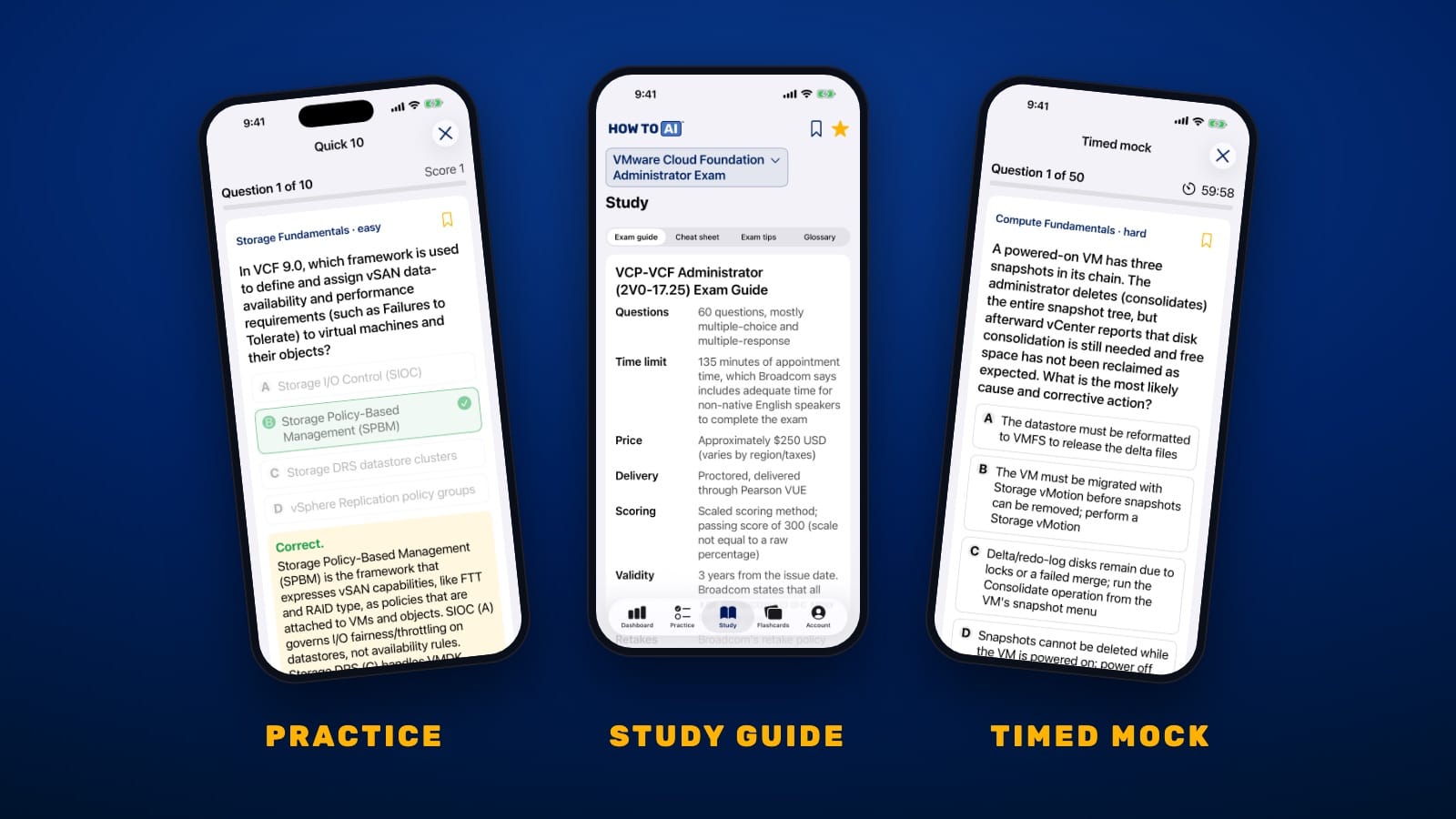
Study this exam on your phone
HOW TO // AI CERT has 6,151 original practice questions across 18 AI and cloud certifications, with plain-English explanations on every answer, full timed mock exams, weak-area drills, and an AI tutor powered by Claude. Free to download, with a free question set for every exam.

How to prepare for the VCP-VCF Administrator exam
Broadcom recommends its VMware Cloud Foundation: Build, Manage, and Secure and VMware Cloud Foundation: Automation and Operations courses along with hands-on lab time. A study loop that works: read the official exam guide on Broadcom’s certification page, take a practice set like the one above, then work through the deploy, configure, and operate objectives. Because the exam is based on VCF 9.0, review the 9.0 release notes for renamed components (VCF Operations, VCF Automation, and VCF Fleet Management).
Free VCP-VCF Administrator study guide & cheat sheet
No sign-up needed — quick study tips, a topic-by-topic cheat sheet, and a full glossary for the VCP-VCF Administrator exam.
Open the full VCP-VCF Administrator study guide →
HOW TO // AI is not affiliated with or endorsed by VMware or Broadcom. VMware Cloud Foundation, VCP-VCF Administrator, and exam 2V0-17.25 are trademarks or certifications of Broadcom Inc.; we reference them descriptively. All practice questions on this page are original, written from the publicly published exam objectives — they are not actual exam questions.
Related practice sets
- NVIDIA NCA-AIIO Practice Questions
- AWS AI Practitioner (AIF-C01) Practice Questions
- Azure AI Fundamentals (AI-901) Practice Questions
- All AI & Cloud Exam Prep
Practice for every AI & cloud cert
- NVIDIA NCA-AIIO practice questions
- NVIDIA NCA-GENL practice questions
- AWS AIF-C01 practice questions
- AWS MLA-C02 practice questions
- AWS MLA-C01 practice questions
- Microsoft AI-901 practice questions
- Microsoft AI-103 practice questions
- CompTIA AI Fundamentals practice questions
- Google Cloud Generative AI Leader practice questions
- Oracle OCI AI Foundations practice questions
- CertNexus AIP-210 practice questions
- Anthropic CCAO-F practice questions
- Anthropic CCDV-F practice questions
- Anthropic CCAR-F practice questions
- Anthropic CCAR-P practice questions
- Databricks GenAI Engineer Associate practice questions
- Salesforce Agentforce Specialist practice questions
- CompTIA SecAI+ practice questions
- All AI & cloud exam prep →
Frequently asked questions
How many questions are on the VMware VCP-VCF Administrator (2V0-17.25) exam, and what do I need to pass?
The VMware Certified Professional – VCF Administrator exam has 60 questions (multiple-choice and multiple-response) and gives you 135 minutes (appointment time). To pass you need a scaled score of 300. It is a proctored exam delivered through Pearson VUE.
How much does the VMware VCP-VCF Administrator exam cost?
VMware (a Broadcom company)'s VMware Certified Professional – VCF Administrator exam costs about $250 USD. You register through the official VMware (a Broadcom company) certification site. Pricing can vary by region and taxes.
How should I prepare for the VMware VCP-VCF Administrator exam?
It is an administrator exam; VMware recommends roughly a year of IT experience plus about six months working with VMware Cloud Foundation. The most reliable way to prepare is to study the official exam guide and then work through lots of practice questions to find and fix weak spots. Our 301-question bank for 2V0-17.25 covers every section of the official exam guide — practice until your readiness score is consistently high, then book your exam.
Are HOW TO // AI — CERT's VMware VCP-VCF Administrator questions real exam questions?
No. All 301 of our 2V0-17.25 practice questions are 100% original, written from the published exam objectives. We never copy, leak, or reproduce real exam content ("brain dumps") — that would violate VMware (a Broadcom company)'s policies and would not actually teach you the material. Every question comes with a plain-English explanation so you learn the concept, not just the answer.
Is HOW TO // AI — CERT affiliated with VMware (a Broadcom company)?
No. HOW TO // AI — CERT is an independent study resource and is not affiliated with, authorized by, endorsed by, or sponsored by VMware (a Broadcom company). All product and exam names are trademarks of their respective owners; we reference them only to describe what our practice questions cover.
Can I try VMware VCP-VCF Administrator practice questions for free?
Yes. You can practice a free set of 2V0-17.25 questions with no sign-up required, then unlock more by email. Pro unlocks the full 301-question bank plus timed mock exams, flashcards, spaced-repetition review, a readiness score, and an AI tutor that explains any question — from $12/month, and one subscription covers every certification we offer.