
HOW TO // AI — CERT · AWS AIF-C01
Pass the AWS AI Practitioner — the First Time
298 original practice questions weighted to the official AIF-C01 blueprint, with a plain-English explanation on every single one.
Start the free quiz — no signup →10 free questions now · 10 more with your email · the full bank from $12 a month
Claude AI Tutor included with Pro — miss a question and it explains exactly why, in plain English, until it clicks.
The AWS Certified AI Practitioner (AIF-C01) is AWS’s foundational certification for anyone who needs to understand AI, machine learning, and generative AI — and the AWS services that deliver them — without writing code. It’s aimed at a broad audience: business analysts, product and project managers, sales and marketing professionals, IT support staff, and developers new to AI. The exam is 65 questions in 90 minutes, taken at a test center or online with remote proctoring, and costs $100 USD. You need a scaled score of 700 out of 1000 to pass, and the certification is valid for three years.
Practice questions are the highest-leverage way to prepare: they show you how concepts get tested, expose the gaps you didn’t know you had, and make the real exam feel familiar. The free quiz below uses multiple choice questions with plain-English explanations (the real exam can also include multiple response, ordering and matching questions), and every question explains why the answer is right, which is where the actual studying happens.
How these questions were made. Every question here is original. HOW TO // AI writes them from AWS’s public AIF-C01 exam guide and maps each one to a domain in its blueprint. They are not real exam questions: real exam content is confidential for every candidate, and we never use exam recall or dumps.
What AWS’s public exam guide covers
Everything in this section comes from AWS’s public exam guide, not from the exam itself.
AWS’s published exam guide has five content domains. Our question set mirrors these weights, so your practice score roughly tracks how the real exam distributes its questions:
| Domain | Exam weight | What it covers |
|---|---|---|
| Fundamentals of AI and ML | 20% | AI vs ML vs deep learning, supervised/unsupervised/reinforcement learning, inference types, common use cases, and core AWS AI services (SageMaker, Comprehend, Rekognition, Textract, Transcribe, Polly, Translate, Lex, Kendra, Personalize) |
| Fundamentals of Generative AI | 24% | Tokens, embeddings, foundation models, prompt engineering, and the AWS generative-AI stack — Amazon Bedrock, Amazon Q, SageMaker JumpStart, PartyRock |
| Applications of Foundation Models | 28% | Model selection, inference parameters, RAG with Bedrock Knowledge Bases, prompt-engineering techniques, fine-tuning, and evaluating model performance |
| Guidelines for Responsible AI | 14% | Bias and fairness, transparency and explainability, and tools like Amazon Bedrock Guardrails and SageMaker Clarify |
| Security, Compliance, and Governance | 14% | Securing AI systems (IAM, encryption), data governance, and compliance — AWS Config, CloudTrail, Audit Manager, and Artifact |
Take the free practice quiz
Start with 10 free questions — read the explanation after each — then unlock 10 more with your email. Twenty in all, weighted like the real blueprint, no account needed to begin.
FREE PRACTICE QUIZ
Try 10 free AIF-C01 practice questions
Answer at your own pace. Every question shows the correct answer and a plain-English explanation, and that's where the learning happens. Unlock 10 more questions free at the end.
Read the 10 free AIF-C01 questions as text, with answers and explanations
A data science team describes deep learning to a new stakeholder. Which statement best characterizes how deep learning relates to artificial intelligence (AI) and machine learning (ML)?
- A. Deep learning is a broad field that contains both AI and ML as subfields.
- B. Deep learning is a subset of ML, which is itself a subset of the broader field of AI.
- C. Deep learning and ML are unrelated disciplines that both fall outside of AI.
- D. ML is a subset of deep learning, which is a subset of AI.
Answer: B. AI is the broadest field, ML is a subset of AI that learns patterns from data, and deep learning is a subset of ML that uses multi-layered neural networks. Option A and D invert the hierarchy, and C wrongly excludes them from AI.
An online retailer has a dataset of customer transactions where each record includes a label indicating whether the transaction was fraudulent or legitimate. The team wants a model to predict fraud on new transactions. Which type of machine learning does this represent?
- A. Unsupervised learning
- B. Reinforcement learning
- C. Self-organizing learning
- D. Supervised learning
Answer: D. Supervised learning trains on labeled data (each example has a known target, here fraud or legitimate) to predict labels for new data. Unsupervised learning works on unlabeled data to find structure, reinforcement learning learns from rewards through trial-and-error interaction, and 'self-organizing learning' is not a standard ML category (self-organizing maps are actually an unsupervised technique), so none match a labeled fraud dataset.
A logistics company collects sensor readings every minute from delivery trucks, producing values such as temperature and speed indexed by timestamp. To forecast next week's fuel consumption, an analyst needs to choose the correct way to describe this data. Which data type best describes these readings?
- A. Unstructured image data
- B. Categorical text data
- C. Geospatial vector data
- D. Time-series data
Answer: D. Time-series data consists of observations recorded sequentially over time at consistent intervals, exactly matching per-minute timestamped sensor values used for forecasting. Image data is unstructured pixels, text data is unstructured language, and while location may appear, the defining characteristic here is the time-indexed sequence.
A team has trained a model and deployed it. Once per night, they collect all of the day's accumulated records and run them through the model in a single large job to generate predictions, which are written to a database before morning. Which inferencing approach are they using?
- A. Streaming inferencing
- B. Online inferencing
- C. Batch inferencing
- D. Real-time inferencing
Answer: C. Batch inferencing processes a large group of accumulated records at scheduled intervals rather than responding to individual requests instantly, which fits a nightly bulk job. Real-time, streaming, and online inferencing all imply low-latency, per-request predictions as data arrives, which is not what is described.
A developer is integrating a large language model (LLM) into an application and learns that the model processes text by first breaking it into smaller units that are mapped to numeric IDs before any computation occurs. What are these smaller units called?
- A. Parameters
- B. Tokens
- C. Embeddings
- D. Vectors
Answer: B. Tokens are the discrete units (words, sub-words, or characters) that an LLM splits text into and maps to numeric IDs before processing. Embeddings are dense numeric representations that capture semantic meaning, and vectors are the mathematical arrays embeddings are stored as, but those come after tokenization. Parameters are the learned weights of the model, not units of input text.
A media company wants to generate photorealistic marketing images from natural-language text descriptions. Which type of generative AI model is specifically designed for this kind of high-quality image synthesis?
- A. A decision tree ensemble
- B. A k-means clustering model
- C. A diffusion model
- D. A linear regression model
Answer: C. Diffusion models generate images by progressively denoising random noise into a coherent image guided by a text prompt, and are the dominant architecture for text-to-image generation (for example, Stable Diffusion). Decision tree ensembles, linear regression, and k-means are traditional supervised or unsupervised ML methods that do not perform generative image synthesis.
A team is building a retrieval-augmented generation (RAG) solution. Before storing a large library of PDF policy documents in a vector database, they must first split each document into smaller, semantically coherent passages so that retrieval returns relevant context. What is this preprocessing step called?
- A. Chunking
- B. Fine-tuning
- C. Quantization
- D. Tokenization
Answer: A. Chunking is the process of dividing large documents into smaller passages so each piece can be embedded and retrieved individually in a RAG pipeline. Tokenization splits text into model input tokens (a different granularity), fine-tuning updates model weights, and quantization reduces numeric precision to shrink a model; none describe splitting documents into retrievable passages.
A logistics company has about 40 internal REST APIs described by OpenAPI specifications plus a dozen AWS Lambda functions. Agents built with several frameworks must discover and call these as MCP tools through one managed endpoint, with inbound and outbound authentication handled for them. The company does not want to write and host a separate MCP server for each API. Which service meets these requirements?
- A. Amazon Bedrock AgentCore Runtime
- B. Amazon Bedrock AgentCore Gateway
- C. Amazon Bedrock AgentCore Memory
- D. Amazon Bedrock AgentCore Identity
Answer: B. AgentCore Gateway converts APIs (OpenAPI or Smithy) and Lambda functions into MCP-compatible tools behind a single secure endpoint, with built-in tool discovery and both ingress and egress authentication. Runtime hosts and scales the agent code itself. Memory stores conversation and long-term context. Identity manages agent and user credentials, but it does not turn APIs into tools.
A startup wants to add a chatbot to its customer support portal. Support tickets often reference the company's internal product manuals, which change weekly. The team wants the chatbot to answer using the most current manual content without retraining a model each week. Which approach on Amazon Bedrock best meets this requirement?
- A. Increase the model's temperature so it generates more creative answers
- B. Continuously pre-train a foundation model from scratch on the manuals
- C. Fine-tune a foundation model on the manuals every week
- D. Use RAG with a Bedrock Knowledge Base over the manuals
Answer: D. RAG retrieves up-to-date content from an external knowledge source at inference time, so weekly manual updates are reflected immediately by re-indexing rather than retraining. Bedrock Knowledge Bases manage the ingestion, chunking, embedding, and retrieval pipeline. Fine-tuning and continuous pre-training are costly, slow, and would need to be repeated for every change; temperature only affects output randomness, not factual freshness.
An e-commerce company is building a RAG application on Amazon Bedrock. The team has already chosen a relational database for its transactional data and wants to store and query document embeddings in the SAME managed relational engine to minimize the number of services to operate. Which AWS option natively supports vector storage and similarity search for this requirement?
- A. Amazon Redshift with a sort key on the embedding column
- B. Amazon Aurora PostgreSQL with the pgvector extension
- C. Amazon ElastiCache for Memcached caching
- D. Amazon DynamoDB with a global secondary index
Answer: B. Aurora PostgreSQL-Compatible Edition supports the pgvector extension, allowing vector embeddings to be stored and queried with similarity search inside a managed relational engine, satisfying the desire to reuse the relational platform. It is also a supported vector store for Amazon Bedrock Knowledge Bases. DynamoDB is a NoSQL key-value/document store without native vector similarity search, Redshift is an analytics warehouse not designed as a low-latency vector store for RAG, and ElastiCache for Memcached is an in-memory cache without vector search.
Want more? Finish the quiz above to unlock 10 more free questions, or open the full AIF-C01 practice app.
After the free 20
Practice the full AIF-C01 bank, timed like exam day
HOW TO // AI CERT has 298 original AIF-C01 practice questions written from AWS’s public exam guide. You also get timed mock exams, an AI tutor powered by Claude that explains every miss, and a readiness score that tells you when to book. Pro is $12 a month, or $39 for the whole year, and covers every exam we offer. Start with a free account. 14-day refund.
These are original practice questions, not real exam questions. No brain dumps, nothing copied from real exams.
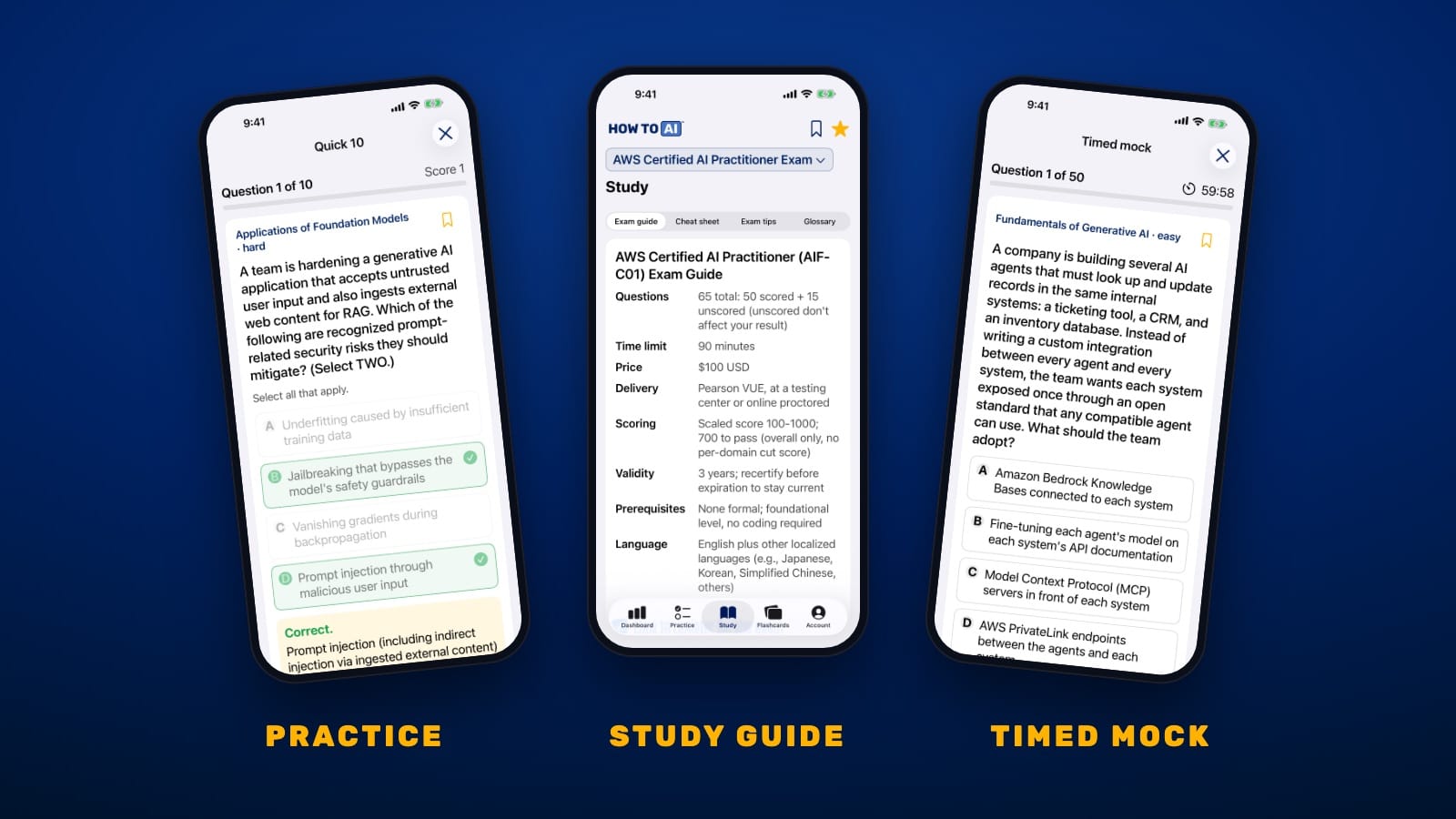
Study this exam on your phone
HOW TO // AI CERT has 6,151 original practice questions across 18 AI and cloud certifications, with plain-English explanations on every answer, full timed mock exams, weak-area drills, and an AI tutor powered by Claude. Free to download, with a free question set for every exam.

How to prepare for the AWS AI Practitioner exam
AWS offers a free AWS Certified AI Practitioner learning path on AWS Skill Builder, plus an official exam guide and sample questions. A study loop that works: skim the official exam guide on AWS’s certification page, take a practice set like the one above, then focus on the domains where you missed questions. Generative AI and foundation models (Domains 2 and 3) together make up more than half the exam, so be comfortable with Amazon Bedrock, prompt engineering, and RAG. New to the underlying concepts? Our plain-English AI glossary and explainer on how AI models actually work cover the fundamentals.
Free AWS AI Practitioner study guide & cheat sheet
No sign-up needed — quick study tips, a topic-by-topic cheat sheet, and a full glossary for the AWS AI Practitioner exam.
Open the full AWS AI Practitioner study guide →
HOW TO // AI is not affiliated with or endorsed by Amazon Web Services. AWS Certified AI Practitioner and AIF-C01 are certifications of Amazon.com, Inc. or its affiliates; we reference them descriptively. All practice questions on this page are original, written from the publicly published exam objectives — they are not actual exam questions.
Related practice sets
- NVIDIA NCA-AIIO Practice Questions
- Azure AI Fundamentals (AI-901) Practice Questions
- VMware VCP-VCF Administrator Practice Questions
- All AI & Cloud Exam Prep
Practice for every AI & cloud cert
- NVIDIA NCA-AIIO practice questions
- NVIDIA NCA-GENL practice questions
- AWS MLA-C02 practice questions
- AWS MLA-C01 practice questions
- Microsoft AI-901 practice questions
- Microsoft AI-103 practice questions
- VMware VCP-VCF Administrator practice questions
- CompTIA AI Fundamentals practice questions
- Google Cloud Generative AI Leader practice questions
- Oracle OCI AI Foundations practice questions
- CertNexus AIP-210 practice questions
- Anthropic CCAO-F practice questions
- Anthropic CCDV-F practice questions
- Anthropic CCAR-F practice questions
- Anthropic CCAR-P practice questions
- Databricks GenAI Engineer Associate practice questions
- Salesforce Agentforce Specialist practice questions
- CompTIA SecAI+ practice questions
- All AI & cloud exam prep →
Frequently asked questions
How many questions are on the AWS AI Practitioner (AIF-C01) exam, and what do I need to pass?
The AWS Certified AI Practitioner exam has 65 questions (50 scored + 15 unscored) and gives you 90 minutes. To pass you need a scaled score of 700 out of 1000. It is delivered online proctored or at a Pearson VUE test center.
How much does the AWS AI Practitioner exam cost?
Amazon Web Services (AWS)'s AWS Certified AI Practitioner exam costs $100 USD. You register through the official Amazon Web Services (AWS) certification site. Pricing can vary by region and taxes.
How should I prepare for the AWS AI Practitioner exam?
It is a foundational exam with no coding required, aimed at people who work with or around AI. The most reliable way to prepare is to study the official exam guide and then work through lots of practice questions to find and fix weak spots. Our 298-question bank for AIF-C01 is blueprint-weighted, so the topic mix mirrors the real exam — practice until your readiness score is consistently high, then book your exam.
Are HOW TO // AI — CERT's AWS AI Practitioner questions real exam questions?
No. All 302 of our AIF-C01 practice questions are 100% original, written from the published exam objectives. We never copy, leak, or reproduce real exam content ("brain dumps") — that would violate Amazon Web Services (AWS)'s policies and would not actually teach you the material. Every question comes with a plain-English explanation so you learn the concept, not just the answer.
Is HOW TO // AI — CERT affiliated with Amazon Web Services (AWS)?
No. HOW TO // AI — CERT is an independent study resource and is not affiliated with, authorized by, endorsed by, or sponsored by Amazon Web Services (AWS). All product and exam names are trademarks of their respective owners; we reference them only to describe what our practice questions cover.
Can I try AWS AI Practitioner practice questions for free?
Yes. You can practice a free set of AIF-C01 questions with no sign-up required, then unlock more by email. Pro unlocks the full 298-question bank plus timed mock exams, flashcards, spaced-repetition review, a readiness score, and an AI tutor that explains any question — from $12/month, and one subscription covers every certification we offer.