
HOW TO // AI CERT · AWS MLA-C02
MLA-C02 Practice Questions: Free Practice Test With Explanations
408 original practice questions weighted to AWS’s MLA-C02 exam guide, including the RAG, agent and guardrail topics MLA-C01 never covered, with a plain-English explanation on every one.
Start the free quiz, no signup →10 free questions now · 10 more with your email · the full bank from $12 a month
Claude AI Tutor included with Pro: miss a question and it explains exactly why, in plain English, until it clicks.
Yes, you can take an MLA-C02 practice test free. The quiz below gives you 10 original MLA-C02 practice questions with explanations and no sign-up, and 10 more unlock with your email. AWS also offers free 20-question Official Practice Question Sets on AWS Skill Builder. This page covers both, plus the exam at a glance (including the ME1-C02 booking code), the four domains, how to use practice questions, and why MLA-C02 dumps are a bad bet.
MLA-C02 is the new version of the AWS Certified Machine Learning Engineer – Associate exam. Its beta has been running since September 29, 2026, the English MLA-C01 exam ended on September 28, and AWS’s certification blog dates general availability to January 14, 2027. Still sitting MLA-C01 in Japanese, Korean or Simplified Chinese? Use the MLA-C01 practice questions instead.
How these questions were made. Every question here is original. HOW TO // AI writes them from AWS’s public MLA-C02 exam guide and maps each one to a domain in its blueprint. They are not real exam questions: real exam content is confidential for every candidate, and we never use exam recall or dumps.
MLA-C02 at a glance
| Exam | AWS Certified Machine Learning Engineer – Associate (MLA-C02) |
|---|---|
| Booking code | ME1-C02 during the beta; search for this code when you book, not “MLA-C02” |
| Status | Beta, delivered since September 29, 2026, in English only |
| Price | $75 USD beta price (AWS lists its Associate exams at $150) |
| Beta length | 85 questions in 170 minutes; the extra questions are unscored items AWS is evaluating |
| Standard exam | The exam guide describes 50 scored plus 15 unscored questions |
| Question types | Multiple choice and multiple response |
| Passing score | 720 on a scaled 100–1,000 |
| Beta attempts | One; if you don’t pass, you retake once the standard version is available |
| Results | Typically within 5 business days of finishing your beta exam |
| Delivery | Pearson VUE test center or online proctored |
| Recommended experience | At least 1 year with Amazon SageMaker AI, Amazon Bedrock and other AWS ML engineering services |
| Validity | 3 years |
| General availability | January 14, 2027 per AWS’s certification blog; the exam page still lists it as TBD |
| Free official practice | Official Practice Question Set (20 questions) on AWS Skill Builder |
Checked against AWS’s MLA-C02 certification page, the MLA-C02 exam guide and AWS’s certification prep page on October 8, 2026.
MLA-C02 exam domains
Our question set is weighted to the blueprint AWS publishes for MLA-C02:
| Domain | Weight | What it covers |
|---|---|---|
| Data Preparation for ML and AI | 28% | Ingest, store, transform and validate data for ML and for generative AI. S3 storage, Glue and EMR/Spark transforms, Athena queries, streaming ingestion with Kinesis and Firehose, feature engineering with SageMaker Feature Store, labeling, and governance with Lake Formation, plus preparing and chunking source data for retrieval-augmented generation. |
| ML Model and Foundation Model (FM) Development | 24% | Choose, train, tune and evaluate models. Built-in algorithms and JumpStart, SageMaker training jobs, Automatic Model Tuning, bias and explainability checks, and the usual metrics, now alongside foundation model work: choosing a model in Amazon Bedrock, prompt design and management, fine-tuning versus retrieval, and evaluating an LLM’s output. |
| Deployment and Orchestration of ML and AI Workflows | 24% | Deploy models and automate pipelines. Real-time, serverless and asynchronous endpoints, Batch Transform, auto scaling, orchestration with SageMaker Pipelines, Step Functions and EventBridge, CI/CD and infrastructure as code, and building agentic workflows rather than only model endpoints. |
| Operating, Monitoring, and Securing ML and AI Solutions | 24% | Keep it running, watch it, and lock it down. Drift and data quality monitoring, observability with CloudWatch and CloudTrail, cost and performance optimization, and security through IAM, KMS, VPC, Secrets Manager and PrivateLink, extended to generative AI with guardrails and the observability of agent workflows. |
Domain names and weightings are AWS’s own, from the MLA-C02 exam guide. The descriptions are ours. For everything AWS added and cut compared with MLA-C01, read our MLA-C02 exam guide.
Take the free practice quiz
Start with 10 free questions and read the explanation after each, then unlock 10 more with your email. No account needed to begin.
FREE PRACTICE QUIZ
Try 10 free MLA-C02 practice questions
Answer at your own pace. Every question shows the correct answer and a plain-English explanation, and that's where the learning happens. Unlock 10 more questions free at the end.
Read the 10 free MLA-C02 questions as text, with answers and explanations
A team trains SageMaker models on a 4 TB tabular dataset stored as gzip-compressed CSV in Amazon S3. Analysts also run frequent Amazon Athena queries that scan only 6 of the 80 columns. Which change to the storage format will MOST reduce both Athena scan cost and SageMaker data-loading time?
- A. Convert the data to a single uncompressed JSON Lines file
- B. Re-store the data as RecordIO-protobuf shards
- C. Keep CSV but increase the gzip compression level
- D. Convert the data to Apache Parquet with Snappy compression
Answer: D. Parquet is a columnar format, so Athena reads only the 6 needed columns instead of scanning all 80, and Snappy-compressed Parquet is splittable for parallel reads. JSON Lines is row-oriented and verbose, increasing scan size. RecordIO-protobuf suits certain built-in algorithms but is not queryable by Athena and does not enable columnar pruning. Higher gzip levels do not enable column pruning, and a single gzip CSV is not splittable.
Clickstream events arrive continuously and must be delivered to Amazon S3 as Parquet, partitioned by event date, with no application code to manage and built-in buffering and format conversion. The team wants the simplest fully managed pipeline. Which AWS service should they use?
- A. Amazon Kinesis Data Streams with a custom consumer running on Amazon EC2
- B. AWS Glue streaming job writing micro-batches to S3
- C. Amazon Data Firehose with record format conversion to Parquet and dynamic partitioning
- D. Amazon MSK with a self-managed Kafka Connect S3 sink
Answer: C. Amazon Data Firehose (formerly Kinesis Data Firehose) is fully managed, buffers records, can convert JSON to Parquet, and supports dynamic partitioning to S3 with no servers to run. Kinesis Data Streams plus a custom EC2 consumer requires you to build and operate the delivery and conversion logic. MSK with Kafka Connect is self-managed and operationally heavier. A Glue streaming job is more code and infrastructure than needed for straightforward delivery to S3.
A team wants a visual, low-code tool to profile a CSV dataset, identify missing values and outliers, and apply 250+ prebuilt cleaning and normalization transformations without writing Spark or pandas code. Which AWS service is designed for this?
- A. AWS Lambda
- B. Amazon EMR on EC2
- C. Amazon Athena
- D. AWS Glue DataBrew
Answer: D. AWS Glue DataBrew is a visual data-preparation tool with hundreds of prebuilt transformations and built-in profiling for missing values and outliers, requiring no code. Athena queries data with SQL but does not provide a visual cleaning UI. EMR requires writing Spark code, and Lambda is general-purpose compute, not a data-prep tool.
A high-cardinality categorical column 'product_id' has 50,000 distinct values and will feed a gradient-boosted tree model. One-hot encoding would create 50,000 sparse columns. Which encoding approach is the MOST appropriate to control dimensionality while preserving predictive signal?
- A. Label encoding that assigns arbitrary sequential integers used directly as the feature
- B. Dropping the column entirely because it is high cardinality
- C. Target (mean) encoding computed only from the training split
- D. One-hot encoding with all 50,000 categories retained
Answer: C. Target encoding replaces each category with a statistic (such as the mean of the target) and keeps the feature one-dimensional, which works well for very high-cardinality columns; computing it only on the training split avoids leakage. One-hot at 50,000 levels explodes dimensionality. Arbitrary integer label encoding imposes a false ordinal relationship that misleads many models. Dropping the column discards potentially useful signal.
A data scientist has a tabular dataset in Amazon S3 with a labeled target column and wants SageMaker to automatically explore feature preprocessing, candidate algorithms, and hyperparameters to produce a leaderboard of trained models with minimal code. Which SageMaker capability is the BEST fit?
- A. Amazon SageMaker Feature Store
- B. Amazon SageMaker JumpStart foundation models
- C. Amazon SageMaker Model Registry
- D. Amazon SageMaker Autopilot (AutoML)
Answer: D. Autopilot (AutoML) automatically handles preprocessing, algorithm selection, and hyperparameter tuning on tabular data, producing a ranked leaderboard of candidate models. JumpStart provides pretrained foundation/proprietary models rather than AutoML over your tabular data. Feature Store stores and serves features and Model Registry catalogs and versions models that are already trained, and neither builds candidate models.
A retail company must forecast daily demand for thousands of SKUs across many stores, where some items have only a few months of sales history. The team wants a managed approach that captures cross-series patterns rather than fitting one model per SKU. Which approach best frames and solves this problem?
- A. Treat it as binary classification using the SageMaker XGBoost built-in algorithm
- B. Treat it as a time-series forecasting problem and use the SageMaker DeepAR built-in algorithm
- C. Treat it as clustering using the SageMaker K-Means built-in algorithm
- D. Treat it as anomaly detection using the SageMaker Random Cut Forest built-in algorithm
Answer: B. This is a time-series forecasting problem, and DeepAR is designed to train a single global model across many related time series, which helps cold-start SKUs with little history by learning shared patterns. XGBoost classification, K-Means clustering, and Random Cut Forest anomaly detection address fundamentally different problem types and would not produce per-SKU demand forecasts.
A team wants to build a customer-support summarization feature. They want to start from a high-quality pretrained large language model deployable on SageMaker, then optionally fine-tune it on their own ticket data. Which SageMaker capability most directly provides access to such pretrained foundation models?
- A. Amazon SageMaker JumpStart
- B. Amazon SageMaker Model Registry
- C. Amazon SageMaker Pipelines
- D. Amazon SageMaker Feature Store
Answer: A. SageMaker JumpStart provides a catalog of pretrained foundation models (including LLMs) that can be deployed and fine-tuned on SageMaker, making it the direct fit for an NLP summarization use case. Feature Store stores features, Model Registry catalogs and versions models you have already trained, and Pipelines orchestrates ML workflows, and none of these provide pretrained foundation models.
During a SageMaker training job for a neural network, the model fits the training data well but the validation loss begins increasing while training loss keeps decreasing. The team wants the training job to automatically stop and keep the best checkpoint when validation stops improving. Which technique should they configure?
- A. Increase the learning rate used in training
- B. Remove the validation channel from the job
- C. Switch across to a larger training instance type
- D. Enable early stopping on the validation metric
Answer: D. Rising validation loss alongside falling training loss is overfitting, and early stopping halts training when the monitored validation metric stops improving, retaining the best model. Increasing the learning rate or scaling up instances does not address overfitting, and removing the validation channel would eliminate the very signal needed to detect the problem.
A team uses SageMaker Automatic Model Tuning (AMT) to find good hyperparameters for an XGBoost model. They want to minimize the number of training jobs while letting the tuner learn from completed jobs to choose promising next configurations. Which tuning strategy best meets this goal?
- A. Grid search over the space
- B. Random search of the space
- C. Bayesian optimization search
- D. Manual search by the team
Answer: C. Bayesian optimization builds a probabilistic model of the objective and uses results from completed jobs to select promising next hyperparameter configurations, typically reaching good results with fewer training jobs. Grid and random search do not learn from prior results, and manual search is not an AMT strategy and is inefficient.
A team runs a fraud-scoring model that must return predictions in under 100 ms for interactive checkout requests, with steady traffic 24/7 of roughly 800 requests per second. Which SageMaker deployment option best fits these requirements?
- A. A SageMaker Asynchronous Inference endpoint
- B. A SageMaker Serverless Inference endpoint
- C. A SageMaker Batch Transform job scheduled every minute
- D. A SageMaker real-time endpoint with auto scaling configured
Answer: D. Real-time endpoints provide persistent, low-latency synchronous inference and support auto scaling to handle sustained high throughput, which matches a 100 ms SLA with steady heavy traffic. Serverless inference can incur cold-start latency and is best for intermittent/spiky low-volume traffic. Asynchronous inference queues requests and is for large payloads or long processing, not sub-100 ms interactive calls. Batch Transform is offline and cannot meet a real-time checkout SLA.
Want more? Finish the quiz above to unlock 10 more free questions, or open the full MLA-C02 practice app.
After the free 20
Practice the full MLA-C02 bank, timed like exam day
HOW TO // AI CERT has 408 original MLA-C02 practice questions written from AWS’s public exam guide. You also get timed mock exams, an AI tutor powered by Claude that explains every miss, and a readiness score that tells you when to book. Pro is $12 a month, or $39 for the whole year, and covers every exam we offer. Start with a free account. 14-day refund.
These are original practice questions, not real exam questions. No brain dumps, nothing copied from real exams.
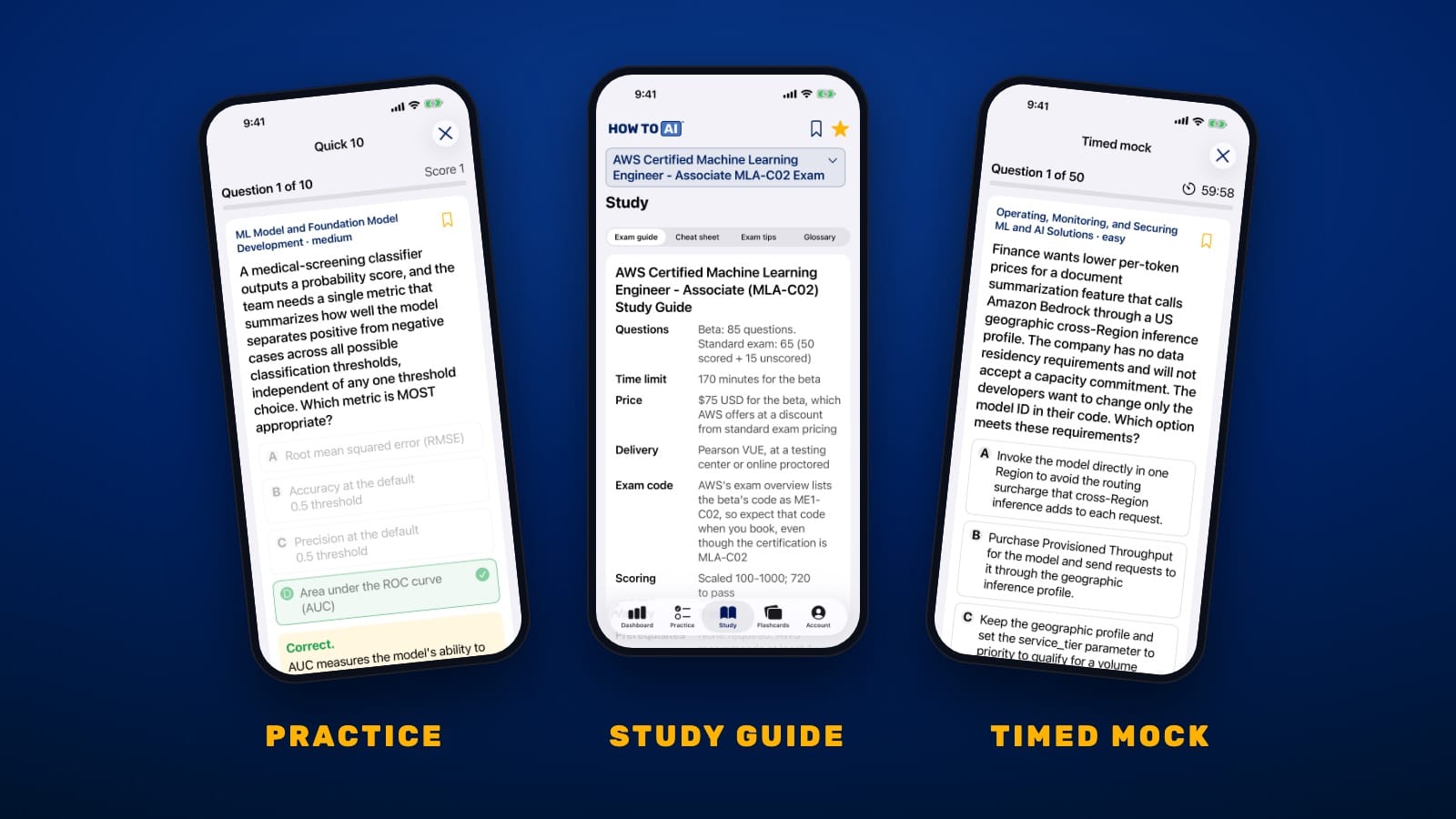
Study this exam on your phone
HOW TO // AI CERT has 6,151 original practice questions across 18 AI and cloud certifications, with plain-English explanations on every answer, full timed mock exams, weak-area drills, and an AI tutor powered by Claude. Free to download, with a free question set for every exam.

How to use MLA-C02 practice questions
- Take a cold set first. Do a round before you study to find your weak domains, not to get a score.
- Read every explanation, including on questions you got right. A lucky guess is still a gap.
- Map each miss to a domain. Data preparation is the largest at 28% and the other three are 24% each, so no domain is safe to skip.
- Fix generative AI misses in the console. Bedrock knowledge bases, agents and guardrails are where MLA-C02 differs most from MLA-C01. Build each one once instead of rereading notes.
- Practice against the clock. The beta gives you 170 minutes for 85 questions, about two minutes each. Timed mocks build that pace.
- Finish with AWS’s official question set once you’re passing our timed mocks consistently.
AWS’s free official MLA-C02 practice
AWS’s MLA-C02 certification page points to an Exam Prep Plan on AWS Skill Builder, the AWS Certification Official Practice Question Set and the Official Pretest. AWS describes its Official Practice Question Sets as free 20-question sets that show the style of its exams, with feedback on each answer. Its full-length Official Practice Exams need a Skill Builder subscription (the Individual plan starts at $29 a month). Use AWS’s set as a final check after our timed mocks: more original questions from different writers means fewer blind spots.
Why not MLA-C02 dumps?
“Dumps” claim to be real exam questions. AWS says some circulating study material contains actual exam items that were improperly disclosed, and that accessing these materials, even unintentionally, violates the AWS Certification Program Agreement. If you break that agreement, AWS’s policies say it can invalidate your results, revoke your certifications and suspend you from the program. MLA-C02 dumps are also especially unreliable: the exam guide only went live on September 1, 2026, and memorized answers don’t help when a question is worded differently. Original questions with explanations teach the reasoning the exam tests.
Free MLA-C02 study guide and cheat sheet
Prefer to study first? The free MLA-C02 study guide has the exam breakdown, a topic cheat sheet and a full glossary, with no sign-up. For what changed between the versions, read the MLA-C02 exam guide, and for the dates behind the switch, see MLA-C01 English retired, MLA-C02 beta open.
How to prepare
Read the official objectives in AWS’s MLA-C02 exam guide and check the dates on the AWS exam page, take a practice set above, then study the domains where you missed questions rather than re-reading everything. If you are coming from MLA-C01, spend your first week on Bedrock: knowledge bases, agents and guardrails are where the new questions are, and they are not something you can learn by reading. Before you book, check what the AWS ML Engineer exam costs and whether it is worth it for you; for a week-by-week schedule, use how to pass the AWS ML Engineer Associate.
HOW TO // AI is not affiliated with or endorsed by Amazon Web Services. AWS Certified Machine Learning Engineer – Associate, MLA-C01 and MLA-C02 are certifications of Amazon.com, Inc. or its affiliates; we reference them descriptively. All questions are original.
Practice for every AI & cloud cert
- NVIDIA NCA-AIIO practice questions
- NVIDIA NCA-GENL practice questions
- AWS AIF-C01 practice questions
- AWS MLA-C01 practice questions
- Microsoft AI-901 practice questions
- Microsoft AI-103 practice questions
- VMware VCP-VCF Administrator practice questions
- CompTIA AI Fundamentals practice questions
- Google Cloud Generative AI Leader practice questions
- Oracle OCI AI Foundations practice questions
- CertNexus AIP-210 practice questions
- Anthropic CCAO-F practice questions
- Anthropic CCDV-F practice questions
- Anthropic CCAR-F practice questions
- Anthropic CCAR-P practice questions
- Databricks GenAI Engineer Associate practice questions
- Salesforce Agentforce Specialist practice questions
- CompTIA SecAI+ practice questions
- All AI & cloud exam prep →
Frequently asked questions
Is there a free MLA-C02 practice test?
Yes. The quiz on this page gives you 10 original MLA-C02 practice questions with explanations and no sign-up, and 10 more unlock with your email. AWS also offers free 20-question Official Practice Question Sets on AWS Skill Builder.
Are these real MLA-C02 exam questions?
No. Every question is original, written from AWS's published MLA-C02 exam guide. Real exam content is confidential under the AWS Certification Program Agreement, and our questions are built to teach the reasoning, with an explanation on every answer.
Should I use MLA-C02 dumps?
No. AWS says accessing improperly disclosed exam items, even unintentionally, violates the AWS Certification Program Agreement, and AWS can invalidate results or revoke certifications. Dumps for a beta that opened in September 2026 are also very likely to be wrong.
What is ME1-C02?
ME1-C02 is the code AWS uses for the MLA-C02 beta exam. Search for ME1-C02 when you book through Pearson VUE, not MLA-C02.
How many questions are on MLA-C02, and what score do I need?
The beta has 85 questions in 170 minutes, including extra unscored items AWS is evaluating. The exam guide describes 50 scored plus 15 unscored questions for the standard exam. You need a scaled score of 720 out of 1,000 to pass.
How much does MLA-C02 cost?
The beta costs $75 USD. AWS hasn't listed the standard MLA-C02 price yet; it lists its Associate exams at $150. You get one attempt at the beta, and if you don't pass you retake once the standard version is available.
Can I still take MLA-C01?
Not in English: the last English sitting was September 28, 2026. MLA-C01 stays available in Japanese, Korean and Simplified Chinese until MLA-C02 is generally available, which AWS's certification blog dates to January 14, 2027.
Will MLA-C01 practice questions help with MLA-C02?
Partly. The four domains are the same and every MLA-C01 task maps to an MLA-C02 task, but MLA-C02 adds Amazon Bedrock, RAG, agents, guardrails and LLM evaluation. Use MLA-C02 practice questions for those topics.