
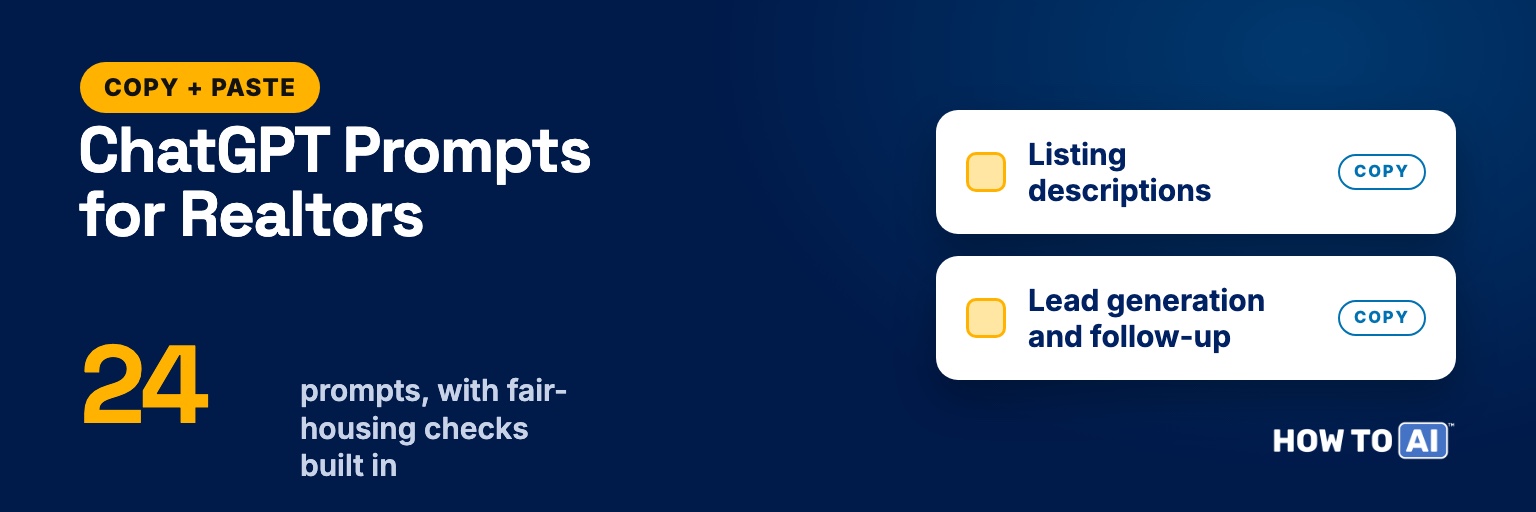
These 24 ChatGPT prompts for real estate agents cover the work that fills your week: listing descriptions, lead generation and follow-up, buyer and seller updates, social posts and the transaction checklist. Each one has [BRACKETS] for your details, so the output sounds like your market instead of a template.
They work in ChatGPT, Claude and Gemini. Want a copy to keep in the car? Download the printable version below.
Fair housing and client privacy come first
Every listing, ad, post and email you create with AI still has to follow fair-housing rules. The federal Fair Housing Act bans discrimination based on race, color, national origin, religion, sex, familial status and disability, and many states and cities protect more groups than that. AI doesn’t reliably apply those rules, and it loves phrases like “perfect for young families” that describe people instead of the property.
- Describe the property, not the buyer. Bedrooms, light, yard, updates, commute routes. Not who “should” live there.
- Check every AI draft for fair-housing problems before it goes out, the way you’d check a new assistant’s work. Prompt 2 below gives you a first pass, but it isn’t a legal review. When you’re unsure, ask your broker.
- Keep client details out of AI tools your brokerage hasn’t approved. No names, phone numbers, financial details, or a seller’s reasons for moving.
- Don’t let AI invent features. It will happily add quartz counters you don’t have. Give it the facts and tell it not to add any.
Listing description prompts
1. Listing description from your fact sheet. Use it when you have the specs and photos but no words yet.
You are a real estate copywriter. Write a listing description using ONLY these facts. Do not add features, finishes, or neighborhood claims that aren't listed here.

Property facts: [BEDS, BATHS, SQ FT, LOT, YEAR BUILT, KEY UPDATES, STANDOUT FEATURES]
Location facts: [NEARBY PARKS, COMMUTE ROUTES, AMENITIES]
Style: [e.g. warm and specific; no hype words like "stunning" or "must-see"]

Write a [CHARACTER LIMIT FROM YOUR MLS]-character version for the MLS and a 60-word version for social media. Describe the property and its features, not the kind of person who should buy it. Follow fair-housing rules: no references to race, color, religion, sex, disability, familial status, national origin, or any other protected characteristic.2. Fair-housing wording check. Use it on any listing, ad or post before it goes live, as a second set of eyes.
Review this real estate marketing copy for wording that could raise fair-housing concerns. Flag any phrase that describes or prefers a type of person (for example by family status, age, religion, disability, national origin, race, or sex) instead of describing the property, or that could steer buyers toward or away from an area. For each flag, explain why and suggest neutral wording.

Also flag any claim I should be able to prove, like school ratings, "safest," or "best." This is a first pass, not legal advice; I'll confirm anything uncertain with my broker.

[PASTE COPY]3. Room-by-room photo captions. Use it when you’re posting the photo gallery and want captions that point out what the photo can’t show.
Write short captions (under 15 words each) for these listing photos. For each room I'll give you the facts. Point out one detail a buyer might miss in the photo (natural light, storage, the view, a recent update), using only what I list.

[ROOM: FACTS]
[ROOM: FACTS]
[ROOM: FACTS]4. Open house flyer copy. Use it when you need a one-page flyer for Saturday’s open house.
Write copy for a one-page open house flyer:
- A headline under 8 words
- 5 bullet highlights from the facts below
- A date-and-time line
- A short call to action to sign in or text me

Facts only; no invented features.
Facts: [PROPERTY FACTS]
Open house: [DATE, TIME]Lead generation and follow-up prompts
Before you phone or text anyone who isn’t already a client, check do-not-call rules and your brokerage’s policy. These prompts write the words; the list and the permission are on you.
5. Sphere check-ins that aren’t “just checking in”. Use it for your monthly touch with past clients and your sphere.
Write 6 short text messages (under 40 words each) I can send to past clients and people in my sphere this month. No "just checking in," no hard sell. Each should give something useful: a local event, a seasonal home-maintenance tip, a market stat I'll fill in [LOCAL STAT], or a genuine question about them.

Market: [CITY / AREA]. Month: [MONTH]. My tone: [e.g. friendly, a little dry].6. First reply to an online lead. Use it when a portal or website lead comes in and you want to answer fast with a question that gets a reply.
A new online lead asked about [PROPERTY OR SEARCH, e.g. the 3-bed on Maple, or homes under $X in Y]. Write:
1. A text reply under 50 words that answers their question and asks one easy question back
2. An email version under 120 words
3. Three qualifying questions (timeline, financing, must-haves) I can work into the next conversation without it feeling like an interrogation7. Open house follow-up sequence. Use it the evening after an open house, while visitors still remember the kitchen.
Write a 3-message follow-up sequence for people who signed in at my open house:
- Day 1 (text): thank them, mention one detail about the house, ask one question
- Day 3 (email): offer to send similar homes in their range, or share a short market note [FILL IN]
- Day 10 (text): low-pressure check-in

Keep each under 70 words. Vary the openings. No pressure language.8. Neighborhood farming postcards. Use it when you farm a neighborhood and need a fresh angle every month.
I farm [NEIGHBORHOOD], mostly [HOME TYPE, e.g. 1970s ranch homes]. Give me 6 postcard ideas for the next 6 months. For each: a headline, about 40 words of body copy, and the data I'd need to fill in (I'll supply recent sales numbers myself). Mix market updates, home-value tips, and local happenings. Describe homes and places, not the people who live there.9. Expired listing letter. Use it when you’re reaching out to owners whose listing ended without a sale.
Write a short letter to a homeowner whose listing expired without selling. Tone: respectful, no criticism of the previous agent, no promises about price. Offer a specific reason to talk: a free review of what the market told us about their home [e.g. showing count, days on market, price changes] and what I'd do differently. Under 200 words. Leave placeholders for my details.Buyer client prompts
10. First-time buyer roadmap. Use it after a first meeting with a buyer who’s never bought a home before.
Write a plain-English roadmap of the home-buying process for a first-time buyer in [STATE / AREA], from pre-approval to closing. Use numbered steps, one or two sentences each, and note where the buyer will need to make a decision or send money. Mark anything that varies by state, lender, or contract with "confirm with your lender, attorney, or me." Under 400 words.11. Compare the homes we saw. Use it after a showing day when your buyers start blurring the houses together.
Here are my notes from today's showings: [FOR EACH HOME: price, beds/baths, pros, cons, buyer reactions].
My buyers' must-haves: [LIST]. Nice-to-haves: [LIST].

Make a comparison table (one row per home) that checks each home against the must-haves. Then write a short, neutral summary I can text my buyers. Don't recommend one; lay out the trade-offs.12. Make the inspection report less scary. Use it when your buyers get a long inspection report and panic.
My buyers received a home inspection report. Here are the summary items (address removed): [PASTE SUMMARY ITEMS].

Group them into: safety concerns, major systems, routine maintenance, and cosmetic. Explain each item in plain English. For each, list the question the buyers should ask the inspector or a licensed contractor. Don't estimate repair costs and don't say whether anything is a deal-breaker.13. Offer conversation prep. Use it before you sit down with buyers to write an offer in a competitive situation.
Help me prepare talking points for an offer conversation. Situation: [LIST PRICE, DAYS ON MARKET, OFFERS EXPECTED, BUYER'S BUDGET AND PRIORITIES].

List the terms besides price that could make an offer stronger or weaker (for example timing, contingencies, earnest money), with the risk of each to my buyer in plain language. Give me 3 questions to ask so the buyers make the call themselves. Don't recommend a price.Seller client prompts
14. Listing presentation outline. Use it the night before a listing appointment.
Build an outline for a 30-minute listing presentation to a seller in [AREA] with a [HOME TYPE]. My strengths: [e.g. professional photography, 12 years in this zip code, strong negotiation record].

Sections: their goals, market snapshot (I'll add the data), pricing approach, marketing plan, how I'll communicate, and next steps. For each section, give 2 to 3 talking points and one question to ask the seller.15. Weekly seller update. Use it every Monday while a listing is active.
Turn this week's activity into a short update email to my sellers:
Showings: [NUMBER]
Feedback: [PASTE FEEDBACK, NO BUYER OR AGENT NAMES]
Online views and saves: [NUMBERS, IF YOU HAVE THEM]
New competing listings: [SUMMARY]

Tone: honest and calm. Group the feedback into themes, say what it suggests, and end with my recommendation for next week: [YOUR RECOMMENDATION]. Under 200 words.16. The price reduction conversation. Use it when the data says the price is too high and you need to say so kindly.
Help me prepare for a conversation with sellers about reducing the price. Facts: listed [DAYS] days ago at [PRICE], [NUMBER] showings, feedback themes: [LIST], recent comparable sales: [SUMMARY].

Give me:
- An opening that doesn't blame them
- The 3 facts that matter most
- Two or three options, with the trade-offs of each
- Calm responses to "Let's wait another month" and "Another agent said it was worth more"17. Explain your CMA in plain English. Use it when your comparable-sales analysis is solid but the seller’s eyes glaze over.
Here are the comparable sales from my CMA: [FOR EACH COMP: nickname, price, sq ft, beds/baths, condition, date sold, notes].
Subject property: [FACTS].

Write a one-page plain-English explanation of how these comps support a price range of [RANGE]. Explain the adjustments simply. Don't change my numbers or add comps. If something looks inconsistent, point it out to me instead of smoothing it over.Social media and content prompts
18. Monthly market update. Use it when you have the numbers but not the words for your newsletter or video.
Turn these local market numbers into a short market update for [BUYERS / SELLERS / BOTH] in [AREA]:
[MEDIAN PRICE, DAYS ON MARKET, INVENTORY, CHANGE VS LAST YEAR, ANYTHING NOTABLE]

Write a 150-word email version, a 3-sentence social post, and a 45-second video script. Explain what the numbers mean for someone thinking of buying or selling. Use only these numbers; don't add any.19. Neighborhood guide. Use it for a blog page or relocation packet about an area you know well.
Write a neighborhood guide for [NEIGHBORHOOD] using my notes: [PARKS, RESTAURANTS, COMMUTE, HOUSING STYLES, EVENTS, WHAT I LIKE ABOUT IT].

Focus on places, amenities, and housing, not on who lives there. Don't describe the area as right for a particular type of person, and don't make claims about safety or school quality. End with a short list of questions to ask when touring homes here.20. 60-second video script. Use it when you want to film a quick home tour or tip video without rambling.
Write a 60-second video script about [TOPIC, e.g. the kitchen at my new listing, or 3 things to fix before you list]. Format:
- A hook for the first 3 seconds
- 3 short beats, each with what I say and what the camera shows
- A closing line inviting people to message me

Conversational, like I'm talking to one person. Only mention features from these facts: [FACTS].For longer posts on LinkedIn, see how to polish your LinkedIn posts with AI. For more writing prompts beyond real estate, try our AI prompts for writing.
Transaction and business prompts
21. Transaction timeline from contract dates. Use it right after you go under contract.
Build a transaction timeline from these contract dates (no client names): acceptance [DATE], inspection period ends [DATE], appraisal [DATE], financing contingency [DATE], closing [DATE]. Other terms: [LIST].

Make a checklist in date order: what's due, who's responsible (buyer, seller, lender, title, me), and a reminder 2 days before each deadline. Flag anything I should double-check against the actual contract.22. Rehearse the fee conversation. Use it when you want to practice explaining your fee before a skeptical client asks.
Role-play with me. You are a [SELLER / BUYER] in [AREA] who is skeptical about my fee. Push back realistically, one message at a time, and wait for my answer each time. After 6 exchanges, stop and give me feedback: what I explained well, where I sounded defensive, and a better way to say my weakest answer.

My services and how I'm paid: [SUMMARY].23. A client FAQ you send once. Use it when you answer the same questions for every new client.
Here are questions my [BUYER / SELLER] clients ask me all the time: [LIST]. Here are my usual answers, in rough notes: [NOTES].

Turn these into a clean FAQ I can send new clients. Keep my answers, tighten the wording, and add "confirm with your lender or attorney" wherever the answer depends on their situation or state rules.The same idea works for your website; here’s how to turn repeat questions into a self-serve FAQ.
24. Protect your prospecting time. Use it on Sunday night when showings and paperwork keep crowding out lead generation.
Here's my week: [APPOINTMENTS, SHOWINGS, CLOSINGS, DEADLINES]. My goals: [e.g. 20 sphere contacts, 2 listing appointments, 1 open house].

Build a time-blocked schedule that protects at least [HOURS] hours for lead generation, groups errands by area, and leaves buffer for last-minute showings. Tell me what to move or hand off if it doesn't fit.Common mistakes agents make with AI
- Letting it pad the listing. Every adjective AI adds is a claim you’re making. Keep the “use only these facts” line in every listing prompt.
- Asking AI for market numbers. It doesn’t know your local stats and may invent plausible ones. Pull numbers from your MLS and paste them in.
- Skipping the fair-housing read. Run prompt 2 on anything public, then read it yourself. AI misses things too.
- Sounding like every other agent. Paste two of your best past listing descriptions and add “match this voice.” Our fix for generic AI answers shows why specifics change the output.
- Pasting contracts and client files. Summarize the dates and terms instead, and keep the documents in the systems your brokerage approves.
Try it on your next listing
Take your next listing’s fact sheet and run prompts 1 and 2 back to back: draft, then check. Then use prompt 7 for your next open house. For any email these prompts don’t cover, the three-part formula in our guide to writing better emails with AI gets you a solid draft fast. If you also sell to businesses, see ChatGPT prompts for sales reps.
📄 Free download: the printable prompt pack
Every prompt on this page in one print-ready PDF, grouped by task, with the fill-in-the-blanks left blank. No email required.
Related guides
- Write better emails with AI
- Polish your LinkedIn posts with AI
- The AI prompting guide
- AI FAQ Generator: Turn Support Tickets Into an FAQ Page
- Why Your AI Keeps Giving You Generic Answers — And the Fix (Free Kit)
Frequently asked questions
Can ChatGPT write MLS listing descriptions?
It can write a good first draft if you give it the facts and tell it not to add any. You still check every detail, your MLS's character limit and rules, and fair-housing wording before it goes live.
How do I keep AI listing copy fair-housing compliant?
Tell the AI to describe the property, not the buyer, and to avoid references to protected characteristics. Then run a wording check like prompt 2 and read it yourself. AI checks aren't legal reviews, so ask your broker when you're unsure.
What are the best ChatGPT prompts for real estate lead generation?
Prompts that give leads a reason to reply: a fast first response with one easy question, open house follow-ups that mention a real detail, and sphere messages that share something useful. Always check do-not-call rules and your brokerage's policy before contacting new people.
Is it safe to paste client information into ChatGPT?
Only into tools your brokerage has approved for client data. Otherwise leave out names, contact details, finances and a seller's reasons for moving, and summarize the situation instead.