
Look up advice on AI cover letters and you’ll find a lot of worry about getting “flagged.” It helps to be precise about who does the flagging. Software that claims to detect AI writing is unreliable. The real risk is a person reading a letter that could have been sent to any company by anyone, and recognizing it within a few lines.
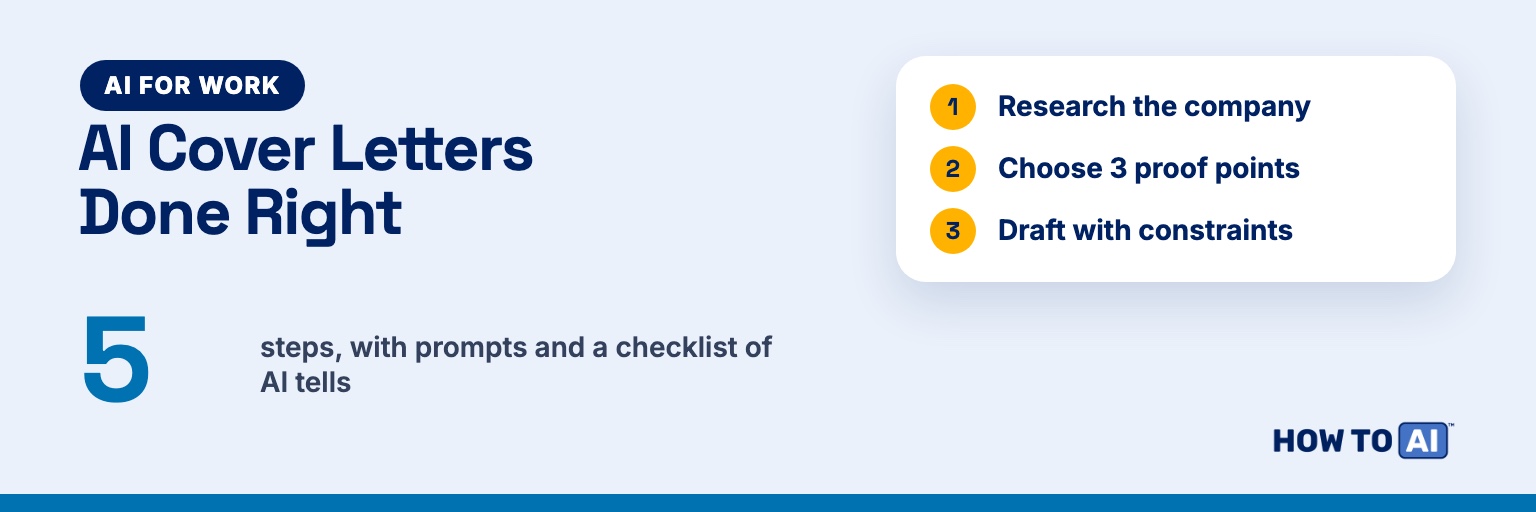
This guide deals with that real risk. You’ll research the company, pick three proof points, draft with tight constraints, add details only you know, and finish with a read-aloud pass. Each step has a prompt, and there’s a checklist of AI tells to cut at the end.
What “flagged” really means
Start with detectors. OpenAI built a classifier to spot AI-written text and withdrew it in July 2023 because of its low accuracy. In OpenAI’s own evaluation, it correctly caught only 26% of AI-written text and wrongly labeled human writing as AI-written 9% of the time. OpenAI also noted it got more reliable with longer text, and a cover letter is short.
OpenAI’s help center still answers “Do AI detectors work?” with “In short, not in our experience,” adding that its own attempt labeled Shakespeare and the Declaration of Independence as AI-generated.
That doesn’t mean anything goes. Other companies sell detection tools, and an employer can set its own rules about AI in applications. If an application says not to use AI, or asks you to confirm the work is your own, respect that.
The flag you can count on is human. A generic letter is easy to spot whoever wrote it: it opens by restating the job title, praises the company in words that fit any company, and repeats the résumé in paragraph form. Fix those, and the detector question matters a lot less.
The 5-step workflow
- Research the company from its own pages (about 10 minutes)
- Pick 3 proof points that match what the job needs
- Draft with constraints so AI can’t fall back on filler
- Personalize with specifics only you know
- Read it aloud and cut anything you wouldn’t say
Step 1: Research the company from its own pages
Don’t ask a chatbot what it “knows” about a company. Its information may be out of date or simply made up (here’s why AI makes things up). Instead, copy text from sources the company controls: the job posting, its About and careers pages, recent press releases or blog posts, and product pages. Then make AI work only from that material.
Below is text I copied from [COMPANY]'s own website and the job posting. Using ONLY this material:

1. Summarize what they sell and to whom, in two sentences.
2. Describe the problem this role is being hired to solve.
3. List 3 specific things I could mention in a cover letter (a launch, a stated priority, a project, a value they explain in detail). Quote the line each one comes from.
4. List the words they use to describe their own work, so I can match their vocabulary.

If something isn't in the material, say "not in the material." Don't fill gaps from memory.

Material:
[PASTE]A tool with web search works too, but open every link it cites and confirm the fact on the company’s own site before it goes in your letter.
Step 2: Choose your 3 proof points
A cover letter isn’t a summary of your résumé. It’s an argument: you need what I’ve done. Three pieces of evidence are enough to make it.
Here's the job description and my résumé (contact details removed).

1. Identify the 3 requirements the hiring manager is most likely to care about, with a one-line reason for each.
2. For each one, pick the strongest matching evidence from my résumé: a specific result, not a responsibility.
3. If there's no strong match for a requirement, say so plainly. Don't stretch.

Job description:
[PASTE]

My résumé:
[PASTE]Check its picks against your own memory. You may have a better story that never made it onto your résumé. If you built achievement notes while writing your résumé with AI, paste those instead; they hold more detail than the final bullets.
Step 3: Draft with constraints
Ask AI for “a cover letter” and you get its default: formal, eager, and generic. Constraints push it off that default. This prompt is a stricter version of the cover-letter step in our 2026 Job Search Prompt Vault: it bans the usual filler and leaves gaps for you to fill.
Write a cover letter for the [JOB TITLE] role at [COMPANY], using only the research notes and proof points below.

Constraints:
- 250 to 320 words, 3 or 4 short paragraphs.
- First sentence: a specific reason I'm interested in this company, drawn from the research notes. Never start with "I am writing to" or by restating the job title.
- Use my 3 proof points, each with its result. Don't repeat my résumé line by line.
- Plain words and short sentences. Avoid: passionate, thrilled, excited to apply, proven track record, dynamic, fast-paced, align perfectly, ideal candidate, "Furthermore," "Moreover."
- Where a personal detail would make a sentence stronger, write [ADD DETAIL: what's needed] instead of inventing one.
- End with one simple sentence asking for a conversation.
- After the letter, list any claim you made that isn't directly supported by my notes.

Research notes:
[PASTE STEP 1 OUTPUT]

Proof points:
[PASTE STEP 2 OUTPUT]That last instruction matters. It makes AI show you where it filled a gap, so nothing slips into the letter that you can’t back up.
Step 4: Add what only you know
This step makes the letter yours, and no prompt can do it for you. Replace every [ADD DETAIL] marker with something true and specific:
- Why this company, for you. You use their product, you’ve worked with customers like theirs, or one of their projects connects to your work.
- A moment from a proof point. The obstacle, the number, the thing that almost went wrong.
- What you’d do first. One concrete idea based on the job description, offered lightly.
Here’s an illustrative example, written for a fictional applicant to a fictional scheduling-software company:
| Generic | Specific |
|---|---|
| I have long admired your company’s commitment to innovation and customer success. | I’ve used your scheduling app to run volunteer shifts at our food bank for two years, and the recurring-shift feature is why our coordinator finally retired her spreadsheet. |
The generic line could go to any company on earth. The specific one could only come from this applicant, and it gives the reader a reason to keep going.
Step 5: Read it aloud
Read the whole letter out loud. Mark every spot where you stumble, run out of breath, or use a word you’d never say to a hiring manager’s face. Rewrite those lines first. Then get a second opinion:
Here's my edited cover letter. Act as a skeptical hiring manager who has read a big stack of these today.

Flag any sentence that sounds generic, overly formal, or like AI filler. For each one, suggest a plainer version in the same voice as the rest of the letter. Don't add new claims, and keep every specific detail and number exactly as is.

Letter:
[PASTE]Then do the boring checks: the company name is right everywhere (reused letters are where this goes wrong), the hiring manager’s name is spelled correctly if you have it, and the job title matches the posting. For a final polish, see how to use AI as your personal proofreader.
Checklist: AI tells to cut
- “I am writing to express my interest in…”
- “I am thrilled (or excited, or eager) to apply”
- “Passionate about,” “a proven track record,” “results-driven”
- Praise that fits any company: “innovative leader,” “commitment to excellence”
- “My skills align perfectly with…” or “I am confident I would be an ideal fit”
- Back-to-back sentences starting with “Furthermore,” “Moreover,” or “Additionally”
- Lists of three abstract nouns, like “collaboration, innovation, and impact”
- Every paragraph the same length and shape
- A closing that says nothing: “Thank you for your time and consideration. I look forward to the opportunity to discuss how I can contribute…”
- Any claim you couldn’t back up with a story in an interview
None of these prove AI wrote a letter. People wrote this way long before chatbots. They’re simply the phrases that make one letter sound like every other letter.
Try it now: fix one opening
Take your most recent cover letter, or the one you’re about to send, and run the Step 5 prompt on it. Then rewrite the first paragraph around one real, specific reason you want this job. If the new opening would only make sense for this one company, you’re on the right track.
And when the interview invite arrives, rehearse with an AI mock interview.
🎁 Free download: The 2026 Job Search Prompt Vault
10 copy-paste prompts for résumés, cover letters, interview prep, and follow-ups, in one free Notion page. Free with your email address.
Related guides
- How to Write a Résumé With AI (That Doesn’t Sound Like AI)
- AI Mock Interviews: Practice With ChatGPT or Claude
- How to Write Better Emails With AI in 5 Minutes
- Job Scam Checker: How to Tell If a Job Is a Scam
- The 2026 Job Search Prompt Vault: 10 AI Prompts That Actually Work – DOWNLOADABLE!
Frequently asked questions
Can employers tell if my cover letter was written by AI?
Not reliably with software. OpenAI withdrew its own AI-text classifier in 2023 because of its low accuracy, and its help center says detectors haven't proven reliable in its experience. People are a different story: a generic letter stands out quickly, whoever wrote it.
Should I run my cover letter through an AI detector or a humanizer tool?
It's not a good use of your time. Detector scores aren't reliable enough to tell you much, and rewriting tools that promise to beat them don't fix the real problem, which is a lack of specifics. Spend those minutes adding one detail only you could know.
How long should a cover letter be?
Unless the application says otherwise, keep it well under a page. About 250 to 350 words is enough for a specific reason you want the job and three proof points. Short and specific beats long and general.
Is it dishonest to use AI to write a cover letter?
Using AI to research, organize, and edit is a lot like getting feedback from a friend, as long as every claim is true and you stand behind every sentence. Follow any rules the employer sets about AI, and never send a letter you haven't read closely and reworked yourself.