
Turn scattered thoughts into professional posts that start conversations.
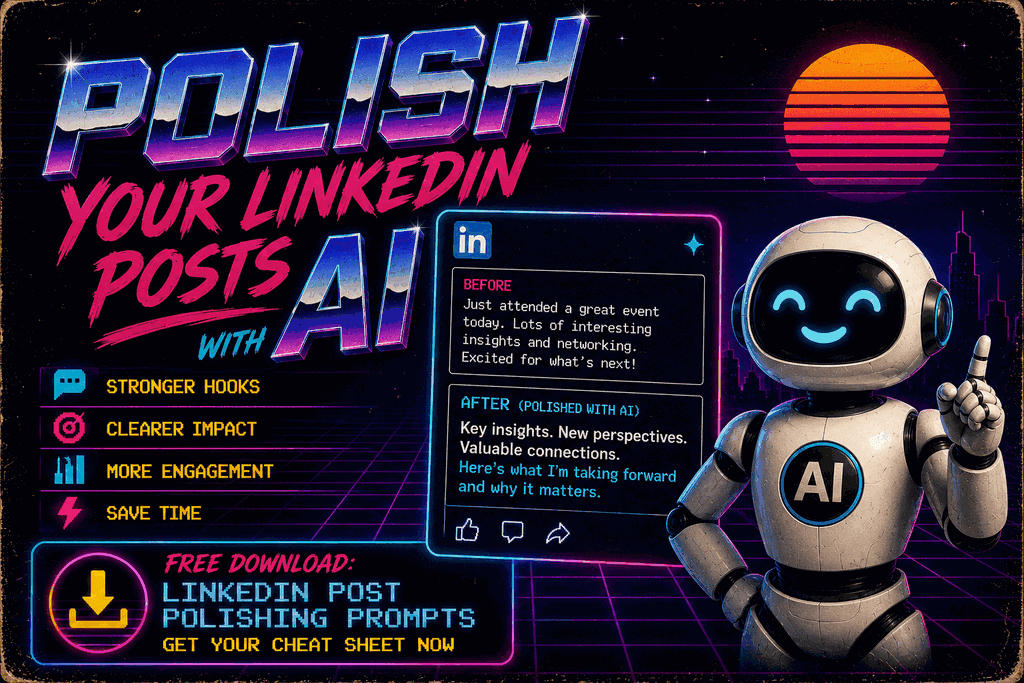
Most professionals freeze in front of LinkedIn’s blank post box. You have ideas worth sharing, but translating them into something polished and engaging feels like a separate skill. Take advantage of the tools at hand: write your messy first thoughts, then let AI structure and smooth them into a clear, authentic post.
Capture your core insight without editing.
Write two or three sentences about what you want to share. Focus on substance, not style. Maybe it’s a lesson from a recent project, a trend you’ve noticed, or a contrarian take. Include details or numbers that ground your point. Don’t worry about typos yet. Save this version as your raw material.
Let ChatGPT restructure and polish.
Open a fresh ChatGPT chat and paste this complete prompt:
Rewrite this as a LinkedIn post for [your target audience, e.g., u0022marketing managers at SaaS companiesu0022]. Keep my core message and specific examples intact, but make it more engaging and scannable. Use 2-3 line paragraphs maximum, add 1-2 relevant emojis, and end with a specific question that asks for examples or experiences rather than opinions. Avoid corporate jargon and buzzwords.nnu003cpaste your brain dump hereu003eThe AI will preserve your insight while adding structure, visual breaks, and discussion hooks that actually work.
Fine-tune with targeted follow-ups.
Review the output and fix common AI patterns with these micro-prompts:
For generic openings:
Rewrite the hook to be more specific and attention-grabbing.For corporate language:
Replace any jargon or buzzwords with simpler, conversational language.For weak endings:
Change the closing question to ask for specific examples or stories, not general opinions.Format for mobile and publish.
Most people read LinkedIn on phones, so structure matters. Polish your post up for readability with this final prompt:
Reformat with shorter paragraphs (2-3 lines each), add line breaks between main ideas, and use bullet points for any lists.Do a quick sanity check: Does this sound like something you’d say in a meeting? Remove any details that feel too internal or confidential. Now you’re ready to post!
What Makes a LinkedIn Post Actually Land
AI handles the structure, but a few things decide whether a post gets read at all. Keep these in mind as you review the draft:
- The first line is the whole game. LinkedIn shows two or three lines before “see more.” If the hook is generic, nobody expands it. Make line one specific or surprising.
- One idea per post. A post that makes a single clear point outperforms one that crams in three. Save the others for later.
- Specifics beat platitudes. “We shipped the feature two weeks early” lands; “hard work pays off” does not. Keep the real numbers and details AI tends to smooth away.
- White space is a feature. Short paragraphs and line breaks make a post feel easy. A dense block gets scrolled past.
Common Mistakes to Avoid
- Posting the first draft. AI’s first pass is competent but a little flat. The follow-up prompts — sharper hook, less jargon, better question — are where it gets good.
- Leaving in the tells. Em-dash pile-ups, “in today’s fast-paced world,” and three-part lists everywhere read as AI. Cut them.
- Ending with a weak question. “Thoughts?” gets nothing. A question that asks for a specific example or story gets real comments.
- Over-emoji-ing. One or two emojis add warmth. Ten make it look like a billboard.
LinkedIn With AI: FAQ
Will people know I used AI to write it?
Not if you start from your own idea and keep your own examples. The AI is structuring your insight, not inventing one. What reads as “AI-written” is generic content with no real point of view — and that comes from skipping the brain-dump step, not from using the tool.
How often should I post?
Consistency beats volume. One genuinely useful post a week, every week, builds more presence than a burst of five and then silence. This workflow makes weekly realistic because the hard part — turning a thought into a polished post — now takes minutes.
What should I write about?
The things you already know. A lesson from a recent project, a mistake you fixed, a trend you have a take on. You do not need to be an influencer — you need one specific, true thing to say. AI cannot supply that part; it can only shape it.
📌 Key takeaway: AI doesn’t replace your expertise. It helps you present your ideas in LinkedIn’s format, turning scattered thoughts into posts that build your professional presence and start real conversations.
More info is available at – Writing LinkedIn posts utilizing ChatGPT
Related guides
- Use AI as Your Personal Proofreader
- Turn Slides Into Talking Points With AI
- why your AI gives generic answers
- Turn AI Into Your Brainstorming Buddy
- How to Write Better Emails With AI in 5 Minutes
Frequently asked questions
How do I use AI to write a LinkedIn post?
Start by writing two or three rough sentences about your actual insight, focusing on substance over style and keeping any real details or numbers. Then paste that raw material into ChatGPT and ask it to restructure and polish it. The AI adds structure and flow while preserving the point you brought.
What makes a LinkedIn post actually get read?
The first line decides everything, since LinkedIn only shows two or three lines before see more, so make line one specific or surprising. Stick to one clear idea per post, use concrete specifics over platitudes, and break the text into short paragraphs with white space so it is easy to skim on a phone.
How do I keep an AI-assisted post from sounding generic?
Start from your own idea and keep your own examples and numbers, since generic posts come from skipping the brain-dump step, not from using AI. Then use targeted follow-up prompts to sharpen a weak hook, cut corporate jargon, and replace a flat ending like Thoughts? with a question that asks for a specific story.
How often should I post on LinkedIn?
Consistency beats volume. One genuinely useful post a week, every week, builds more presence than a burst of five followed by silence. This workflow makes weekly realistic because turning a thought into a polished post now takes minutes instead of an evening.