
AWS AI Practitioner Study Guide & Cheat Sheet
A free study guide for the AWS AI Practitioner exam (AIF-C01) — exam facts, the domain breakdown, study tips, a topic cheat sheet, and a full glossary. No sign-up needed.
Ready to practice? Take the free AWS AI Practitioner practice quiz → · Get the full exam prep →
Who the AWS AI Practitioner is for
AIF-C01 is a foundational exam: nobody asks you to write code or size a GPU cluster. AWS writes it for someone with up to about six months of exposure to AI and ML on AWS, and the questions are mostly about picking the right service and the right approach rather than building anything. If you already ship machine learning on AWS, the ML Engineer Associate is the exam that matches your job.
The difficulty is breadth, not depth. There are a lot of AWS service names to keep straight, and multi-answer questions are all-or-nothing, so a half-right answer scores zero. Some questions on your exam do not count at all: AWS seeds unscored items it is testing, and you will not know which ones, so an odd-looking question is not a reason to panic.
How to use this guide
- Read the domain weights first. Generative AI dominates this exam across two domains, so that is where your hours belong.
- Then the tips, which cover how AWS frames scenario questions and how to handle the all-or-nothing ones.
- Work the cheat sheet as a checklist. Anything you cannot explain out loud, especially service names that sound alike, goes on your study list.
- Test early. Our free AIF-C01 practice questions follow the same blueprint, with an explanation on every answer.
Before you book
See what it costs including retakes and renewal, whether it is worth it, and, if you are weighing clouds, AWS against Azure AI Fundamentals. For a schedule, follow our three-week plan.
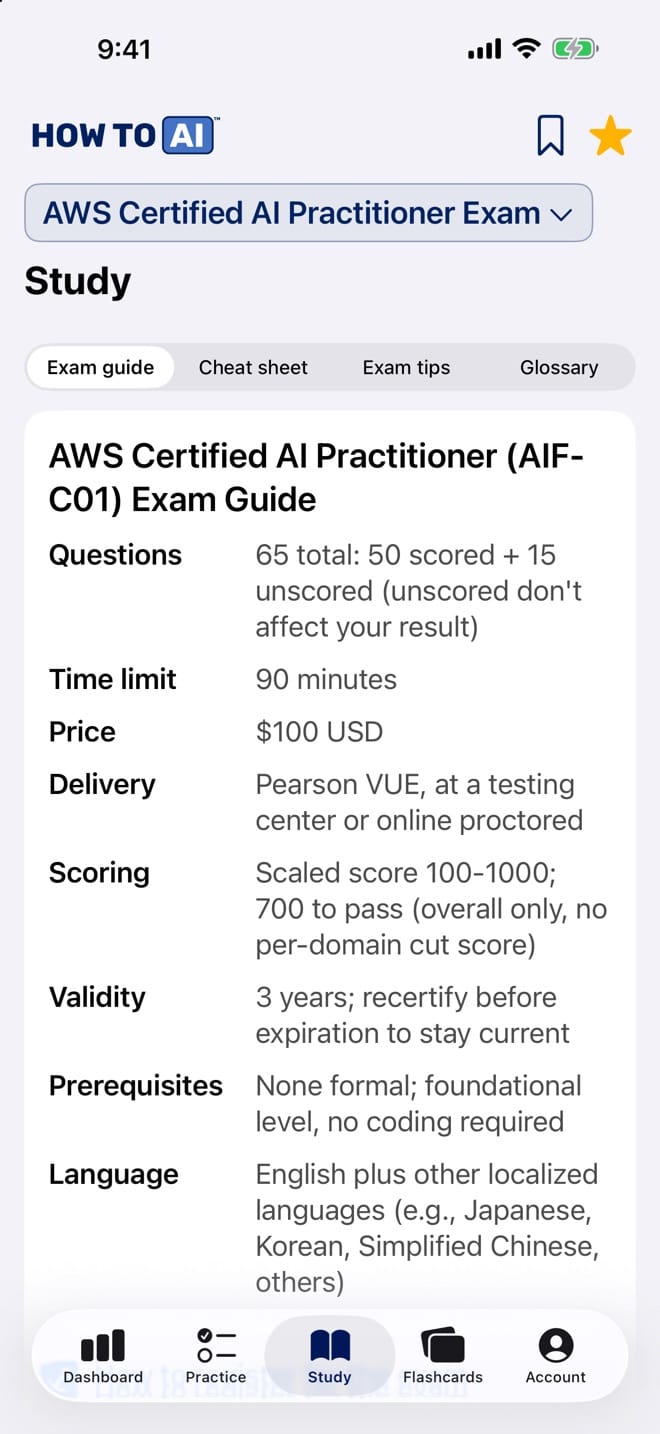
AWS Certified AI Practitioner (AIF-C01) Exam Guide
| Questions | 65 total: 50 scored + 15 unscored (unscored don't affect your result) |
|---|---|
| Time limit | 90 minutes |
| Price | $100 USD |
| Delivery | Pearson VUE, at a testing center or online proctored |
| Scoring | Scaled score 100-1000; 700 to pass (overall only, no per-domain cut score) |
| Validity | 3 years; recertify before expiration to stay current |
| Prerequisites | None formal; foundational level, no coding required |
| Language | English plus other localized languages (e.g., Japanese, Korean, Simplified Chinese, others) |
Exam domains
| Domain | Weight | What it covers |
|---|---|---|
| Fundamentals of AI and ML | 20% | Core AI, ML, and deep-learning concepts: supervised vs. unsupervised vs. reinforcement learning, the ML lifecycle, training/validation/test data, and metrics like accuracy, precision, recall, F1, and AUC. Also covers AWS ML services such as SageMaker, Comprehend, Rekognition, and when to use ML vs. a rules-based approach. Roughly 10 of the 50 scored questions. |
| Fundamentals of Generative AI | 24% | Generative AI building blocks: foundation models, tokens, embeddings/vectors, prompt engineering, and the generative AI lifecycle from model selection to deployment. Covers benefits, limitations (hallucination, cost, nondeterminism), agentic AI basics (tools, memory, MCP), and AWS services like Amazon Bedrock, SageMaker JumpStart, Amazon Quick, Kiro, Strands Agents, and Amazon Bedrock AgentCore. Roughly 12 of the 50 scored questions. |
| Applications of Foundation Models | 28% | The largest domain: designing FM-based solutions, prompt engineering techniques (zero/one/few-shot, chain-of-thought), inference parameters (temperature, top-p), and choosing between RAG, fine-tuning, continuous pre-training, and in-context learning. Covers Bedrock Knowledge Bases, AI agents, vector stores, and evaluation metrics (ROUGE, BLEU, BERTScore). Roughly 14 of the 50 scored questions. |
| Guidelines for Responsible AI | 14% | Responsible-AI principles: fairness, bias and variance, explainability, transparency, robustness, safety, and human oversight. Covers tools such as Amazon Bedrock Guardrails, SageMaker Model Cards, and Amazon Bedrock Model Evaluations, bias checks such as human audits and subgroup analysis, plus the trade-offs between model performance and responsible-AI goals. Roughly 7 of the 50 scored questions. |
| Security, Compliance, and Governance for AI Solutions | 14% | Securing and governing AI/ML workloads: IAM, KMS encryption, data privacy, PrivateLink, Macie, and the AWS shared responsibility model. Covers governance and audit services (Config, CloudTrail, Inspector, Artifact, Trusted Advisor) and regulatory/compliance considerations for AI data. Roughly 7 of the 50 scored questions. |
Who it’s for: Business and technical professionals - analysts, product and project managers, sales and marketing staff, and developers - who need foundational fluency in AI/ML concepts and the AWS AI service portfolio. No coding or hands-on model-building experience is required; AWS suggests up to ~6 months of general exposure to AI/ML technologies on AWS.
Study & test-day tips
- Spend the most prep time on generative AI: Domains 2 and 3 together are 52% of the exam, so master foundation models, prompt engineering, RAG, fine-tuning, and Amazon Bedrock before anything else.
- Learn the 'when to use what' decision tree for managed AI services - Comprehend (text/NLP), Rekognition (images/video), Textract (document data extraction), Transcribe (speech-to-text), Polly (text-to-speech), Translate, Lex (chatbots), and Personalize (recommendations). Amazon Kendra is no longer open to new customers; for search over your own documents, think Bedrock Knowledge Bases.
- Memorize the RAG vs. fine-tuning vs. continuous pre-training vs. in-context learning distinction: RAG adds external knowledge at inference without retraining, fine-tuning adapts weights to a task, continuous pre-training extends domain knowledge, and in-context learning teaches via the prompt only.
- Know inference parameters cold: lower temperature and lower top-p make output more deterministic and focused; higher values increase randomness and creativity. Expect a scenario question asking which to adjust.
- Map each SageMaker AI capability to its job: Model Cards (documentation), Data Wrangler (data prep), Feature Store (feature reuse), Autopilot (AutoML), JumpStart (prebuilt/foundation models). SageMaker Clarify and Model Monitor are no longer open to new customers, and the current exam guide doesn't name them.
- Pin responsible-AI tooling to scenarios: Bedrock Guardrails (filter harmful content/PII in GenAI apps), SageMaker Model Cards (document intended use and limits), and Bedrock Model Evaluations (compare models with automatic metrics, a judge model, or human reviewers).
- For security questions, default to AWS-native answers: IAM for access, KMS for encryption at rest, Macie for discovering sensitive data in S3, and PrivateLink for private connectivity - and remember the shared responsibility model (AWS secures the cloud, you secure what's in it).
- Know your evaluation metrics by output type: accuracy/precision/recall/F1/AUC for classification; ROUGE and BLEU for text summarization/translation; BERTScore for semantic similarity of generated text.
- Treat it as a vocabulary exam - many questions test whether you recognize a term, so drill the glossary (tokens, embeddings, hallucination, overfitting, RLHF, vector store) until definitions are automatic.
- Budget your time and answer everything: ~90 minutes for 65 questions is generous, there's no penalty for guessing, 15 questions are unscored, and you only need 700/1000 overall - flag hard items, eliminate wrong options, and never leave a blank.
Cheat sheet
Core AI/ML concepts
- Supervised learning = labeled data (classification, regression); unsupervised = unlabeled (clustering); reinforcement = reward-driven trial and error.
- Overfitting = memorizes training data, fails on new data (high variance); underfitting = too simple, misses patterns (high bias).
- Classification metrics: accuracy (overall correct), precision (of predicted positives, how many right), recall (of actual positives, how many found), F1 (precision/recall balance), AUC (ranking quality).
- ML lifecycle: collect/prepare data, train, evaluate, deploy, then monitor for drift and retrain.
- AI > ML > deep learning are nested; not every problem needs ML - rules-based logic can be simpler and cheaper.
Generative AI & foundation models
- Foundation models (FMs) are large models pre-trained on broad data and adapted to many tasks; LLMs are FMs for text.
- Tokens are the chunks of text a model processes; embeddings are numeric vectors capturing meaning; similar meanings sit close in vector space.
- Prompt engineering styles: zero-shot (no examples), one-shot (one example), few-shot (several), chain-of-thought (show reasoning steps).
- Temperature and top-p control randomness: low = focused/deterministic, high = diverse/creative.
- Hallucination = confident but false output; mitigate with RAG, grounding, and guardrails.
- RLHF (reinforcement learning from human feedback) aligns model behavior with human preferences.
Amazon Bedrock & the AWS GenAI stack
- Amazon Bedrock = fully managed, serverless access to FMs from multiple providers via one API; no infrastructure to manage.
- Bedrock Knowledge Bases = managed RAG: connect your data so the model answers from it without retraining.
- Amazon Bedrock AgentCore = AWS's platform to build and run AI agents that carry out multi-step tasks by calling APIs/tools. It replaces Bedrock Agents (now Agents Classic), which is closed to new customers.
- Bedrock Guardrails = configurable content filters, denied topics, and PII redaction for safer GenAI apps.
- Amazon Quick = AI assistant for work, grounded in your company's data (it succeeds Amazon Q Business, now closed to new customers); Kiro = AWS's agentic IDE for AI-assisted coding; SageMaker JumpStart = prebuilt models and solutions; PartyRock = no-code app playground.
- Customization spectrum: prompt engineering -> RAG -> fine-tuning -> continuous pre-training, in increasing cost/effort.
AWS AI services (when to use what)
- Comprehend = NLP (sentiment, entities, key phrases, PII detection); Translate = language translation.
- Rekognition = image/video analysis (objects, faces, moderation); Textract = extract text/forms/tables from documents.
- Transcribe = speech-to-text; Polly = text-to-speech; Lex = conversational bots (powers Alexa-style chat).
- Personalize = real-time recommendations; for search and answers over your own documents, use Bedrock Knowledge Bases (Amazon Kendra is closed to new customers).
- Amazon SageMaker AI = build/train/deploy custom ML; JumpStart, Model Cards, Data Wrangler, Feature Store, and Autopilot are its key features.
- Amazon Nova = Amazon's own family of foundation models, used through Amazon Bedrock.
Responsible AI
- Core pillars: fairness, explainability, transparency, robustness, privacy/security, safety, and governance.
- Bias = systematic unfairness in outcomes; catch it by checking label quality, running human audits, and comparing results across subgroups.
- SageMaker Model Cards document a model's purpose, data, and limits; Bedrock Model Evaluations compare models with automatic metrics or human reviewers.
- Bedrock Guardrails enforce content safety and block harmful or off-topic responses.
- Trade-offs are real: maximizing accuracy can conflict with fairness, transparency, or cost - design for the use case.
- Keep humans in the loop for high-stakes or low-confidence decisions, and give users a way to flag bad answers.
Security, governance & compliance
- Shared responsibility model: AWS secures the cloud infrastructure; you secure your data, access, and configuration.
- IAM = identity and least-privilege access; KMS = encryption keys for data at rest.
- Amazon Macie = discovers and protects sensitive data (e.g., PII) in Amazon S3; PrivateLink = private, in-VPC connectivity to services.
- CloudTrail = API activity/audit logs; AWS Config = resource configuration and compliance tracking.
- AWS Artifact = on-demand compliance reports and agreements; Amazon Inspector = automated vulnerability scanning; AWS Trusted Advisor = best-practice checks.
- Protect training and inference data with encryption, access controls, and data-residency awareness.
Glossary
- Artificial Intelligence (AI)
- The broad field of building systems that perform tasks normally requiring human intelligence, such as understanding language or recognizing images.
- Machine Learning (ML)
- A subset of AI where models learn patterns from data rather than being explicitly programmed with rules.
- Deep Learning
- ML using multi-layered neural networks; powers modern image, speech, and language models.
- Supervised Learning
- Training on labeled examples so the model learns to predict the correct output (classification or regression).
- Unsupervised Learning
- Finding structure in unlabeled data, such as grouping similar items via clustering.
- Reinforcement Learning
- Learning by trial and error, where an agent maximizes a reward signal from its environment.
- Foundation Model (FM)
- A large model pre-trained on broad data that can be adapted to many downstream tasks.
- Large Language Model (LLM)
- A foundation model specialized for understanding and generating human language.
- Token
- A unit of text (word or word-piece) that a model reads or generates; usage and cost are often measured in tokens.
- Embedding
- A numeric vector representation of text or data that captures meaning so similar items are close together.
- Vector / Vector Store
- A vector encodes meaning numerically; a vector store (e.g., OpenSearch, Aurora pgvector, RDS PostgreSQL, Neptune, DocumentDB) indexes them for similarity search in RAG.
- Prompt Engineering
- Crafting model inputs to get better outputs, using techniques like zero-, one-, and few-shot prompting.
- Zero/One/Few-Shot
- Providing zero, one, or several examples in the prompt to guide the model's response.
- Chain-of-Thought
- A prompting technique that asks the model to show step-by-step reasoning to improve complex answers.
- Temperature
- An inference setting controlling randomness; lower is more focused and deterministic, higher is more creative.
- Top-p (Nucleus Sampling)
- An inference setting that limits choices to the most probable tokens whose cumulative probability reaches p, balancing diversity and coherence.
- RAG (Retrieval-Augmented Generation)
- Supplying a model with relevant external data at inference time so answers are grounded without retraining.
- Fine-Tuning
- Further training a foundation model on task- or domain-specific labeled data to adapt its behavior.
- Continuous Pre-Training
- Extending a model's general knowledge by training further on large amounts of unlabeled domain data.
- In-Context Learning
- Teaching a model a task purely through examples and instructions in the prompt, without changing its weights.
- RLHF
- Reinforcement Learning from Human Feedback - using human preference signals to align model outputs with what people want.
- Hallucination
- When a model produces fluent but factually incorrect or fabricated output.
- Bias / Variance
- Bias is error from oversimplified assumptions (underfitting); variance is sensitivity to training data (overfitting); good models balance the two.
- Overfitting / Underfitting
- Overfitting memorizes training data and generalizes poorly; underfitting is too simple to capture the underlying pattern.
- Precision / Recall / F1
- Precision is the share of predicted positives that are correct; recall is the share of actual positives found; F1 is their harmonic mean.
- AUC
- Area Under the ROC Curve - measures how well a classifier ranks positives above negatives across thresholds.
- ROUGE / BLEU / BERTScore
- Text-generation metrics: ROUGE for summarization overlap, BLEU for translation overlap, BERTScore for semantic similarity.
- Amazon Bedrock
- A fully managed service offering serverless API access to foundation models, with Knowledge Bases, Guardrails, and Model Evaluations. Agents run on Amazon Bedrock AgentCore.
- Bedrock Guardrails
- Configurable safety controls that filter harmful content, block denied topics, and redact PII in generative AI apps.
- Amazon Quick
- AWS's AI assistant for work: it answers questions from your company's data and can act across connected apps. It succeeds Amazon Q Business, which is no longer open to new customers.
- Amazon SageMaker
- AWS's platform to build, train, tune, deploy, and monitor custom ML models, with features like JumpStart, Model Cards, and Feature Store.
- SageMaker Clarify
- A SageMaker feature that detects bias in data and models and explains feature importance for transparency. No longer open to new customers; existing customers can continue to use it. The current AIF-C01 exam guide no longer names it.
- Amazon A2I
- Amazon Augmented AI - adds human review workflows for low-confidence or high-stakes ML predictions. No longer open to new customers; existing customers can continue to use it. The current AIF-C01 exam guide no longer names it.
- Shared Responsibility Model
- AWS secures the underlying cloud infrastructure, while the customer secures their data, access, and configurations in the cloud.
Put it into practice
Studying is step one — practice questions are where it sticks. Start with free AWS AI Practitioner practice questions, then go Pro for the full 298-question bank, timed mocks, and an AI tutor.
HOW TO // AI is not affiliated with or endorsed by Amazon Web Services. AWS Certified AI Practitioner and AIF-C01 are certifications of Amazon.com, Inc. or its affiliates; we reference them descriptively. All content is original.
Take this guide with you
The same study guide, cheat sheet and glossary live in HOW TO // AI CERT on iPhone, next to 5,245 original practice questions, timed mock exams, flashcards and an AI tutor powered by Claude. Free to download, with a free question set for every exam.

Practice for every AI & cloud cert
- NVIDIA NCA-AIIO practice questions
- NVIDIA NCA-GENL practice questions
- AWS MLA-C02 practice questions
- AWS MLA-C01 practice questions
- Microsoft AI-901 practice questions
- Microsoft AI-103 practice questions
- VMware VCP-VCF Administrator practice questions
- CompTIA AI Fundamentals practice questions
- Google Cloud Generative AI Leader practice questions
- Oracle OCI AI Foundations practice questions
- CertNexus AIP-210 practice questions
- Anthropic CCAO-F practice questions
- Anthropic CCDV-F practice questions
- Anthropic CCAR-F practice questions
- Anthropic CCAR-P practice questions
- All AI & cloud exam prep →
Frequently asked questions
How much does the AWS AI Practitioner (AIF-C01) exam cost?
$100 USD, delivered through Pearson VUE — at a test center or online proctored.
How many questions is AIF-C01 and what score passes?
65 questions — 50 scored plus 15 unscored — in 90 minutes. You need a scaled score of 700 out of 1000 overall; there are no per-domain minimums.
How long should I study for the AWS AI Practitioner?
AWS suggests up to about 6 months of general exposure to AI/ML on AWS, but that is exposure, not study. If you already work with AI tools, a few focused weeks with practice questions is a realistic prep window. Generative AI is over half the exam, so weight your time there.
Does the AWS AI Practitioner certification expire?
Yes — it is valid for 3 years, then you recertify to stay current. No coding and no formal prerequisites are required to take it.