
Most people who use AI have no idea how good they actually are at it. They open ChatGPT, type something, get an answer, move on. No framework, no scorecard, no way to tell whether they’re pulling 30% of what the tool can do or 90%.
That’s the problem we built the AI Amplified Quiz to fix. But before you take it, here’s the framework underneath it — the four AI skill levels we see in practice, what each one actually looks like, and the moves that take you from one to the next. And if you want a credential to prove your level, explore our AI & cloud certification practice.
🎯 Skip the framework, find your level: Take the AI Amplified Quiz — 5 questions, 5 minutes to see your score.
Why AI Skill Level Matters More Than You Think
The gap between someone who uses AI like a fancy search engine and someone who uses it as a thinking partner isn’t 2x productivity. It’s closer to 10x on the tasks where AI fits — and the gap compounds, because every hour you save with AI is an hour you spend on work AI can’t do.
If you don’t know where you sit on the skill curve, you can’t focus. You burn time on tutorials for habits you already have, or you skip the foundational moves because they feel beneath you. Knowing your level is the cheapest way to figure out what to do next.

Level 1: AI Curious
You’ve opened ChatGPT or Claude a few times. You know AI exists. You’ve asked it a couple of questions and gotten answers that were… fine? You haven’t built it into anything.
Signs you’re here:
- You think “AI” mostly means ChatGPT.
- You use it like Google — one question, one answer, close the tab.
- You haven’t tried Claude, Gemini, or Grok.
- A typical week has zero to two AI interactions.
What you’re missing: specificity. AI gets dramatically better when you give it a role, a goal, and a format. Most curious users still type three-word prompts and decide AI is “kinda useful.”
The fastest way to move up: pick one real task this week — an email, a planning question, a draft — and do it with AI instead of by yourself. Save the prompt that worked. Start there. Our quick AI beginner’s guide walks through it in 10 minutes.

Level 2: AI User
You use AI a few times a week. You’ve figured out that longer, more specific prompts get better answers. You know about Custom Instructions or Projects. You’ve maybe tried a second tool.
Signs you’re here:
- You ask AI for writing help on a regular basis.
- You follow up with “make it shorter” or “change the tone.”
- You’re starting to notice when an answer is wrong.
- Five to ten AI interactions a week.
What you’re missing: habit and stack. AI Users reach for the tool when they remember. The next level makes it the default. And you’re probably still loyal to one tool when a stack of two or three would serve you better.
The fastest way to move up: build a morning AI routine (even ten minutes counts) and run the same question in a second tool this week to see how they differ. Prompt refinement basics is the other big lever at this stage.

Level 3: AI Advanced
You have a system. You know which tool to reach for. You’ve written prompts that worked so well you saved them. You’ve used AI on real, hard problems and seen it earn its keep.
Signs you’re here:
- You use AI daily, multiple times.
- You have a personal prompt library.
- You’ve configured at least one Custom Instruction, Project, or Gem.
- You can spot a hallucination before it bites you.
What you’re missing: tool stacking and trust calibration. Advanced users use AI well within their main tool but haven’t built a real multi-tool stack. They also under-use AI’s deeper capabilities — connectors, long-context research, agentic workflows.
The fastest way to move up: add a sanity-check habit (run important answers through a second AI), and adopt one new task category for AI each month. The full picture of what a real stack looks like is in the AI tool stack I actually use.

Level 4: AI Amplified
You treat AI as core infrastructure. Multiple tools. A daily stack. Workflows that would have been impossible eighteen months ago. You verify anything important and you can tell within ten seconds whether an answer is good.
Signs you’re here:
- AI is your first move on a new task, not your last.
- You use three or more tools regularly, each for different jobs.
- You’ve built something — a workflow, a doc, a side project — that wouldn’t exist without AI.
- You’ve taught at least one other person how to use AI better.
What you’re maintaining (not missing): pace. The field moves fast. The risk at this level is complacency — assuming the stack you built six months ago is still the best one.
Find Your Level
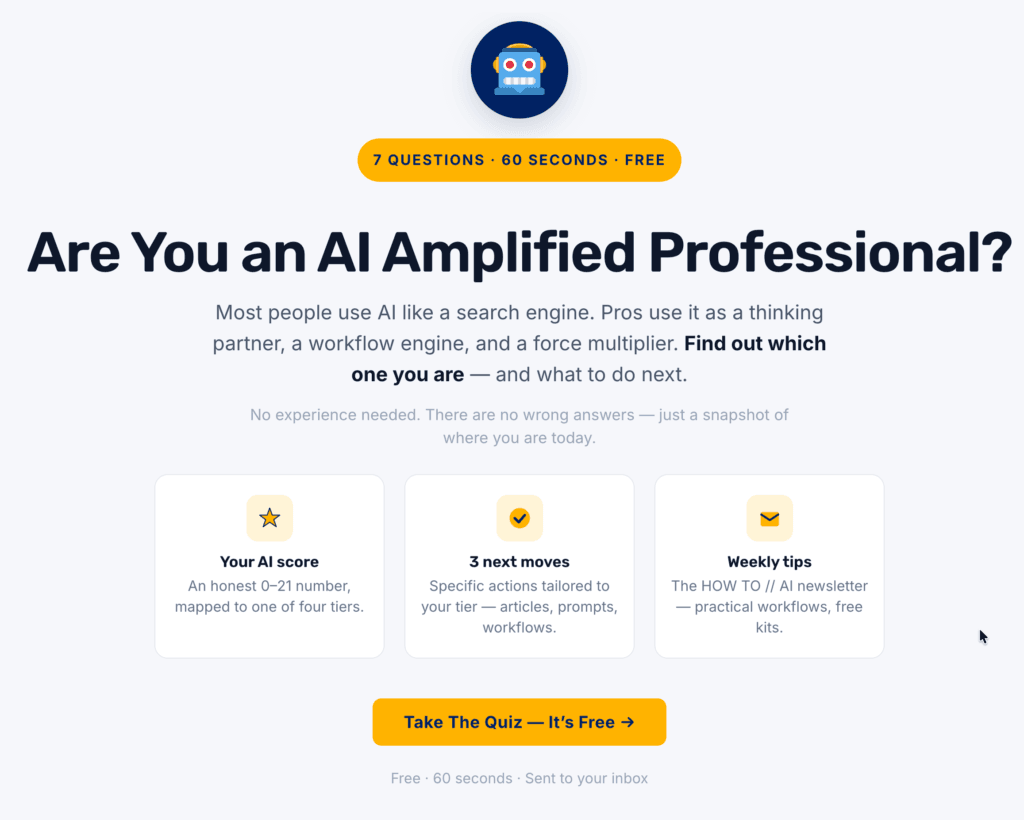
The four levels are the framework. The quiz is the actual assessment. Five questions, real-world scenarios — just an honest read of where you sit and three specific next moves to level up.
🎯 Take the AI Amplified Quiz — 5 questions, 5 minutes, free. You’ll get your level and a personalized 3-step plan to move up.
Three Moves That Work at Any Level
Regardless of where the quiz puts you, three habits move you up faster than anything else:
- Save your best prompts. The single most underrated habit. When something works, paste it into a notes file. That file becomes your personal toolkit and the next month gets dramatically easier.
- Try the same question in a different tool. Running one prompt in Claude and ChatGPT teaches you what each is actually good at faster than any tier-list article.
- Use AI on one task this week you’d normally do unaided. Not a practice task — a real one. Skill lives in repetitions on work that matters.
AI Skill Level FAQ
How fast can I move up a level?
Most people stuck at AI Curious can move to AI User in about a week of daily practice. The jump from User to Advanced takes longer because it’s about habit, not knowledge. Advanced to Amplified is the slowest leap — it’s tool stacking plus trust calibration, both of which take repetitions to develop.
Does paying for ChatGPT or Claude move me up a level?
No. Level is about how you use AI, not what you pay. Paid plans give faster responses and the newest models, which are nice. The actual difference between Curious and Amplified is technique, not subscription.
Is the quiz biased toward specific AI tools?
No. The questions are about how you use AI, not which tool you prefer. Someone Amplified on Claude lands in the same tier as someone Amplified on ChatGPT or Gemini.
What if I’m AI Amplified on writing but AI Curious on data?
That’s common. The quiz measures your overall pattern, but most people are stronger in some domains than others. The way to think about it: your level reflects your typical behavior, and the upgrade path is the same regardless — expand the weakest part of your stack first.
Related guides
- Take the AI Amplified Quiz
- Quick AI Beginner’s Guide
- The AI tool stack I actually use
- Which AI are you?
- Your Personalized AI Learning Path: Choose Your Own Adventure + Copy-Paste Prompts!
Keep reading
Know your level? Put it to work: follow the personalized AI learning path to climb to the next one, and if a job move is the goal, try using AI as your personal interview coach.
Frequently asked questions
What are the 4 AI skill levels?
The four levels are AI Curious, AI User, AI Advanced, and AI Amplified. AI Curious means you have tried AI a few times; AI User means you use it regularly for simple tasks; AI Advanced means you build repeatable workflows and refine your prompts; AI Amplified means AI is woven into how you work, with automations and agents doing real work for you.
How do I know which AI level I am at?
Look at how you use AI day to day. If you mostly ask one-off questions, you are likely AI Curious or AI User. If you reuse prompts, chain steps, and trust AI with real work, you are AI Advanced or Amplified. You can also take the free 5-minute AI Amplified Quiz to get your exact level.
How do I move up to the next AI level?
Pick the one habit that defines the next level and practice it. AI Users level up by saving and reusing prompts; AI Advanced users level up by automating a repeatable workflow; the jump to AI Amplified comes from letting AI agents handle multi-step tasks end to end.
How long does it take to get better at AI?
Most people see a noticeable jump within a few weeks of deliberate practice — not by reading more, but by running one real workflow repeatedly until it is second nature. Consistency matters more than volume.