
AI is great at the parts of résumé writing most people dread: organizing messy notes, matching your experience to a job post, and cutting bullets down to size. It’s bad at the one part that matters most, which is knowing what you actually did. Hand it a blank page and it invents a polished, forgettable candidate.
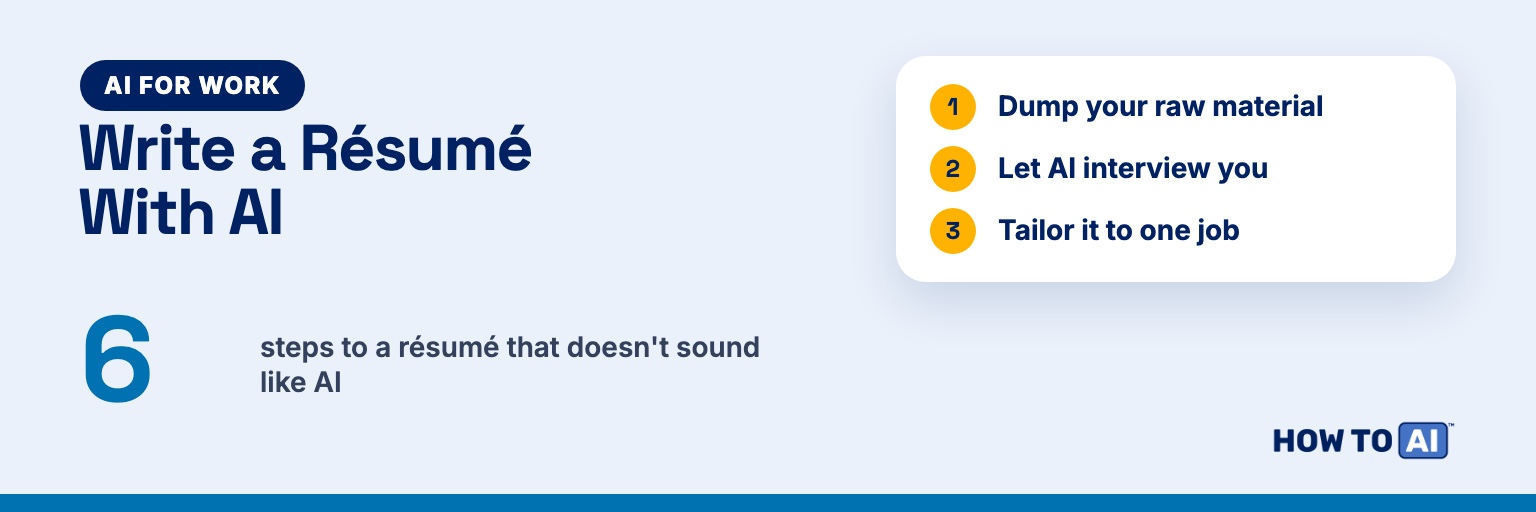
So here’s how to write a résumé with AI the other way around: you supply the facts and numbers, and AI asks the questions, tailors, and trims. Six steps, each with a copy-paste prompt, plus a before-and-after example.
The 6-step workflow at a glance
| Step | You do | AI does |
|---|---|---|
| 1. Raw material dump | Paste old résumés, reviews, project notes | Organizes it into a timeline |
| 2. Achievement interview | Answer questions honestly | Digs for results and numbers |
| 3. Tailor to the job | Paste one job description | Maps requirements to your evidence and flags gaps |
| 4. Rewrite the bullets | Supply the real numbers | Tightens each bullet |
| 5. Voice pass | Share a sample of your own writing | Flags buzzwords and filler |
| 6. Final check | Verify every line | Nothing. This step is yours. |
Plan on about an hour for the first full pass. After that, tailoring for each new job (steps 3 to 6) goes much faster.
Before you paste anything: remove personal details
Your résumé is full of things a chatbot doesn’t need: your name, phone number, email, home address, and LinkedIn URL. Delete them before you paste, or swap in placeholders like [NAME] and [EMAIL]. You’ll add the real ones back in the final file.
Do the same with anything an employer would consider confidential, like client names or internal revenue figures. “A national retail client” works just as well on a résumé.
Then check your settings. In ChatGPT, Settings → Data Controls → “Improve the model for everyone” controls whether your chats are used to train OpenAI’s models (see OpenAI’s Data Controls FAQ). Claude has a model-improvement switch in its privacy settings, and its Incognito chats aren’t used to improve Claude (see Anthropic’s privacy page).
Step 1: Dump your raw material (messy is fine)
Gather everything that describes your work, in any format:
- Your current résumé and older versions (they often hold achievements you’ve since cut)
- Performance reviews, with other people’s names removed
- Project write-ups, awards, and thank-you emails
- Your LinkedIn Experience section
Paste it all in with this prompt. The key line is “don’t write any résumé content yet.” You want an organized pile, not a draft.
I'm rebuilding my résumé. Below is raw material: old résumés, review notes, and project notes. Personal contact details are removed.

Don't write any résumé content yet. Instead:
1. Organize everything into a timeline by role (title, employer, dates).
2. Under each role, list every responsibility, project, and result mentioned, in plain words.
3. Flag anything that's unclear, contradictory, or missing a date.
4. List the roles or projects where I describe what I did but not what changed as a result.

Raw material:
[PASTE EVERYTHING HERE]Step 2: Let AI interview you for achievements
This step makes the biggest difference. Weak bullets describe duties (“responsible for onboarding new clients”). Strong ones describe what changed because you were there. You know those results; you just can’t recall them on demand. A good interviewer drags them out.
Using the timeline you just made, interview me to find achievements for my résumé. Start with my most recent role.

Rules:
- Ask one question at a time and wait for my answer.
- For each project or responsibility, ask: What was the problem or goal? What did I personally do? Who benefited? What changed afterward?
- Push for numbers: time saved, money, volume, error rates, customers, team size, deadlines.
- If I don't know an exact number, help me reach an honest estimate I could defend (for example, "about 30 a week"), or find other proof, such as "adopted by two other teams" or "became the standard process."
- Never invent facts, numbers, or outcomes.
- After each role, summarize what we found as short achievement notes, then ask if I want to move to the next role.If typing slows you down, answer out loud. Both ChatGPT and Claude let you dictate or talk instead of type, and speaking tends to shake loose details (more on why talking to AI gets better answers). Save the achievement notes. They feed every future résumé, cover letter, and interview story.
Step 3: Tailor it to one job description
A résumé tailored to one posting beats a general one sent to fifty. Paste the full job description along with your achievement notes:
Here is a job description and my achievement notes.

1. List the 6 to 8 requirements this employer seems to care about most, in order of emphasis, with the line from the posting that shows it.
2. For each requirement, point to my strongest matching evidence from the notes. If there's no real match, write "GAP" and don't stretch.
3. List skills and terms from the posting that honestly describe my experience, next to the wording I currently use for the same thing.
4. Suggest which of my achievements to lead with for this role, and which to drop.

Do not add skills, tools, or experience I haven't mentioned.

Job description:
[PASTE]

My achievement notes:
[PASTE]Point 3 is how you handle keywords honestly. Many employers use applicant tracking software to collect and search applications, and a recruiter searching for “customer onboarding” may never think to search for “client setup.” If both phrases describe the same work, use the employer’s words. If a term doesn’t describe your work, leave it out, no matter how often the posting repeats it.
Keep the layout plain: standard headings (Experience, Education, Skills), one column, and the file type the application asks for. You’ll also see claims online that screening software runs secret AI detectors on résumés. Don’t build your plan around rumors. Accurate, specific writing holds up whether a person or a program reads it first.
It also helps to see a posting from the other side: our guide to how hiring managers draft job descriptions with AI shows how required and preferred qualifications get written, so you can judge which gaps matter.
Step 4: Rewrite the bullets with your real numbers
Now AI earns its keep as an editor. The formula: a plain verb, what you did, and the result, backed by a number or other proof.
Rewrite my experience for this role as résumé bullets.

Rules:
- Use only facts and numbers from my achievement notes. If a bullet needs a number I haven't given, write [NUMBER?] instead of guessing.
- Format: specific verb + what I did + result.
- Keep each bullet under 25 words and no longer than two lines.
- Use plain verbs (built, cut, ran, wrote, trained, fixed, launched). No "spearheaded," "orchestrated," or "championed."
- Write 3 to 5 bullets per role, most relevant to this job first.
- Give me two versions of each bullet so I can pick or combine.

Achievement notes and priorities from the tailoring step:
[PASTE]Fill in every [NUMBER?] yourself, or cut the bullet. Don’t let AI “estimate” for you. Chatbots fill gaps with plausible guesses (here’s why AI makes things up), and a confident 37% you can’t explain will come back to bite you in an interview.
Before and after: one bullet
Here’s an illustrative example for a fictional operations coordinator. The numbers are invented for the demonstration; yours have to be real.
| Version | Bullet |
|---|---|
| Generic AI draft | Spearheaded cross-functional initiatives to streamline operational workflows, driving significant efficiency gains and fostering a culture of continuous improvement. |
| After the interview, with real numbers | Rebuilt the returns process with the warehouse and support teams, cutting average refund time from 9 days to 4. |
The first version sounds impressive and says nothing. Which initiatives? What got faster? The second is shorter, uses a normal verb, and gives a recruiter something specific to ask about.
Step 5: The voice pass (cut the AI tells)
AI-polished résumés share a sound, and once you’ve seen a few, it’s hard to miss. Hunt for these:
- Inflated verbs: spearheaded, orchestrated, championed, fostered, revolutionized.
- Buzzwords with no proof: results-driven, dynamic, passionate, proven track record, cutting-edge, synergy.
- Vague impact words: significantly, various, multiple stakeholders, key initiatives.
- Overlong bullets: anything past two lines, or chained together with “while,” “ensuring,” and “resulting in.”
- Identical rhythm: every bullet shaped exactly like “Verb + task, resulting in X% increase.”
- A summary that fits anyone: if you could swap in a stranger’s name and it still works, rewrite it.
Act as a blunt résumé editor. Below is my draft résumé and a short sample of my own writing (an email I wrote).

Go line by line and flag:
- inflated verbs, buzzwords, and vague impact words
- bullets longer than two lines
- repeated sentence patterns
- anything that sounds generic or machine-written
- any claim that isn't backed by a number or a concrete detail

For each flag, suggest a plainer version that matches the vocabulary in my writing sample. Don't change any facts or numbers, and don't add new claims. Return a table: original line | problem | suggested fix.

Writing sample:
[PASTE 2 OR 3 PARAGRAPHS YOU WROTE]

Résumé draft:
[PASTE]The writing sample is the secret ingredient. Without it, “sound more human” just produces a different flavor of AI.
Step 6: The human final check
This step has no prompt on purpose. Print the résumé or read it on a different screen, and check that:
- Every number is true and you can explain where it came from.
- You can tell the story behind each bullet in about a minute. If you can’t, cut it or rehearse it in an AI mock interview.
- Titles, employers, and dates are exact. AI sometimes “tidies up” a job title or merges two roles into one.
- No skill appears that you couldn’t demonstrate in a technical screen.
- Your contact details are back at the top and spelled correctly.
- It sounds like you when you read it out loud.
If you can, ask a former colleague to read it too. They’ll spot what you undersold and what you oversold.
Common mistakes to avoid
- Starting from the job description instead of your history. Ask AI to “write a résumé for this job” and it will describe the ideal candidate, not you.
- Keyword stuffing. Repeating the posting’s terms without evidence reads as padding.
- Sending one résumé everywhere. Keep a master file of achievement notes and tailor from it each time, as in the master-résumé step of our 2026 Job Search Prompt Vault.
- Forgetting the rest of your profile. Once your bullets are sharp, reuse them on LinkedIn. Our guide to polishing your LinkedIn posts with AI uses the same edit-for-voice approach.
Try it now: one role, 20 minutes
Don’t rebuild everything tonight. Pick your most recent role, run the Step 2 interview for that role only, turn the results into three bullets with Step 4, and run the voice pass on those three. If they beat what’s on your résumé now, repeat it one role at a time.
🎁 Free download: The 2026 Job Search Prompt Vault
10 copy-paste prompts for résumés, cover letters, interview prep, and follow-ups, in one free Notion page. Free with your email address.
Related guides
- Use AI as a Personalized Interview Coach
- Job Scam Checker: How to Tell If a Job Is a Scam
- The 2026 Job Search Prompt Vault: 10 AI Prompts That Actually Work – DOWNLOADABLE!
- Use AI as Your Personal Proofreader
Frequently asked questions
Is it okay to use AI to write my résumé?
Yes, as long as every fact and number is yours and you can back up each line in an interview. Use AI to organize, tailor, and edit, not to invent experience. If an application gives instructions about AI use, follow them.
Will an applicant tracking system reject a résumé written with AI?
Applicant tracking systems are built to collect, sort, and search applications, so focus on what they and the recruiter actually see: clear headings, the job's own terms for skills you really have, and accurate details. AI text detectors are unreliable in general (OpenAI withdrew its own classifier over low accuracy), so specific, truthful writing is a better use of your effort than trying to game software.
Should I use ChatGPT or Claude to write my résumé?
Either works for this workflow. The prompts matter more than the tool: an achievement interview, a tailoring pass, and a voice edit with a sample of your own writing. Pick the one you're comfortable going back and forth with, and check its privacy settings before you paste.
How long should a résumé bullet be?
Aim for one to two lines, roughly under 25 words. Lead with a plain verb, say what you did, and end with the result. If a bullet needs three lines to make sense, it's usually two bullets or one bullet with filler.