
Here’s the answer nobody selling you a subscription will give you: free AI in 2026 is dramatically better than most people think. The free tiers of ChatGPT, Claude, Gemini, and Grok today would have embarrassed the paid tiers of two years ago. Real file uploads, real web search, genuinely capable models. For a lot of people reading this, free is not the budget option. It’s the correct option.
So what does $20 a month actually buy? Not a smarter AI, mostly. You’re paying for the ceiling to disappear: bigger limits, bigger documents, and features that simply don’t exist on free. Which means the question isn’t “is paid better?” It’s “am I hitting the ceiling?”
The 3 signals you’ve outgrown free:
- 1. You hit limits mid-task more than once a week. Not a warning you saw once. A cap that stopped real work, repeatedly. Every free plan caps you differently. As of September 2026, Claude and Gemini refill your allowance every five hours (Gemini adds a weekly cap), while ChatGPT’s everyday text chat is unlimited and only its tools, like uploads, images, and voice, have caps. For everyday chat, ChatGPT’s free tier is still the most generous.
- 2. A feature you need doesn’t exist on free. Scheduled tasks on ChatGPT (they start on the $8 Go plan). Video generation on Gemini. Image and video generation on Grok. Full access to the top-tier models everywhere. If your task needs the feature, patience won’t fix that. (Custom GPTs used to be on this list, but OpenAI’s own pages now disagree: the pricing page lists GPT creation on Go and Plus, while its help center says new GPT creation isn’t available on any personal plan.)
- 3. You bill for the output. If AI work goes to clients or your boss, one saved hour covers the month. Stop doing math and upgrade.
Zero signals? Stay free, with pride. That’s not settling. That’s the test working.
And if you do upgrade, the math is simple. I call it the 3-hour rule: $20 is worth it when friction on the free plan costs you three or more hours a month. Waiting out limits, working around missing features, re-pasting documents that got cut off. Under three hours, keep your $240 a year. Over it, upgrade exactly one tool. Which one depends on how you work (still picking your main tool? Start with the 2026 AI starter stack): writers and analysts lean Claude, all-rounders lean ChatGPT, Google-household people lean Gemini (Google AI Pro, $19.99 a month, bundles 5 TB of storage, so part of the $20 pays for itself outside AI), and if your work runs on real-time news and X, that’s Grok’s home turf (though its paid SuperGrok plan is $30 a month, not $20).
One honest warning from the other side: subscription creep is real. $20 becomes $40 becomes $97 quietly. That’s why the kit below includes a monthly audit. Every subscription re-earns its spot, every month, or it gets cancelled.
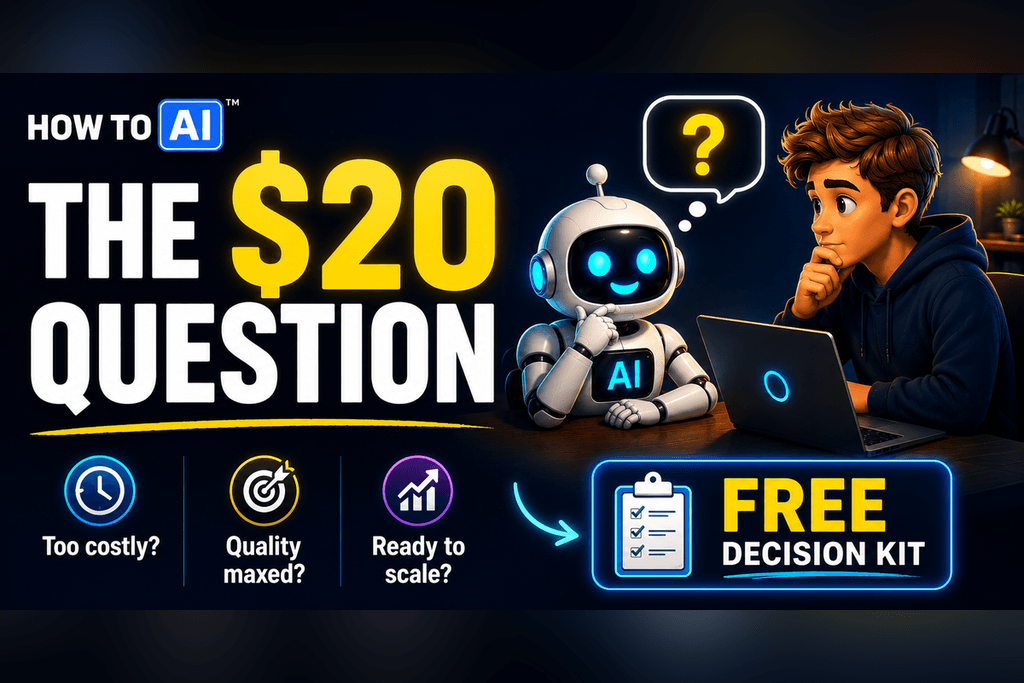
🎁 🎯 Free download: The Free vs Paid Decision Kit
The 15-minute test that answers the $20 question: the 3-signal ceiling test, 5 copy-paste diagnostic prompts, a verified free-vs-paid comparison of ChatGPT, Claude, Gemini, and Grok, the 3-hour rule worksheet, and the monthly subscription audit.
Related guides
- ChatGPT vs Claude vs Gemini: Which AI Should You Use in 2026?
- The AI Tool I Use Most (And the 5 Others I Use Too)
- The 2026 AI Starter Stack: Learn Faster, Work Smarter
- Which AI Tool Should You Use? (1-Minute Quiz)
Frequently asked questions
Is paying $20 a month for AI worth it?
Use the 3-hour rule: a paid plan is worth it when friction on the free plan costs you three or more hours a month — waiting out limits, working around missing features, re-pasting documents that got cut off. Under three hours, keep your $240 a year.
Is free ChatGPT good enough in 2026?
For many people, yes. The free tiers of ChatGPT, Claude, Gemini, and Grok now include real file uploads, web search, and genuinely capable models — better than the paid tiers of two years ago. If you are not hitting limits mid-task weekly, free is the correct option, not the budget one.
What does a paid AI subscription actually get you?
Mostly not a smarter AI — you are paying for the ceiling to disappear: bigger usage limits, bigger documents, and features that do not exist on free, like scheduled tasks on ChatGPT (from the $8 Go plan up), video generation on Gemini, and image and video generation on Grok.
Which AI subscription should I pay for first?
Upgrade exactly one tool, matched to how you work: writers and analysts lean Claude, all-rounders lean ChatGPT, Google-household people lean Gemini (Google AI Pro, $19.99 a month as of September 2026, bundles 5 TB of storage), and if your work runs on real-time news and X, Grok (its SuperGrok plan is $30 a month).