

An AI trainer is a remote contractor who helps AI companies improve their models. You rate chatbot answers, write prompts and the answers a model should give, check facts and code, or review answers in your own field. You work through platforms such as Outlier, DataAnnotation, Mercor and Mindrift, paid by the hour or by the task.
Many roles need no tech degree or coding. DataAnnotation says its general projects need no coding experience, and Handshake AI says no AI experience is required. But every platform screens you before you get paid work, and some tests give you one attempt. Every platform fact here comes from that platform’s own pages, checked in October 2026.
Applying soon? Prepare first
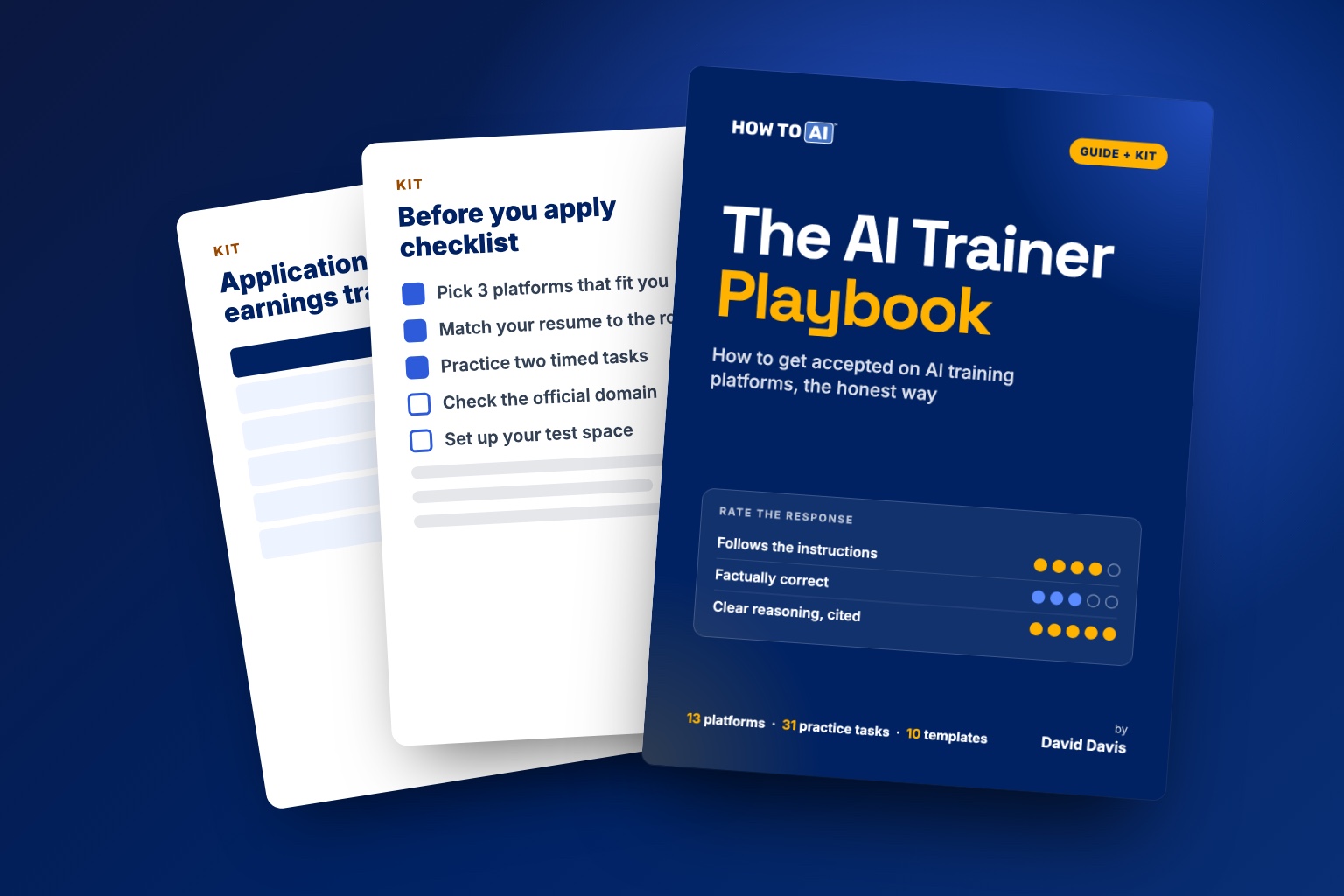
The AI Trainer Playbook covers 13 platforms: who each one wants, how its screening works and how it pays. It adds 31 practice tasks with model answers, an online lab that gives AI feedback on 12 timed tasks, and 10 templates and checklists. $19 launch price through November 23, then $29. 14-day refund.
What does an AI trainer do?
Most AI trainer work falls into six groups:
- Rating and ranking answers against written guidelines. Outlier, DataAnnotation and TELUS Digital list this work.
- Writing prompts and ideal answers that test a model. Outlier, DataAnnotation, Alignerr and Mindrift list it.
- Writing rubrics and grading against them. Outlier lists rubric writing, and Mercor and Alignerr describe grading answers against rubrics.
- Checking facts and code. DataAnnotation lists fact-checking and code review, and Turing hires engineers to evaluate AI-written code.
- Expert reviews by doctors, lawyers, engineers and finance professionals. Mercor and Scale AI’s Human Frontier Collective focus on this.
- Language and voice work, such as transcribing audio, recording your voice or checking language quality. Alignerr, Appen and Turing list it.
It’s contract work, not a job. Outlier’s FAQ says you’re an independent contractor, and Mindrift answers “Is this a job?” with a flat no: no employment contract and no fixed hours. Some weeks there may be no work at all. Our AI training jobs hub compares the platforms and lists open AI trainer jobs, updated hourly.
Who gets accepted as an AI trainer
Platforms sort applicants into tracks, and your track decides where to apply first:
- Generalists and strong writers: the widest door, and the lowest pay. DataAnnotation’s general track asks for a bachelor’s degree or equivalent real-world experience, and Outlier asks for at least an associate degree. Handshake AI takes students, graduates and professionals based in the US. Mindrift’s all-access projects have no requirements, though Mindrift says they tend to pay less.
- Credentialed experts: harder screens and higher pay. DataAnnotation’s STEM track wants a master’s or PhD, or a bachelor’s plus 10 or more years of experience. Mercor says many of its projects need years of experience or an advanced degree.
- Coders: DataAnnotation has a coding track whose rates start higher than general work, and Turing hires software engineers to evaluate AI-written code.
- Native speakers of other languages: DataAnnotation’s multilingual track, Appen’s CrowdGen and TELUS Digital. Many of these listings name the country you must be in.
Check your age and location before anything else. Outlier requires you to be 18 or older, with an ID and a mobile phone from your country of residence, and its rules forbid misrepresenting where you are. Don’t try to get around a country limit with a VPN.
How to become an AI trainer in 5 steps
Step 1: Pick two or three platforms that fit you
Cross off any platform that doesn’t hire where you live, then pick two or three that match your track. Projects start and stop without much notice, so one platform is rarely steady work. Apply first where practice is free: Mercor’s practice interview can be taken as many times as you like and doesn’t affect future opportunities. Save one-attempt tests, such as DataAnnotation’s starter assessment, for when you’re ready.
Step 2: Get your resume and profile ready
Outlier reviews each resume against the minimum requirements for specific domains and asks for a LinkedIn profile that shows your education and work history, so make the two match. Mercor applications show your latest resume and can’t be changed once they’re in, so update it before you apply.
Write evidence, not labels: what you did, in which field, to what standard and with what result. Only claim domains where you’d spot an expert-level mistake. Our free AI resume checker shows what a job post wants that your resume is missing.
Step 3: Practice the skills the screens test
DataAnnotation says it reviews its starter assessment for thoroughness and accuracy rather than speed. Practice these habits:
- Follow the guideline even when you’d have answered differently.
- Judge each answer on instructions, correctness, completeness, safety and clarity.
- Explain every verdict in a few sentences, and quote the part you’re judging.
- Check facts against a primary source, not your memory.
Write every word yourself. Mercor asks you not to use AI models to write your responses or rationales, and Outlier asks you to complete tasks without help from other people, bots or scripts. Skip anyone selling “real test answers,” too: using leaked material can cost you your account.
Want practice before a one-attempt test? The AI Trainer Playbook has 31 practice tasks with model answers and an online lab that gives AI feedback on 12 timed tasks.
Step 4: Pass the screening
- A written assessment. DataAnnotation’s starter assessment takes most people about an hour, and specialized ones one to two hours. There are no retakes.
- Onboarding with skill screenings. Outlier’s usually takes 30 to 90 minutes, including an identity check.
- An AI interview. Most of Mercor’s take about 20 minutes. Save retakes for technical problems, because hiring managers can see how many you used.
- No test to start. Mindrift’s all-access projects are open to everyone on the platform.
Expect an ID check. DataAnnotation uses a partner called Persona to check a photo ID and a selfie, and asks you to turn off any VPN first. Many platforms never send a rejection, and DataAnnotation says approvals usually arrive within a few days, so work down your list instead of waiting on one. Getting in isn’t getting work, either: Outlier adds a project qualification step, with its own guidelines and tests, before paid tasks.
Step 5: Avoid the scams aimed at AI trainers
Real platforms pay you, never the other way around. DataAnnotation, Mercor and Appen all say they never ask you for money.
- Apply only on the platform’s own site, and type the address yourself.
- Ignore recruiters who reach you on WhatsApp, Telegram or text. Prolific warns that impostors pose as its staff there.
- Never buy an account or an “answer key.” Outlier’s rules ban buying or selling accounts.
- Send ID photos and bank details only through the platform’s own process.
If a message looks off, paste it into our free job scam checker. Our guides on whether Outlier, DataAnnotation and Mercor are legit cover pay and complaints for each.
How much does an AI trainer make?
Rates depend on the platform, the project, your field and where you live, and they change often. Outlier says you always see a project’s rate before you start. Here’s what platforms publish about their own pay:
- Outlier: up to $15 an hour for English writing, up to $50 an hour for biology.
- DataAnnotation: $25 to $50+ an hour for general projects and $40 to $150+ for coding. Another answer on the same FAQ says $25 to $30+ and $50 to $100.
- Handshake AI: up to $17 an hour for AI evaluation work, up to $125 an hour for specialist roles.
- Mindrift: $15 to $30 an hour at entry level, $60 to $100+ for domain experts.
- Mercor: an average contracted rate of $109 an hour.
- Prolific: at least $8 (£6) an hour for its studies.
These are each platform’s own figures, not a forecast of what you’ll earn. The top rates go to coders, licensed professionals and people with advanced degrees, and no platform promises a set number of hours. Most platforms pay you as a contractor, so nothing is held back for tax.
If you want the full prep
The AI Trainer Playbook
This guide covers the basics. The AI Trainer Playbook goes deeper on 13 platforms: who each one says it wants, how its screening works and how it pays, all from each platform’s own pages. It includes 31 practice tasks we wrote, each with a model answer, an online practice lab that gives AI feedback on 12 timed tasks, and 10 templates and checklists. It runs 195 pages, and updates are free for 12 months.
It can’t promise acceptance, hours or pay, and nothing honestly can. It’s built so you sit a one-attempt test prepared instead of hopeful.
$19 launch price through November 23, then $29. 14-day refund.
Sources
- Outlier: FAQ, About, community guidelines
- DataAnnotation: FAQ, trust and safety
- Mercor: home, experts, AI interview guide, time tracking and pay policy
- Mindrift: home, FAQ
- Handshake AI: Handshake AI, help article on sensitive information
- Turing: jobs
- Alignerr: home
- Appen: CrowdGen, scam awareness, job listings
- TELUS Digital: jobs
- Prolific: how Prolific works, is this message from Prolific?
- Human Frontier Collective: home
Checked against each platform’s own pages on October 18 and 19, 2026. Platforms change their rules, screening steps and pay often, so check the official page before you apply.
Related guides
- AI Training Jobs
- Is Outlier AI Legit? What It Pays and What to Watch For
- Is DataAnnotation Legit? What It Pays and What to Watch For
- Is Mercor Legit? What It Pays and What to Watch For
- Job Scam Checker: How to Tell If a Job Is a Scam
Frequently asked questions
How long does it take to become an AI trainer?
It depends on the platform. Outlier's onboarding usually takes 30 to 90 minutes, DataAnnotation's starter assessment takes most people about an hour, and most of Mercor's AI interviews take about 20 minutes. DataAnnotation says approvals usually arrive within a few days. Many platforms never send a rejection, so apply to two or three at once instead of waiting on one.
Can you become an AI trainer with no experience?
Yes, for some work. Mindrift says its all-access projects have no education, experience or skill requirements, and Handshake AI says no AI experience is required, though it is only for people based in the US. Entry-level work pays less than expert tracks, and you still have to pass each platform's screening.
Do you need a certification to become an AI trainer?
No. None of the AI training platforms we checked asks for an AI certification. They screen you with their own steps instead: a resume review, a skills test or AI interview, and an ID check. What helps is proof of your expertise and practice with the kinds of tasks the screens use.
Can I use ChatGPT to pass an AI trainer assessment?
No. Mercor allows grammar and wording checks but asks you not to use AI models to write your responses, rate answers, write rationales or evaluate code. Mindrift tells its AI Trainers to avoid using generated content, and Outlier asks you to complete tasks without help from other people, bots or scripts. Breaking these rules can cost you your account.
What happens if I fail an AI trainer test?
It depends on the platform. DataAnnotation's starter assessment can be taken only once, with no retakes. Mercor lets you retake its official AI interview, but asks you to save retakes for technical problems, and hiring managers can see how many you used. If one platform turns you down or goes quiet, practice the skill that tripped you up and apply to the next platform on your list.