
Most “make money with AI” content is either vague or selling a $997 course. This isn’t that.
Below are eight realistic, beginner-friendly ways people use AI to earn extra income: what the work is, who pays for it, and a starter prompt for each. None of them need coding. All of them need the parts AI can’t do for you: finding customers, showing up consistently, and checking the work before it goes out.
The 8 ways at a glance
| Way | Who pays | What AI does for you |
|---|---|---|
| 1. Freelance writing and editing | Small businesses, blogs, newsletters | Research, outlines, first drafts, edits |
| 2. Selling digital products | People with one specific problem | Product drafts, formatting, listing copy |
| 3. Social media for local businesses | Restaurants, salons, gyms, agents | Content calendars, captions, post ideas |
| 4. Resume and LinkedIn services | Job seekers | Rewrites and tailoring to a job posting |
| 5. A niche newsletter | Readers, then sponsors | Research, outlines, editing |
| 6. Virtual assistant work | Busy professionals and owners | Inbox sorting, reply drafts, task lists |
| 7. Repurposing content for creators | YouTubers, podcasters, coaches | Turning one long piece into many short ones |
| 8. AI setup help for small businesses | Owners who haven’t started with AI | Task lists, prompts, staff guides |
Before you start: what to expect
- It’s a small service business, not passive income. Most of these paths trade your time for money. AI makes each hour go further; it doesn’t remove the hours.
- The first customer is the hard part. Start with people you already know, local businesses you use, or one freelance marketplace, and ask every happy customer for a review or a referral.
- Price by checking the market. Look at what people with similar experience charge on Fiverr, Upwork or in your area, start near the low end, and raise your prices once you have reviews. Be wary of anyone promising a specific income.
- You’re responsible for the result. Check facts, keep clients’ private information out of AI tools they haven’t approved, and follow each platform’s rules on AI-generated work.
1. Freelance writing and editing
AI doesn’t replace good writers; it makes them faster. Use it to research, outline, draft and polish, and spend the time you save on what clients actually pay for: judgment, voice and getting the facts right.
You don’t need a big portfolio to start. Write two or three samples in the niche you want, then pitch businesses that need blog posts, newsletters, product descriptions or social captions on a regular schedule. Fiverr, Contra and LinkedIn are common places to find them.
I want to offer freelance writing services for [your niche — e.g. small businesses, health and wellness, tech startups].

Help me:
- Write a one-paragraph pitch I can use to reach out to potential clients
- List 5 types of content I could offer
- Suggest a starter price for each service2. Selling digital products
Templates, checklists, planners, guides and prompt packs cost almost nothing to deliver, and platforms like Gumroad and Etsy handle the checkout. The best ones solve one specific problem for one specific person: “a move-in checklist for first-time landlords” sells better than “a productivity bundle.”
Use AI to research what your buyers struggle with, draft the product and write the listing. Then make it genuinely yours: test it, fix what’s confusing, and add the details only you know. Check each marketplace’s rules on AI-generated products before you list.
I want to create a simple digital product for [who it's for — e.g. first-time landlords].

1. List 10 specific problems this person has that a template, checklist or short guide could solve.
2. Pick the 3 most promising and explain why someone would pay for each.
3. For the best one, outline the product section by section.
4. Write a product listing: a title, a 3-sentence description and 5 bullet points.

Before you start, ask me 3 questions about my experience so the product reflects what I actually know.3. Social media management for local businesses
Plenty of local businesses (restaurants, salons, gyms, real estate agents) know they should post regularly but don’t have the time. That’s your opening.
AI handles the slow parts: content calendars, caption drafts and fresh post ideas. You bring the photos, the local knowledge and the consistency. Most people doing this charge a monthly fee per client, so see what others in your area charge before you set yours.
I'm going to manage social media for a [type of business — e.g. local coffee shop].

Create a 2-week content calendar for their Instagram with:
- A post idea for each day
- A caption draft for each post
- 3 relevant hashtags per post
- One post per week that encourages engagement

Tone: [warm / fun / professional]4. Resume and LinkedIn services
Job seekers pay for help with resume rewrites and LinkedIn profiles, and AI makes the first draft fast enough that you can focus on what matters: understanding the person’s experience and the job they want.
List the service on a freelance marketplace or LinkedIn, ask for the current resume and a target job posting, and deliver a tailored version. Ask before you paste a client’s resume into an AI tool, remove contact details first, and never invent experience. More prompts are in the job search prompt vault.
Rewrite this resume for someone targeting [job title] roles at [type of company].

Make it:
- ATS-friendly with relevant keywords from the job posting below
- Achievement-focused with strong action verbs
- Clear and concise, with no fluff
- Honest: don't add any skill or result that isn't in the original

Job posting:
[paste job posting]

Current resume (contact details removed):
[paste resume]5. Starting a niche newsletter
A newsletter is the slower path, but it can grow into something steady. Pick a topic you know well, publish on a regular schedule, and once you have readers, earn through sponsorships, affiliate links or paid subscriptions.
AI can help you research, outline and edit each issue. People subscribe for your perspective, so use it as an assistant, not a ghostwriter.
I'm starting a weekly newsletter about [topic] for [audience].

1. Suggest 5 names, each with a one-line promise to the reader.
2. Plan the first 8 issues: a working title and 3 key points for each.
3. Suggest a simple repeating format that takes under 2 hours a week to produce.
4. List 3 ways I could earn from it once I have readers, and what each one needs to work.6. Virtual assistant work
Busy professionals and small business owners need help with email, scheduling, research and admin. AI lets one assistant handle more: sorting an inbox, drafting replies, summarizing long threads and turning notes into to-do lists. Here’s how AI speeds up inbox work.
Agree up front on which tools you can use with the client’s information, and keep anything sensitive out of tools they haven’t approved.
I'm a virtual assistant for [type of client — e.g. a real estate agent]. Here are today's emails and notes, with personal details removed:
[paste]

1. Sort everything into: reply today, reply this week, file, or ignore.
2. Draft short replies for the "reply today" items in a friendly, professional tone.
3. Pull every task and deadline into a checklist.
4. Flag anything that needs my client's decision.7. Repurposing content for creators
Creators who publish long videos, podcasts or webinars often want that content turned into short posts, newsletters, articles and clip ideas, and don’t have time to do it themselves. AI is good at the first pass: pulling key points, quotes and angles out of a transcript.
Your value is taste and reliability: picking the best moments, matching the creator’s voice and delivering on schedule.
Here is the transcript of a [podcast episode / video]:
[paste transcript]

1. List the 5 strongest ideas or moments, with a short quote for each.
2. Turn the best one into a LinkedIn post and a 5-post thread for X.
3. Suggest 3 short-clip ideas, with the first and last line of each clip from the transcript.
4. Write a 150-word newsletter summary in the creator's voice.8. AI setup help for small businesses
Many small business owners know AI could save them time but haven’t started. If you’re comfortable with ChatGPT, Claude or Gemini, you can offer a short, practical service: find the two or three tasks where AI would help most, set up simple prompts for them, and show the team how to use them. What to delegate to AI is a good starting framework.
Keep it honest: no promises about replacing staff, and clear rules about what information stays out of AI tools.
I help small businesses start using AI. My client is a [type of business] with [number] staff.

1. List 10 tasks in this kind of business where AI could save time, and rate each for time saved and risk.
2. Pick the top 3 low-risk tasks and write a ready-to-use prompt for each.
3. Write a one-page "how we use AI" guide for the staff, including what should never be pasted into an AI tool.Mistakes to avoid
- Buying a course before you’ve earned anything. Every path here can be tested for free this week.
- Selling unchecked AI output. Clients notice generic or wrong work quickly. Edit everything before it goes out, and use these 7 accuracy habits on anything factual.
- Chasing all eight at once. Pick one, get one paying customer, then decide whether to keep going.
- Ignoring platform rules and records. Check each platform’s rules on AI-generated work, and keep simple records of what you earn and spend.
“You don’t need to be an expert to make money with AI. You need to be one step ahead of the person you’re helping.”
Your first week
- Day 1: pick one path from the table above.
- Day 2: run its starter prompt and make one sample of the work.
- Days 3–4: make two more samples and set a simple starting price.
- Days 5–7: offer it to five people or businesses, or list it on one platform.
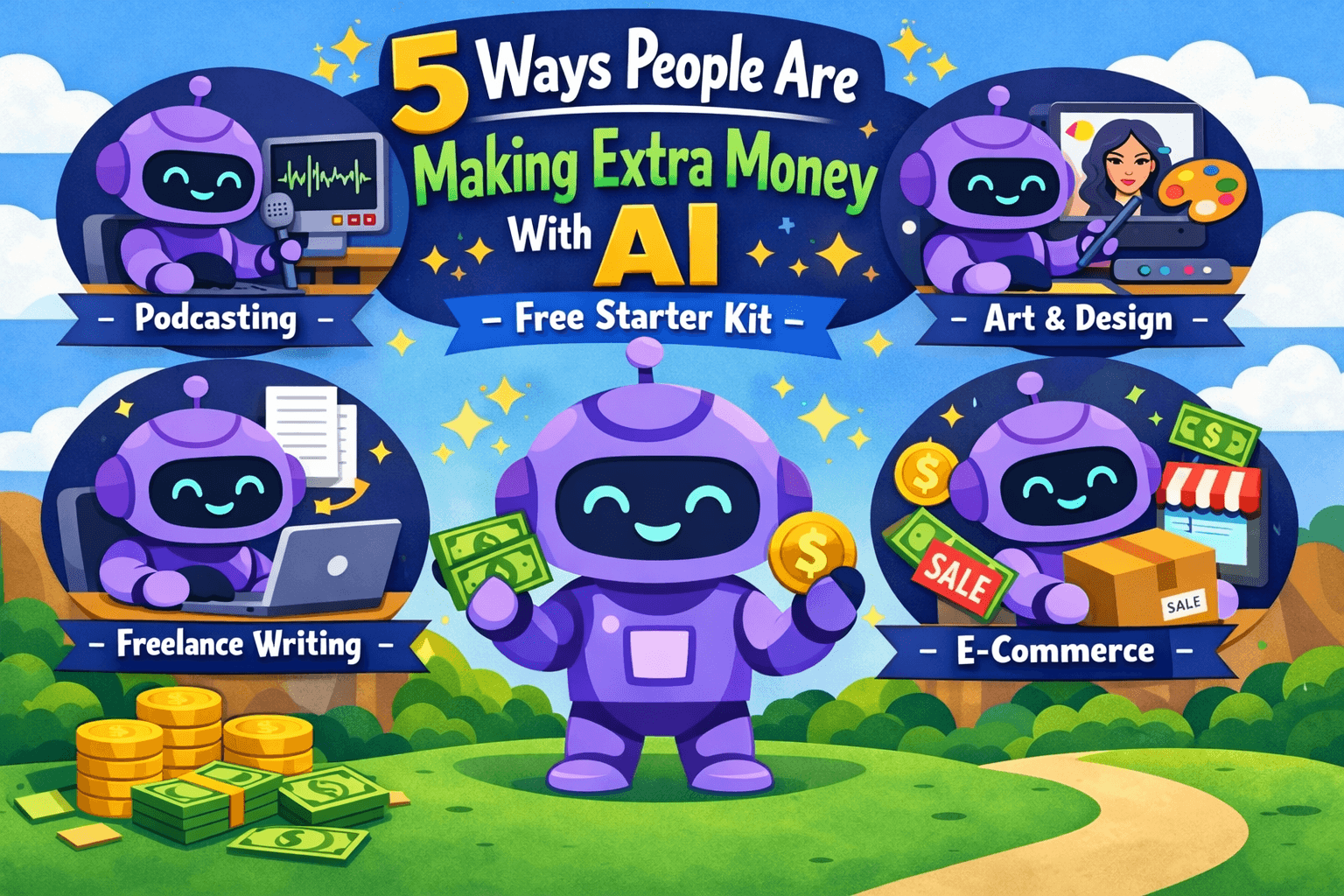
The free AI Income Starter Kit below goes deeper on the first five paths, with expanded prompts, platform ideas, a beginner pricing guide and a weekly action plan.
🎁 Free download: The AI Income Starter Kit
Expanded prompts for five income paths, platform recommendations, a beginner pricing guide, a weekly action plan and the mistakes first-timers make. A free Notion template you can duplicate. Free with your email address.
Related guides
- What to delegate to AI (and what to keep)
- 10 things to do with AI outside work
- Take control of your finances with AI
- The AI Income Starter Kit
- Polish Your LinkedIn Posts with AI
Frequently asked questions
What are realistic ways to make extra money with AI as a beginner?
Eight beginner-friendly paths: freelance writing and editing, digital products, social media management for local businesses, resume and LinkedIn services, a niche newsletter, virtual assistant work, repurposing content for creators, and AI setup help for small businesses. None need coding, but all of them need you to find customers and check the work.
How much can you make with an AI side hustle?
It depends on the path, your skills, how many clients you find and what your market pays, so be wary of anyone promising a specific number. Service work like writing, social media or VA work pays as soon as you land a client; newsletters and digital products take longer to build.
Do clients mind if I use AI?
Many don't, as long as the work is good and accurate, but some do. Be honest if a client asks, follow any rules in your agreement or on the platform you sell through, and never hand over AI output you haven't checked.
Do I need to be an expert to make money with AI?
No. You need to be one step ahead of the person you're helping, and reliable enough that they come back. Pick a path that uses a skill you already have, like writing, organizing or knowing a local industry, and let AI make you faster.