
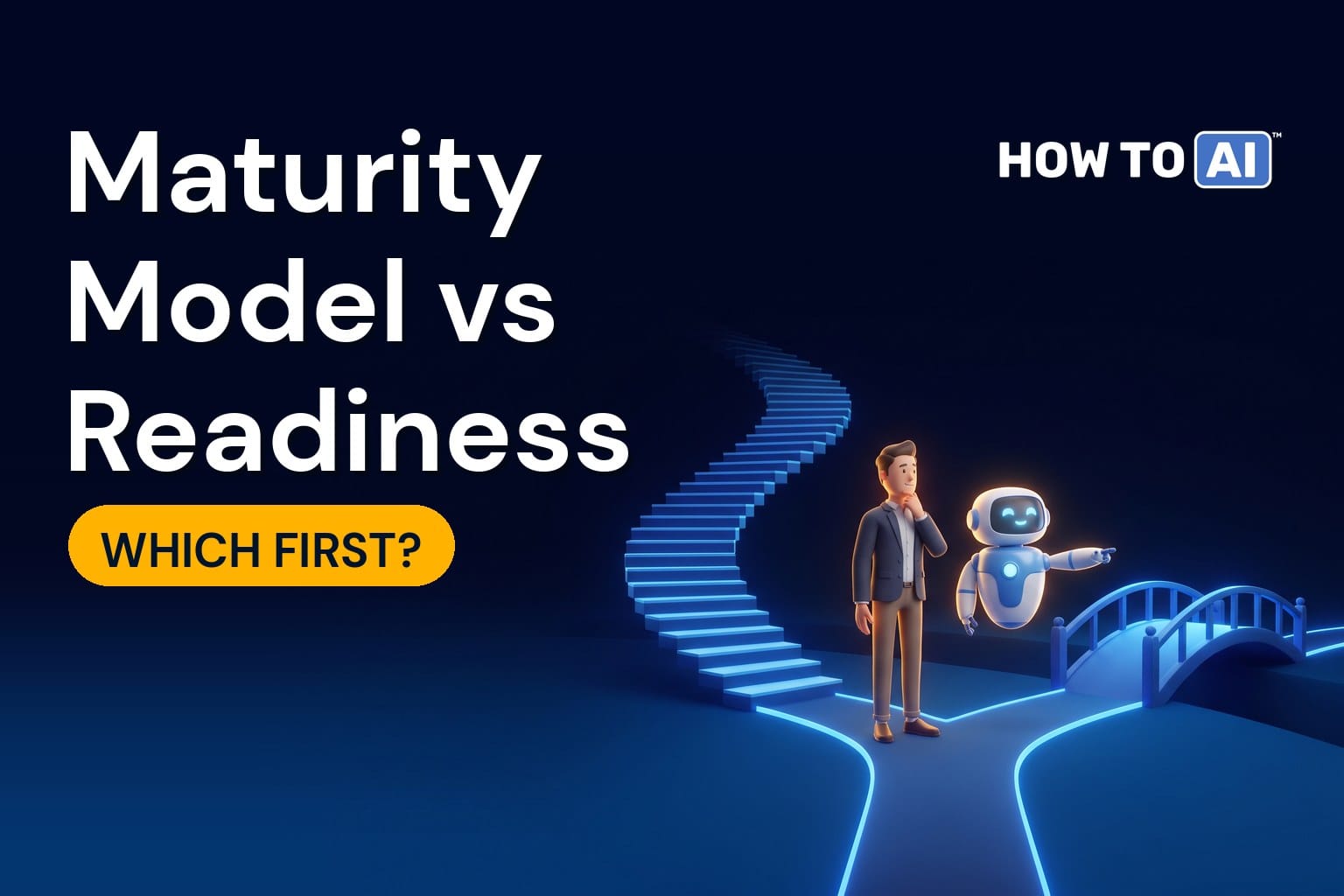
“Should we use an AI maturity model or do an AI readiness assessment?” The terms get used interchangeably, and plenty of vendors and consultancies offer one while calling it the other. They’re not the same thing. They answer different questions, over different time horizons, for different audiences, and choosing the wrong one tends to produce either a plan nobody can act on or a picture nobody can place in context.
This post explains what each is for, where they overlap, and which a mid-size IT team usually needs first. The short version: most mid-size organizations should start with a readiness assessment and consider a maturity model later, but it’s worth understanding why.
What an AI maturity model is
An AI maturity model describes the stages an organization moves through as its use of AI develops, typically four or five of them, from early experimentation to AI being embedded across the business. Analyst firms, consultancies, academic researchers, and platform vendors have all published their own versions. They’re designed to answer a strategic question: where are we on the long journey, and what does the next stage look like?
Maturity models are organization-wide, descriptive, and long-horizon. They’re good at giving leadership a shared vocabulary for ambition, and at placing an organization in context. They’re less good at telling a small IT team what to do next week.
What an AI readiness assessment is
An AI readiness assessment asks a narrower and more urgent question: what stands between us and our next AI step, and what should we fix first? It scores specific prerequisites, such as permissions, policy, identity, data ownership, skills, and governance, and turns the gaps into a ranked list of risks and a short-term plan.
Readiness assessments are point-in-time, prescriptive, and action-oriented. They’re good at producing a 90-day plan and a defensible answer to “are we ready?” They’re less good at describing a multi-year transformation. What an AI readiness assessment for IT teams covers goes into detail.
Side by side
- The question: a maturity model asks “where are we on the journey?”; a readiness assessment asks “what’s blocking our next step?”
- Time horizon: years for a maturity model; the next one to four quarters for a readiness assessment.
- Output: a stage and a description of the next stage, versus scores, ranked risks, quick wins, and a plan.
- Audience: mainly the board and executives, versus IT leadership and the teams who’ll do the work, with a summary for executives.
- Granularity: broad stages across the organization, versus specific questions with defined answers.
- How often: annually, or less, versus quarterly re-scoring.
Where they overlap
The two ideas meet inside a good readiness assessment. The AI Readiness assessment, for example, scores each of its 24 questions on a 0 to 4 maturity ladder. So maturity is measured at the level of individual capabilities, such as how mature your identity management is or how mature your AI policy is, while readiness is judged at the level of a decision: can we take the next step safely? That’s a useful combination. Question-level maturity tells you exactly what to improve; decision-level readiness tells you whether you can proceed. The 6-dimension AI readiness framework, explained shows how the ladders work.
When you need a readiness assessment
- You’re about to spend money on AI tools, licenses, or a pilot.
- Leadership has asked “are we ready?” and needs a clear answer.
- You need a sequenced plan for the next quarter.
- You’re a mid-size organization with a small IT team and limited time.
When you need a maturity model
- You’re planning a multi-year AI transformation across several business units.
- The board wants a long-term view and a way to benchmark against industry peers.
- You already have the foundations in place and are deciding where to go next.
- You’re a large organization running many AI programs that need a common frame.
Pitfalls of each
Maturity models at mid-size scale tend to have three problems. They’re usually built for large enterprises, so the higher stages describe capabilities a mid-size organization may never need. Their stages are too broad to act on; “move from stage 2 to stage 3” isn’t a work plan. And they can encourage stage envy, where the goal becomes a higher label rather than a better outcome.
Readiness assessments have their own limits. They’re a snapshot, so they need re-scoring to stay useful. And they can be too narrow if they focus only on technology, which is why a good one includes use cases, skills, and governance alongside security and infrastructure.
Questions to ask about any maturity model
If you’re offered a maturity model, or are considering one, a few questions separate the useful from the decorative. Who built it, and for organizations of what size? Are the stages defined by observable behaviors, or by aspirational descriptions? How is your stage determined: by evidence, or by self-report in a workshop? Does it tell you what to do to reach the next stage, or only what the next stage looks like? And is it connected to a product or service the provider sells? None of these rules a model out, but the answers tell you how much weight to put on it.
What leadership usually means
When an executive asks “how mature are we on AI?”, they rarely want a stage label. Usually they want answers to three questions: are we falling behind, are we exposed, and what’s the plan? A readiness assessment answers the second and third directly, and gives a reasonable view of the first through the scores. That’s another reason it’s usually the right place to start: it responds to what’s actually being asked, in terms leadership can act on.
The asset: a six-question decision guide
- Are you about to make an AI spending or rollout decision in the next six months? If yes, start with readiness.
- Do you need a plan your team can execute this quarter? If yes, readiness.
- Is the main audience IT leadership and the people doing the work? If yes, readiness.
- Are you planning a transformation over several years across several business units? If yes, add a maturity model.
- Does the board want to benchmark against peers? If yes, add a maturity model.
- Are the foundations, meaning policy, permissions, identity, and governance, already solid? If no, readiness comes first regardless.
For most mid-size organizations, the answers point to a readiness assessment now and a maturity model later, if ever. Revisit the guide once a year, because the answers change as your foundations mature.
Using both together
If you do adopt both, give them different jobs. Use readiness scores as the quarterly measure of progress, re-scored with the same questions each time. Use the maturity stage as the annual narrative for the board: where you were, where you are, and where you’re heading. The readiness work is what moves you between stages, so the two reinforce each other rather than compete.
Where does your team actually stand?
The quickest way to see where you stand is the free AI Readiness Score: 10 of the 24 questions, spread across all six dimensions, with a result in a few minutes.
Get your free AI Readiness Score →
Want to see a full readiness assessment? Flip through a complete 38-page sample report.
Related guides
- The AI Readiness Assessment for IT Teams: What It Covers and Why Scores Beat Opinions
- The 6-Dimension AI Readiness Framework, Explained
- The AI Readiness Checklist: 24 Questions to Answer Before Spending a Dollar
Frequently asked questions
What is the difference between an AI maturity model and an AI readiness assessment?
A maturity model describes stages an organization moves through over years. A readiness assessment asks what stands between you and your next AI step, scores specific prerequisites, and produces a short-term plan. One is strategic and descriptive; the other is tactical and prescriptive.
Which should a mid-size organization start with?
Usually a readiness assessment. It supports the decisions mid-size IT teams face now, such as whether to license an assistant or run a pilot, and gives a plan the team can execute this quarter. A maturity model can come later, if a multi-year program needs one.
When is an AI maturity model useful?
When you're planning a multi-year AI transformation across several business units, when the board wants to benchmark against peers, when the foundations are already solid, or when a large organization needs a common frame for many AI programs.
Can you use a maturity model and a readiness assessment together?
Yes, with different jobs. Use readiness scores as the quarterly measure of progress, re-scored with the same questions each time, and the maturity stage as the annual story for the board. The readiness work is what moves you between stages.